#1
Night Luck
8.2Editorial score
Casino welcome bonus 805% up to €6,400 + 280 FS
- MuchBetter · VISA · Apple Pay
- Crypto welcome 140% up to 1,600 USDT
- VIP pack 800% up to €14,500
Terms change often. Verify on the operator's own page.
Offers modelled before you claim
18+. Betting carries risk. Never stake more than you can afford to lose.
A Visa debit deposit lands at once and a Visa payout takes 1 to 3 banking days after approval, so the card is the fastest way in and rarely the fastest way out.
The board is editorial and its placement is bought, which the disclosure page explains. Terms move without notice, so verify each line on the operator's own page.
Casino welcome bonus 805% up to €6,400 + 280 FS
Terms change often. Verify on the operator's own page.
Welcome bonus €/£5,000 + 500 FS
Terms change often. Verify on the operator's own page.
Welcome pack €5,000 + 500 FS + €650 free bet
Terms change often. Verify on the operator's own page.
Welcome package 300% up to €/£1,000 + 150 FS
Terms change often. Verify on the operator's own page.
On this page
Since 14 April 2020, the Gambling Commission has prohibited licensed operators from accepting credit card gambling, online and offline. Walk up to any cashier holding a Commission licence and the Visa rail on offer is a debit rail, drawing on money that already sits in the account. The change removed an entire category of decision from the British cashier, and it rested on a plain piece of reasoning: gambling with borrowed money converts a loss into a debt, and the Commission judged that trade too costly to leave open.
The rule binds Commission licensees, and it stops at the edge of the British regime. Some overseas cashiers still accept credit cards from British players, which is why a credit option on a cashier is information rather than a perk: it tells you which rulebook the operator sits outside. The debit-only line is one of the quiet protections a licence carries, and it never announces itself at the moment of payment.
One legal point belongs here, because readers ask it often. The offence provisions of the Gambling Act 2005 fall on operators and advertisers, on those providing gambling facilities or advertising them without a licence. The Act creates no offence for an individual who plays on an unlicensed overseas site. What the player loses is protection, not legality: no register entry to check beforehand, no dispute route to climb afterwards, and no credit card ban doing its quiet work in the background. The plastic in your hand is identical either way. Everything wrapped around it is not.
A Visa casino, as this page uses the phrase, is any cashier that accepts the card, and the first thing the card does is move money in. A deposit is a push payment: you authorise it, the card rails pass it, and the balance updates in seconds so play can begin. Floors at this end of the market usually sit between £5 and £10, and no cashier has a reason to slow a payment it is receiving. Speed on the deposit leg is structural, not generosity.
A payout runs the other way, through more hands. The request waits while the operator completes its own checks: identity, payment history, and whether any wagering attached to a bonus has been settled. Only after approval does the return leg leave for the card, and a card leg moves in banking days rather than seconds. Weekends and cut-off times stretch the count, because banking days are the only days a card payout recognises.
The table on this page models the four directions a card conversation can take, with the floors and notes that usually attach to each.
| Direction | Speed | Usual floor | Notes |
|---|---|---|---|
| Visa deposit | instant | 5 to 10 pounds | Debit only at licensed sites |
| Visa payout | 1 to 3 banking days | 10 pounds | After approval |
| Currency conversion | varies | none | Non-pound accounts pay |
| Chargebacks | n/a | n/a | Disputed gambling spend is contested |
Two of those rows earn a sentence each. Currency conversion: where an account runs in euros or dollars, the card network applies its own rate and the spread is the player’s cost, so a pound account removes a whole fee line before the deposit is even made. Chargebacks: disputed gambling spend is contested by operators as a class, so the mechanism is not a refund lever, and raising one over a settled losing streak tends to leave the player in a weaker position than before.
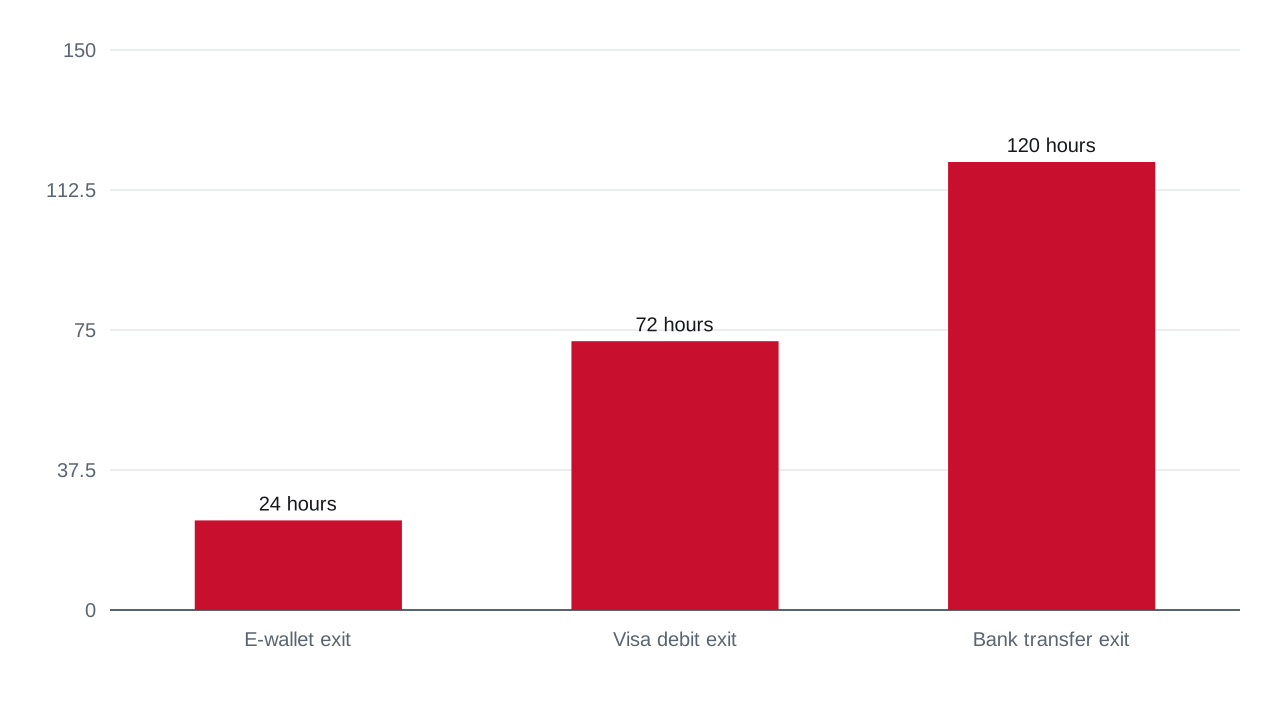
Once a payout is approved, the rail takes over, and the rail is where the real differences sit. This page works with assumption bands rather than measurements: e-wallet exits typically clear inside 0 to 24 hours, Visa debit exits take 1 to 3 banking days, and bank transfer runs 1 to 5 banking days. Those are category-typical bands used for modelling, and any individual cashier can sit faster or slower inside them.
The chart below turns the bands into bars by plotting each upper bound in hours: 24 for an e-wallet exit, 72 for the Visa debit exit, and 120 for a bank transfer exit. Read the bars as the ceilings of a model, not as promises about any cashier. Approval time sits before the clock starts, so a slow approval can add more than the rail itself does. A weekend can stretch the banking-day bars by a day or two, because those hours only count while the banks are open.
Why the spread? An e-wallet is its own closed rail, so once the operator releases the money the remaining journey is short. A Visa payout travels back through the card scheme and the issuing bank, which is why the model gives it a 72-hour ceiling. Bank transfer crosses the clearing system and collects the longest band of the three. Crypto sits outside the bars: where a cashier offers it, the model bands it at minutes to a few hours, under the same assumption flag as the rest.
For a reader who values the exit as much as the entry, the 48-hour gap between the first bar and the second is the whole argument for keeping an e-wallet open alongside the card. The card wins the entry, the wallet tends to win the exit, and a cashier that offers both lets a reader use each for what it does well.
Bonus credit £10.00.
Wagering before cash out £700.00 at 35 times.
Wagering per pound deposited 70 times.
Assumptions: spins return 90 percent of face value before wagering; session cost uses the stated house edge as expected loss of bankroll per session.
The Gambling Act 2005 aims its offence provisions at operators and advertisers, not at individual players, so a British player who joins an unlicensed overseas site commits no offence. What the player loses is protection: no public register entry, no GAMSTOP coverage, no approved dispute route and no British game-testing requirements. The licence gap is about safeguards, not legality for the reader.
This page's model takes a £10 deposit, a 100 per cent match and a 35 times multiplier, which is the working midpoint of the 20 to 50 times band common at this end of the market. Thirty-five times the £10 bonus is £350 of wagering before the balance is treated as withdrawable under the model. The operator's own terms carry the binding figure.
A deposit is a payment you push to the cashier, and the card rails clear it at once so play can start. A payout runs the other way: the operator completes its own checks, approves the request, and only then does the return leg move through the banking system. The model on this page allows 1 to 3 banking days after approval for the card leg.
Most offers of this kind set a ceiling on the bonus itself, and this page's worked example uses a £150 cap, which a £10 deposit sits far beneath. Expiry windows are set offer by offer, so the days you are given live in the bonus terms rather than in any general rule. Read both lines before you commit money, because a cap changes what a bigger deposit is for and an expired bonus is simply gone.
The rail suits readers who already hold a Visa debit card, want the deposit to land without delay, and are content to wait 1 to 3 banking days after approval for the return leg. It fits smaller, controlled deposits, since the card spends money already in your account. Readers who need the fastest possible exit should weigh an e-wallet alongside the card, because the model gives e-wallets the shortest window.
Look for a casino holding a Gambling Commission licence: the status is checkable on the public register, the operator must offer approved dispute resolution, and card play is restricted to debit. GAMSTOP self-exclusion covers every licensed online operator serving Britain, and the National Gambling Helpline on 0808 8020 133 is free and open around the clock. The protections travel with the licence, not with the card.
Not on a British licensed cashier: since 14 April 2020 the Gambling Commission has prohibited licensed operators from accepting credit card gambling, online and offline. Some overseas sites without a UK licence still accept credit, and that difference is one of the clearest markers of the licence gap. A debit card draws on money you hold, which is the reasoning behind the ban.
Payouts return to the source card or account, and operators match the name on the card with the name on the account before approving a withdrawal. A mismatch stalls the request while checks run, and using another person's card usually ends with the payout refused. Keep one card registered in your own name and let 3-D Secure confirm each payment.
Offers of this kind hold no UK Gambling Commission licence. That is not a technicality: it is the difference between a market with a public register, a national self-exclusion scheme, approved dispute resolution, a ban on credit card gambling, affordability checks and independently tested games, and a market with none of those guarantees. A dispute at a licensed operator goes to an approved scheme; an offshore dispute goes to the operator itself. Nothing on this page is an exception to that. If self-exclusion matters to you, GAMSTOP covers licensed operators only, and no tool on this page changes that.
Gambling can harm. For free, confidential support in the UK, call the National Gambling Helpline on 0808 8020 133 or contact BeGambleAware.
Keep reading
UK Gaming Club. Independent modelling of casino offers for British readers. No operator pays for a word on this page; board placement is bought and disclosed on the How We Are Paid page. 2026.