#1
Night Luck
8.2Editorial score
Casino welcome bonus 805% up to €6,400 + 280 FS
- MuchBetter · VISA · Apple Pay
- Crypto welcome 140% up to 1,600 USDT
- VIP pack 800% up to €14,500
Terms change often. Verify on the operator's own page.
Offers modelled before you claim
18+. Betting carries risk. Never stake more than you can afford to lose.
A cashier that skips identity checks at signup almost always runs them before the first payout, so the check is delayed rather than removed, and the delay sits at the worst possible moment.
The board is editorial and its placement is bought, which the disclosure page covers. Terms move without notice, so verify each line on the operator's own page.
Casino welcome bonus 805% up to €6,400 + 280 FS
Terms change often. Verify on the operator's own page.
Welcome bonus €/£5,000 + 500 FS
Terms change often. Verify on the operator's own page.
Welcome pack €5,000 + 500 FS + €650 free bet
Terms change often. Verify on the operator's own page.
Welcome package 300% up to €/£1,000 + 150 FS
Terms change often. Verify on the operator's own page.
On this page
KYC stands for know your customer, the identity file a regulated business builds on the person moving money through it. Pages selling no KYC casinos compress that file into a selling point: a signup that wants a name, a date of birth, an address and little else, sometimes no more than an email and a wallet, before the first stake can be placed. The pitch is measured in minutes saved at the door, and the measurement is honest as far as it goes.
What the term does not measure is the till. The same cashier that waved you through signup runs the full file, photo identity, proof of address and, for larger sums, the origin of the money, before the first payout leaves. That is not a contradiction in the business model; it is the business model. The check exists in both cases. The only thing the label changes is the queue you stand in, and whose clock is running while you stand in it.
So the honest definition reads: no KYC means KYC later. Later is not a small difference in timing. A check run before a deposit costs you a few minutes and nothing else, because you are walking away from nothing. The same check run after a deposit falls on a balance you have already funded, at the exact moment you have asked for it back. This page takes that deferral seriously. It explains what the term means, when the request actually lands, what a held payout does to a session plan and what a licence would have bought instead. It will not tell anyone how to avoid the second check, because there is no legitimate way to, and every attempt to engineer one ends in the same place: a frozen balance and a terms clause doing the talking.
Split a cashier’s life with you into two stages and the pattern is easier to see. Stage one is the door: the form takes the minimum the site needs to open an account, and in this part of the market that minimum is thin. Some cashiers compress it further, to a wallet address and a username, and advertise the compression as a feature. Stage two is the till: a named checkpoint with its own demands, its own queue and its own consequences for refusing. The table above sets out the four checkpoints in the shape terms of this kind typically take.
| Checkpoint | What is asked | What a refusal costs |
|---|---|---|
| Signup | Name, date of birth, address | No account |
| First withdrawal | Photo ID, proof of address | Payment held |
| Large payouts | Source of funds | Account frozen pending review |
| Dispute | Full history | No referee to appeal to |
Read the last column downwards and the asymmetry appears. The only checkpoint where a refusal costs nothing is the first one, because at signup you have put nothing in. Every checkpoint after that costs money you have already moved: a payment held, an account frozen pending review and, at the dispute stage, no referee to appeal to at all, because the approved dispute route a British licence carries does not exist here.
That is what deferral means in practice. The file is not smaller; it is the same file a licensed cashier would build, gathered at the point of maximum leverage for the cashier and minimum leverage for you. A deferred check is a rescheduled check, and the rescheduling runs in one direction: away from the door, where it is cheap, and towards the till, where it is not.
Deferral is not an accident; it is arithmetic. Every field on a signup form sheds registrations, so the cashier that asks least at the door converts most of the traffic it pays for, and the paperwork, which converts nobody, moves to a stage where the visitor is no longer a visitor but a depositor with a balance. Some operators in this corner of the market advertise the deferral outright: verification framed as an insult, the short form framed as respect. The framing costs nothing to print and everything to honour, because the respect is withdrawn precisely when the reader tries to leave with the money.
Where it backfires on the reader is straightforward. Deposit, play, request a payout, and the second stage arrives with the balance captive. Anyone can end up in that queue for honest reasons: a document that has expired, an address that has moved, a name that has changed since the bill on file was issued. None of those reasons move the money. The written terms at this end typically give the cashier wide discretion to hold a payment until its file is complete, and the reader who signed up to escape paperwork discovers the paperwork was never escaped, only rescheduled to the moment when it hurts.
One boundary belongs here. Nothing on this page will help anyone dodge the second stage, and the attempts people reach for make the position worse, not better: terms of this kind treat borrowed papers and altered images as fraud, and balances attached to them as forfeit. The check at the till is not an obstacle between you and your money; it is the condition the money moves under. The only clean way to skip the wait is not to have a balance on the site when the request lands, which is a decision to make before the deposit, not after.
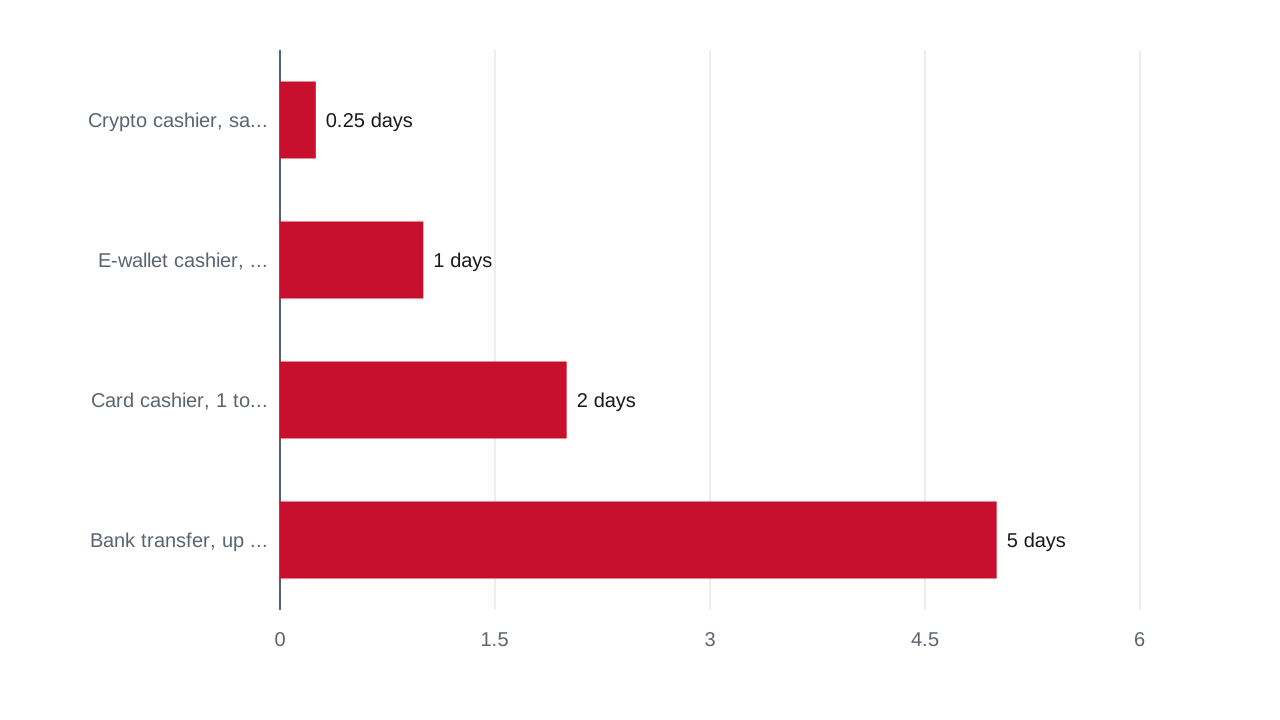
The request is not scattered randomly across a customer’s life; it tracks the payout rail, because the check gates the transfer of money and rails differ in how fast they move it. The chart below models the gap between a withdrawal request and the identity request landing, across four cashier classes, in days. The bands are category-typical assumptions for modelling, not measurements of any cashier, and the caption says the same.
The numbers run like this. A crypto cashier’s request lands inside the same session, around a quarter of a day, because the rail wants to move within hours and the file has to be complete first. An e-wallet cashier’s request lands the same day, plotted at one. A card cashier’s request falls in a one to three day band, plotted at its midpoint of two. A bank transfer cashier’s request can sit anywhere up to five days, plotted at five. Read the ordering once and it inverts the usual instinct: the faster the cashier promises to pay, the sooner the document email arrives, because speed at the rail is exactly what the check is there to gate.
Two things the chart does not show deserve a line each. The band covers the request, not the review behind it, and few cashiers at the offshore end publish a service standard for the review, so the wait after the upload has no published floor or ceiling. And the bands say nothing about outcome: a complete file in a fast lane still ends wherever the terms say it ends.
Expected loss per session £2.00.
Expected loss across 10 sessions: £20.00.
Assumptions: spins return 90 percent of face value before wagering; session cost uses the stated house edge as expected loss of bankroll per session.
The Gambling Act 2005 places the offence on operators and advertisers, not on the player: there is no law that criminalises an individual for playing on an unlicensed overseas site. What you give up is protection rather than legality. A cashier with no Gambling Commission licence sits outside the British regime, so the register, self-exclusion, dispute resolution and the credit card ban do not reach it.
Wagering at this end of the market typically runs between 20 and 50 times the bonus or, on some offers, the winnings from it, and the multiplier sits in the bonus terms rather than on the cashier page. Read the clause before you deposit, because a payout request usually locks the balance until the playthrough is done. Assume the higher end until the terms say otherwise.
The signup form usually wants only a name, a date of birth and an address. The full file, a photo identity document and proof of address, normally lands with the first withdrawal, and source of funds questions follow larger payouts. The chart on this page models the timing: the request can arrive inside the same session on a crypto rail and up to five days later on a bank transfer.
Both exist in the terms at this end of the market, typically. Cashout caps on no deposit offers commonly run between £50 and £500, and bonus expiry windows are measured in days rather than weeks, so the clock matters. A cap is checked at payout, which means it is checked at the same moment the identity request lands, and a balance above the cap is paid only to the limit the terms set.
Anyone who values the protections a British licence carries should think twice, because this end of the market offers none of them: no register entry, no self-exclusion coverage, no approved dispute route and no credit card ban. It also does not suit anyone who has self-excluded, since an overseas cashier is not a gap in that exclusion but a step outside the protection it exists to give.
The alternative is a cashier holding a Gambling Commission operating licence. Signup verification usually takes minutes rather than being deferred, payouts follow published windows, the licence status is checkable on the public register, GAMSTOP covers the account, an approved dispute service exists if a payout stalls, and credit cards cannot be used. The identity check arrives earlier, which is the trade, and it arrives while nothing is owed to you.
No. GAMSTOP covers online operators holding a Gambling Commission licence, and its exclusion terms run for a minimum of six months with one year and five year options available. An offshore cashier sits outside that coverage, which is a loss of protection rather than a loophole: if you have excluded, a site that cannot see the register is not exempt from your exclusion, it is simply beyond its reach.
The payout stays held while the file is incomplete, and the terms at this end of the market give the cashier wide room to keep a balance frozen pending review. Refusal is a lawful position for you to take, but it is also a position with a price: the money does not move, and if a dispute follows there is no approved referee to take it to.
Offers of this kind hold no UK Gambling Commission licence. That is not a technicality: it is the difference between a market with a public register, a national self-exclusion scheme, approved dispute resolution, a ban on credit card gambling, affordability checks and independently tested games, and a market with none of those guarantees. A dispute at a licensed operator goes to an approved scheme; an offshore dispute goes to the operator itself. Nothing on this page is an exception to that. If self-exclusion matters to you, GAMSTOP covers licensed operators only, and no tool on this page changes that.
Gambling can harm. For free, confidential support in the UK, call the National Gambling Helpline on 0808 8020 133 or contact BeGambleAware.
Keep reading
UK Gaming Club. Independent modelling of casino offers for British readers. No operator pays for a word on this page; board placement is bought and disclosed on the How We Are Paid page. 2026.