#1
Night Luck
8.2Editorial score
Casino welcome bonus 805% up to €6,400 + 280 FS
- MuchBetter · VISA · Apple Pay
- Crypto welcome 140% up to 1,600 USDT
- VIP pack 800% up to €14,500
Terms change often. Verify on the operator's own page.
Offers modelled before you claim
18+. Betting carries risk. Never stake more than you can afford to lose.
Demo play costs nothing and returns nothing, while a no deposit credit of £10 at 40 times asks £400 of stakes before anything converts, and the two offers share a word and nothing else.
The board is editorial and its placement is bought, which the disclosure page explains. Terms move without notice, so verify each line on the operator's own page.
Casino welcome bonus 805% up to €6,400 + 280 FS
Terms change often. Verify on the operator's own page.
Welcome bonus €/£5,000 + 500 FS
Terms change often. Verify on the operator's own page.
Welcome pack €5,000 + 500 FS + €650 free bet
Terms change often. Verify on the operator's own page.
Welcome package 300% up to €/£1,000 + 150 FS
Terms change often. Verify on the operator's own page.
On this page
The search phrase free slots no deposit gathers two offers that behave nothing like each other. The first is demo play: the game runs on play-money chips, the balance refills whenever it empties, and no withdrawal route exists at any point. The second is a no deposit credit: a small sum, commonly between £5 and £50, placed on the account when registration completes, which can convert into withdrawable cash once a wagering obligation has been met. Both are free in the sense that no money changes hands to start. Only one of them can end in money out.
The difference is the whole subject of this page. Demo play is a simulator: it teaches mechanics and costs nothing, and it returns nothing, because the chips were never money. The credit is a contract: you supply registration data and then a stretch of staking, and the terms decide whether anything survives. A reader who conflates the two will either overvalue a demo balance or underestimate the workload inside a credit, and both mistakes are expensive in different currencies. The table below sets the four offer shapes side by side before any arithmetic begins.
| Offer | Cost to hold | What it returns | Where it ends |
|---|---|---|---|
| Demo play | nothing | nothing | Fun only |
| £10 credit | registration data | capped cashout | ceiling |
| 50 spins at 10p | registration data | about £4.50 before terms | wagering |
| Straight deposit | your money | whatever terms allow | open |
Read the last column first, because it is where each offer ends. Demo play ends in fun and stops there. The £10 credit ends at a ceiling, because a cashout cap sits over the balance whatever it shows. The spins end in wagering, where the winnings must be staked before they can move. A straight deposit ends open: your money is yours to stake and to withdraw under the ordinary terms, with no bonus clock attached. Everything that follows on this page expands that column line by line.
Demo mode is the only version of free that involves no counterparty at all. The game loads with a notional balance, spins resolve against the same underlying maths as the paid version, and the balance tops itself up when it runs dry. Nothing is deposited, nothing can be withdrawn, and many sites open the mode without an account while some ask you to register first. As a classroom it does its job well: the paytable, the reel pace, the frequency of features and the feel of a game’s swings are all visible before a pound is at stake.
What demo cannot price is the offer. There is no wagering multiplier in fun mode, no cashout cap, no expiry clock and no game weighting, so the two numbers that decide what a credit is worth, the multiplier and the cap, simply do not exist there. A player who spends an evening in demo and concludes that the game pays readily has learned something about variance and nothing about the terms. The published return figure, commonly in the mid-nineties per cent, describes behaviour across horizons a demo session never reaches, and it is set per game rather than measured by the player.
There is also a quiet trap in how demo uses the word free. Because the chips refill, the natural instinct is to raise the stake and chase the feature round, which is the opposite of how a wagering obligation asks to be walked. Treat demo play as a shortlisting tool: use it to find two or three online slots whose pace you actually enjoy, then price the attached offers with the arithmetic later on this page. The demo balance is a teaching aid. It was never money, and it will never become any.
Now the credit, with the assumptions on the table. The model on this page takes a £10 no deposit credit, a wagering multiplier of 40 times and a cashout cap of £100. The 40 times figure sits inside the 20 to 50 times band that offers of this kind commonly ask, and the £100 cap sits inside the £50 to £500 band that caps of this kind commonly occupy. Neither number is quoted from any single promotion. Both are working assumptions, stated because the arithmetic underneath them is only as honest as its inputs.
At 40 times, a £10 credit demands £400 of stakes before anything in it converts to withdrawable cash. That is the case the calculator on this page is preset to run: nothing deposited, nothing matched, multiplier 40, cap £100. Stakes are not the same as losses. Weighting decides how much each game’s staking counts, with slots usually counting in full and table games counting little or nothing, so the £400 is a workload walked mostly on slots. Whether it ends in a profit is a question of variance; that it demands the time is not.
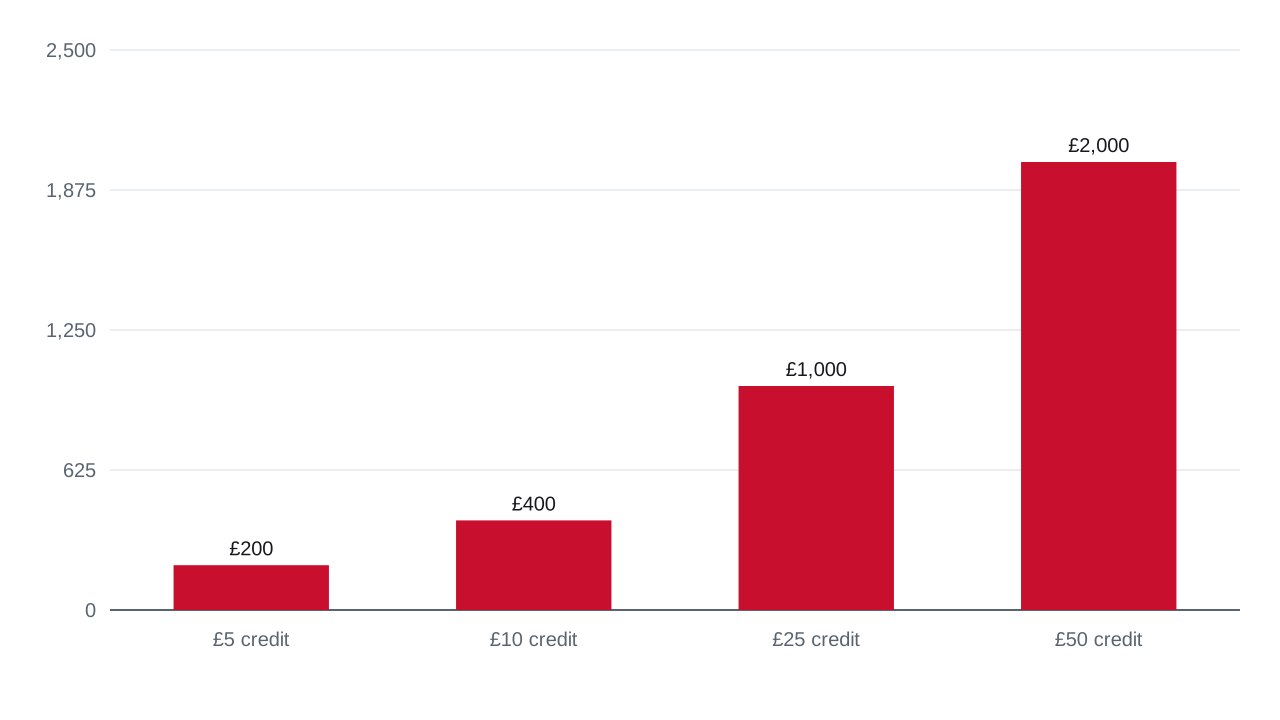
The chart below plots the same model across four credit sizes, holding the multiplier at 40 times throughout. A £5 credit asks £200 of stakes. The £10 credit asks £400. A £25 credit asks £1,000, and a £50 credit asks £2,000. The relationship is linear, because the multiplier scales with the credit: doubling the headline doubles the workload. That is the quiet trade inside every large welcome number. The caption carries the caveat that matters here: the model runs before weighting, so real terms will move each total in either direction.
One further interaction belongs in the same picture. The cap does not scale with the credit: £100 of ceiling sits over all four bars in the model. A £50 credit therefore asks £2,000 of stakes for an outcome the terms limit to £100, while the £10 credit asks £400 for the same ceiling. Bigger credits are not bigger gifts; they are longer shifts at the same rate. The sections that follow take the offer apart: what spins do differently, what the registration data costs, and how caps and clocks close in on the balance.
Bonus credit £0.00.
Wagering before cash out £0.00 at 40 times.
Assumptions: spins return 90 percent of face value before wagering; session cost uses the stated house edge as expected loss of bankroll per session.
The law aims at operators and advertisers, not at players. Providing gambling facilities to British consumers without a Gambling Commission licence is an offence under the Gambling Act 2005, and so is advertising such facilities without one. Playing on an unlicensed overseas site is not an offence for the individual. What a player gives up is protection: no British register entry, no approved dispute route and none of the licence conditions described on this page.
It asks £400 of stakes before anything in the credit converts to withdrawable cash. Stakes are not losses: slots usually count in full toward the total, so the figure is met by spinning, and variance decides what survives. At a lower multiplier the workload shrinks in proportion, and at 50 times it grows to £500. The calculator on this page is preset to the same case, so the arithmetic can be checked line by line.
The terms decide, and the cap is the number to find. Caps on offers of this kind commonly run between £50 and £500, and this page's model uses £100 as its working assumption. Whatever the balance reaches, the release stops at the ceiling: a £180 balance on a £100 cap pays £100. The cap sits on top of wagering, so the full workload must be completed before the ceiling, not the balance, becomes the number that matters.
They carry their own version of them. Spins winnings usually become bonus funds, which means a wagering multiplier applies to the winnings, a cap limits the release and an expiry can forfeit what is left. Fifty spins at 10p carry £5 of game value and produce winnings of a few pounds on the model, so the stakes demanded are smaller than a credit's, but the structure is identical. A minority of offers skip the wagering on spins winnings entirely.
For a no deposit offer the question arrives late, at verification and withdrawal, but it matters. Licensed British cashiers typically run debit cards, PayPal and other e-wallets, with credit cards banned since April 2020. Offshore cashiers lean on crypto rails alongside cards, and their payout windows are stated as ranges for exactly that reason. The honest answer is that rails vary by brand, so the cashier page of the operator in front of you is the source that counts.
Readers who want to watch a cashier's machinery work without putting money down, and who accept that the modelled outcome is a small capped release or nothing. It suits anyone testing whether an operator's terms are readable before a first deposit. It does not suit anyone who needs the balance to convert, because the multiplier, the cap and the clock can each end the experiment with nothing to show. Curiosity is the right budget; income is the wrong expectation.
The British licensed market. Any operator on the Gambling Commission's public register may lawfully serve British customers, and a licence brings protections an offshore offer does not: the credit card ban, approved dispute resolution, declared fund protection and GAMSTOP self-exclusion across every licensed site at once. Licensed casinos run their versions of spins and small credits, often with published caps. The register check is quick, and no offshore offer can match what the licence adds, whatever its headline says.
It is a good way to test the game and a poor way to test the offer. Demo mode shows the mechanics, the pace and the swings, and none of that changes under a credit. What it cannot show is the wagering multiplier, the cashout cap, the expiry or the weighting, because those live in the terms, not the game. Use demo to shortlist games, then price the offer with the five-line routine and the calculator on this page.
Offers of this kind hold no UK Gambling Commission licence. That is not a technicality: it is the difference between a market with a public register, a national self-exclusion scheme, approved dispute resolution, a ban on credit card gambling, affordability checks and independently tested games, and a market with none of those guarantees. A dispute at a licensed operator goes to an approved scheme; an offshore dispute goes to the operator itself. Nothing on this page is an exception to that. If self-exclusion matters to you, GAMSTOP covers licensed operators only, and no tool on this page changes that.
Gambling can harm. For free, confidential support in the UK, call the National Gambling Helpline on 0808 8020 133 or contact BeGambleAware.
Keep reading
UK Gaming Club. Independent modelling of casino offers for British readers. No operator pays for a word on this page; board placement is bought and disclosed on the How We Are Paid page. 2026.