#1
Night Luck
8.2Editorial score
Casino welcome bonus 805% up to €6,400 + 280 FS
- MuchBetter · VISA · Apple Pay
- Crypto welcome 140% up to 1,600 USDT
- VIP pack 800% up to €14,500
Terms change often. Verify on the operator's own page.
Offers modelled before you claim
18+. Betting carries risk. Never stake more than you can afford to lose.
A no deposit bonus of £10 at 50 times wagering asks £500 of stakes for a credit the terms usually cap at £100, so the multiplier and the ceiling decide everything.
The board is editorial and its placement is bought, which the disclosure page explains. Terms move without notice, so verify each line on the operator's own page.
Casino welcome bonus 805% up to €6,400 + 280 FS
Terms change often. Verify on the operator's own page.
Welcome bonus €/£5,000 + 500 FS
Terms change often. Verify on the operator's own page.
Welcome pack €5,000 + 500 FS + €650 free bet
Terms change often. Verify on the operator's own page.
Welcome package 300% up to €/£1,000 + 150 FS
Terms change often. Verify on the operator's own page.
On this page
A no deposit bonus is a slice of playable credit granted for opening an account: no card details, no first payment, nothing beyond the registration form. The credit lands as a small cash balance or as a bundle of spins on named games, and both shapes are priced the same way. You are being handed a stake the house owns, wrapped in terms that decide what, if anything, leaves the cashier.
Two shapes dominate, and it pays to tell them apart early. The cash credit drops a balance, usually £5 to £25, into the account and attaches a multiplier to that balance. The spins shape grants a bundle, usually 20 to 100 spins at 5p to 20p each, and attaches its multiplier to whatever the spins win rather than to their face value. Those size bands are category-typical ranges compiled from published terms, not measurements, and the exact figures on any given offer live in its own terms. The cash shape produces the larger headline stakes; the spins shape produces smaller numbers that readers often mistake for softer terms. Both are worked through on this page.
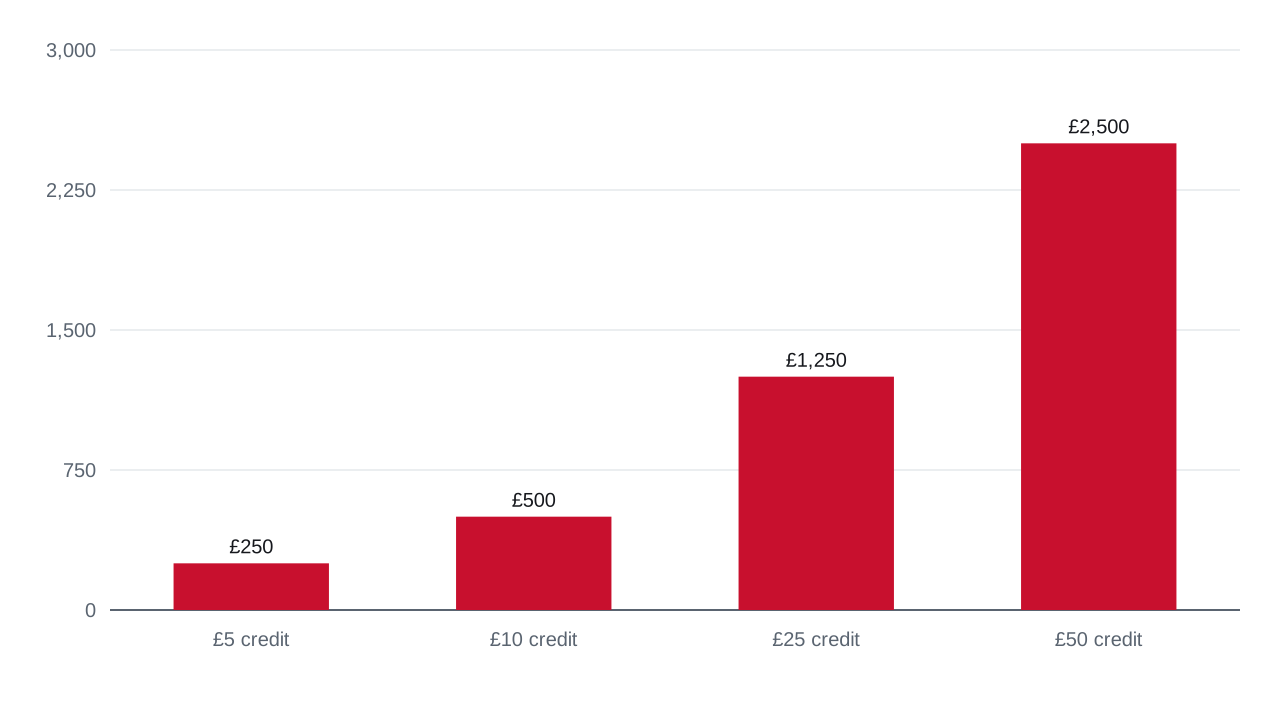
The headline number flatters and the terms collect. Multipliers at this end of the market sit between 20 and 50 times the bonus or the winnings, an assumption band drawn from published terms rather than a measurement, and registration credits cluster toward the top of it. A £10 credit at 50 times demands £500 of qualifying stakes before a single penny becomes withdrawable. Hold that product in your head whenever a banner promises free money, because the promise is only ever the first line of the price.
The height of the multiplier is not generosity and it is not spite; it is pricing. The house fronts the entire stake, so it writes terms that recoup the cost through expected losses. Published slot returns commonly sit around 94 to 96 per cent, a figure set per game by the operator rather than measured by this site, which means roughly 4 to 6 per cent of every pound wagered stays with the house over time. £500 of stakes at those rates is £20 to £30 of expected loss, and that is how a £10 gift pays for itself with room to spare.
Why hand out credit at all? Because the cost is controlled and the return is not measured in stakes. A capped, weighted, expiring credit has a known expected cost per redemption, and it buys what a deposit match cannot: an account, an email address, a habit of opening the app. The arithmetic a player runs on this page is the same arithmetic seen from the other side of the desk, which is why every number here is written as a cost rather than a gift.
Four levers do all the work, and every one of them is printed. The multiplier sets the labour: 50 times turns £10 into £500 of play. The ceiling sets the prize: caps on offers of this kind typically run between £50 and £500, with £100 the common working figure. Weighting decides which games count toward the total, and the clock, in two parts, closes the whole thing down: one timer on the credit’s life, one on the clearing window.
Registration credits carry the heaviest terms of any offer shape because the operator takes all of the exposure and receives none of the commitment. No deposit circulates back through the cashier, so the only defence against second and third accounts is a thicket of conditions: ceilings, weightings, short clocks, max bet rules, eligible games lists. Read the thicket as what it is, a price list, and the offer becomes legible.
Nothing in that arithmetic is hidden. Every figure sits in the terms a click or two from the banner, and the skill this page teaches is reading them before the form rather than after. The next section takes one £10 credit through the model line by line, with every assumption stated where it is used.
Start with the assumptions, stated so the arithmetic can be checked against them. The credit is £10. The multiplier is 50 times, the top of the 20 to 50 band this part of the market publishes for registration credits. The cashout ceiling is £100, the working figure this site uses for caps that typically run between £50 and £500. The games count at full weight, meaning every pound spun on an eligible slot is recognised in full, and the published return is taken as 96 per cent, an operator-set figure used here as a model input rather than a measurement.
With nothing deposited, the whole requirement hangs off the credit. 50 times £10 is £500 of qualifying stakes, and there is no deposit anywhere in the sum to share the load. That is why the calculator on this page opens with the deposit field at zero: the shape of this offer leaves the field empty, and the credit carries the entire base alone. The multiplier attaches to money the player never paid, which is what makes the number so much taller than a first-deposit match of the same face value.
A word on what a qualifying stake is, because the phrase does hidden work in every multiplier. Under the assumption set above, every pound on an eligible slot counts fully. In real terms pages, some games count at 50 or 20 per cent, some count for nothing, and table games or live dealers are often excluded outright, so the same £500 can demand £1,000 or £2,500 of actual play depending on where the stakes are placed. The eligible games list is not small print; it is the denominator of the whole exercise.
Now walk the balance. You hold £10 and must pass £500 through the reels. At a £1 stake, an illustration figure rather than a recommendation, that is 500 spins; at 50p it is 1,000. The expected return on those stakes at 96 per cent is £480, so the expected cost of clearing is £20 against a float of £10. The model therefore expects most runs to reach zero before the wagering meter does, and on those runs the ceiling never comes into play at all.
The ceiling matters on the fortunate tail. A finishing balance of £97 pays £97; a finishing balance of £180 still pays £100, because the cap removes the top rather than scaling it. Between the float and the cap lies a band of outcomes where the credit pays something, and the width of that band, not the size of the credit, is what the offer is really worth. Multiply a rough chance of landing inside the band by the capped prize and a £10 credit at 50 times prices out at a few pounds.
Two cautions keep the model honest. Expectation is not prediction: a single evening swings far from the mean in both directions, and a few hundred spins tell you almost nothing about the underlying rate. And the inputs move: a multiplier of 40 times or 60 times redraws every line, as does a weighting of 50 per cent or a ceiling of £50. The calculator below carries the same assumptions in its prefill; change the multiplier and the ceiling, watch the work move, and take whatever numbers you settle on back to the operator’s own terms page before trusting them.
One more line completes the shape: what happens when the balance dies early. The credit is gone, the wagering stops with it, and the offer closes at a total cost of the minutes spent; nothing further is owed, because there was never anything of yours in the pot. That asymmetry, a bounded loss of time against a capped gain of money, is the honest one-sentence summary of the entire product.
Bonus credit £0.00.
Wagering before cash out £0.00 at 50 times.
Assumptions: spins return 90 percent of face value before wagering; session cost uses the stated house edge as expected loss of bankroll per session.
Yes, for the player. The offence provisions of the Gambling Act 2005 fall on operators and advertisers, on those providing or promoting gambling without a licence, and the Act creates no offence for an individual who plays on an unlicensed overseas site. What you lose is protection rather than legality: no British register entry, no approved dispute route, no self-exclusion coverage. The legal risk sits with the operator, the practical risk sits with you.
It requires £500 of qualifying stakes: 50 times the credit, with nothing deposited to dilute the base. The figure assumes slots that count at full weight; if the eligible games count at 20 per cent, the real requirement becomes £2,500 of play. At a published return of around 96 per cent, £500 of stakes carries an expected cost of about £20, which is more than the credit itself. That gap is why most runs finish at zero.
British licensed cashiers lean on debit cards, PayPal and, increasingly, Apple Pay and Google Pay, with Paysafecard common for smaller top-ups. Offshore cashiers add crypto rails such as Bitcoin and Tether. Credit cards stay off the list at licensed operators: the Gambling Commission has prohibited credit card gambling since 14 April 2020. For the credit itself no payment is needed, and many operators ask for card details only at a first deposit or a withdrawal.
Because the stake was never yours. Caps on no-deposit offers typically run between £50 and £500, with £100 the common working figure, and the ceiling applies to winnings generated from the credit. Anything above the ceiling is removed at the cashier, so a finishing balance of £180 pays £100. The cap is the operator's hedge for fronting the stake, and it is the single term that decides whether the offer is worth your evening.
Two clocks run at once. Registration credits usually live for 24 hours to 7 days, and the wagering window usually runs from 7 to 30 days; both figures are category-typical, so read the exact lines in the terms. The shorter clock governs, because credit that expires takes its unfinished wagering with it. Watch the max bet rule too: a per-spin limit, commonly £2 to £5 while wagering, voids winnings when breached.
Take one to tour a lobby, compare an interface or practise reading terms with no money down; the credit buys a look, not a payout. Skip it if a capped withdrawal would feel like a loss, or if the clearing window does not fit your week. The expected value of a £10 credit at 50 times with a £100 ceiling is a few pounds at most. Read it as a demo with a price list attached.
A register you can check, a self-exclusion scheme that works across every licensed site, and a complaint route with teeth. GAMSTOP covers all Gambling Commission licensed online operators, runs for a minimum of six months and cannot be cancelled mid-term. Licensed operators must also offer access to an approved dispute resolution provider such as IBAS. An offshore site participates in none of that, which is why the licence label on the table above is the first cell worth reading.
No. Gambling winnings are not treated as taxable income for individual UK gamblers, and that holds regardless of where the operator is licensed, so the licence gap does not change your tax position. Tax falls on the operator side: licensed remote operators pay remote gaming duty on their British-facing profits. Your only obligations are the ones in the terms: verify honestly, respect the ceiling, and clear the wagering inside the window if you want the withdrawal at all.
Offers of this kind hold no UK Gambling Commission licence. That is not a technicality: it is the difference between a market with a public register, a national self-exclusion scheme, approved dispute resolution, a ban on credit card gambling, affordability checks and independently tested games, and a market with none of those guarantees. A dispute at a licensed operator goes to an approved scheme; an offshore dispute goes to the operator itself. Nothing on this page is an exception to that. If self-exclusion matters to you, GAMSTOP covers licensed operators only, and no tool on this page changes that.
Gambling can harm. For free, confidential support in the UK, call the National Gambling Helpline on 0808 8020 133 or contact BeGambleAware.
Keep reading
UK Gaming Club. Independent modelling of casino offers for British readers. No operator pays for a word on this page; board placement is bought and disclosed on the How We Are Paid page. 2026.