#1
Night Luck
8.2Editorial score
Casino welcome bonus 805% up to €6,400 + 280 FS
- MuchBetter · VISA · Apple Pay
- Crypto welcome 140% up to 1,600 USDT
- VIP pack 800% up to €14,500
Terms change often. Verify on the operator's own page.
Offers modelled before you claim
18+. Betting carries risk. Never stake more than you can afford to lose.
Slots on a coin cashier pay the same published returns as anywhere, but the balance between spins rides the coin price, and a 10 percent drop during a session cuts the balance with it.
The board is editorial and its placement is bought, which the disclosure page explains. Terms move without notice, so verify each line on the operator's own page.
Casino welcome bonus 805% up to €6,400 + 280 FS
Terms change often. Verify on the operator's own page.
Welcome bonus €/£5,000 + 500 FS
Terms change often. Verify on the operator's own page.
Welcome pack €5,000 + 500 FS + €650 free bet
Terms change often. Verify on the operator's own page.
Welcome package 300% up to €/£1,000 + 150 FS
Terms change often. Verify on the operator's own page.
On this page
The games sold as bitcoin slots are, reel for reel, the same machines as their pound-denominated counterparts. The paytable matches, the random number engine matches, and the return the operator publishes for the game does not change because the balance is held in coin. What moves is everything around the reels: the cashier, the unit the balance is counted in, and the moment the balance turns back into pounds.
On a card rail the sequence is flat. You deposit pounds, the balance shows pounds, every spin is priced in pounds, and a withdrawal hands back pounds. On a coin rail the deposit buys coin at the price of the minute, the balance is a coin count, and the pounds figure on the screen is a conversion the market reprices continuously. A stake you think of as 40 pence is 40 pence only at the instant you press the button.
Two consequences follow, and they shape everything else on this page. The value of a session moves between spins, because the coin count is fixed while its pounds price is not. And the eventual withdrawal converts at whatever the price is that day, which can sit a long way from the price on the day you deposited.
The table sets the two rails side by side, and the returns row is the line where they refuse to differ.
| Rail factor | Slots effect | Card rail effect | Note |
|---|---|---|---|
| Price movement | balance rides the coin | none | volatility stacked on variance |
| Network fee | per transfer | none | fixed cost |
| Settlement | minutes | 1 to 3 days | speed |
| Returns | same published bands | same | games are identical |
Every slot carries a published return to player, a long-run figure the operator sets for the game. Across the market, published returns commonly land in a 94 to 96 percent band, with the exact figure set per game and per operator. Nothing here is a measurement of any title: the band is an assumption about the market’s shape, and it is stated as one.
The rail has no vote in that number. A spin priced in coin draws from the same engine, the same paytable and the same long-run arithmetic as the same game priced in pounds. The return published for bitcoin slots sits where the return published for the identical game sits anywhere else, because the game is the identical game. Site to site, the differences you meet are differences of game selection and of how prominently the return is declared, not of arithmetic.
What the rail changes is the unit the return is paid in. At 95 percent, the game hands back 95 percent of stakes over the long run, and on a coin rail those stakes are coin, so the give-back arrives as coin whose pounds value then moves with the price. That conversion is the quiet difference, and the sections that follow price it.
Long run is doing heavy lifting in that sentence. Across a single session the result can sit almost anywhere, and the published figure is a property of the mathematics, not a forecast for the evening.
Spins packages at coin cashiers share a skeleton with spins packages everywhere: a count of spins, a value per spin, a wagering multiple attached to the winnings, usually a cap on what the package can pay, and an expiry. The coin changes the funding, not the shape. One package, modelled line by line, shows where the value goes.
The working example takes 100 spins at 10p each, which is £10 of spin value. Spin values on packages of this kind typically run from 5p to 20p, so 10p is a midpoint assumption rather than a quoted term. If the underlying game returns 95 percent, itself an assumption lifted from the band in the previous section, the expected winnings land near £9.50 before wagering touches them.
Wagering is where the model narrows. At 35 times the winnings, a multiple this part of the market commonly publishes inside a 20 to 50 times band, the £9.50 asks for about £332.50 of further play before a withdrawal unlocks. A cap of £100, a figure inside the 50 to 500 pounds range typical for packages of this sort, sits far above the expected line, so it binds only on a run well past the average.
The calculator on this page runs the same prefill: 100 spins, 10p a spin, 35 times on the winnings, £100 cap. Change any input and the relationships hold. The wagering multiple does most of the narrowing, the cap trims the top of a lucky run, and the spin value scales the whole figure in a straight line.
Every number above is an assumption, stated so the arithmetic can be checked rather than believed. Substituting the terms of any real package is a two-minute job.
Spins face value £10.00.
Estimated winnings before wagering £9.00 at a 90 percent return.
Wagering £3.15.
Cashable £9.00.
Assumptions: spins return 90 percent of face value before wagering; session cost uses the stated house edge as expected loss of bankroll per session.
Yes for the player, in the narrow sense the law sets. The Gambling Act 2005 places its offence provisions on operators and advertisers, on those providing gambling facilities or advertising them without a licence, and creates no offence for an individual who plays on an unlicensed overseas site. What the player loses is protection rather than legality: no British register entry, no approved dispute route, none of the checks a licence carries.
The wagering multiple is applied to the winnings the spins produce, and the multiple is what you must turn over before a withdrawal unlocks. At the modelled 35 times, winnings of £9.50 ask for about £332.50 of further play. Offers at this end of the market commonly publish multiples somewhere between 20 and 50 times, both figures being assumptions for the model, so read the exact number in the operator's own terms before counting anything as withdrawable.
No. The published return is a property of the game, set per title by the operator, and the same game carries the same return wherever it is offered and whatever the balance is denominated in. Most published slot returns fall between 94 and 96 percent across the market, an assumption band rather than a measurement. The coin rail changes the pounds value of the balance between spins, never the return the reels are set to pay.
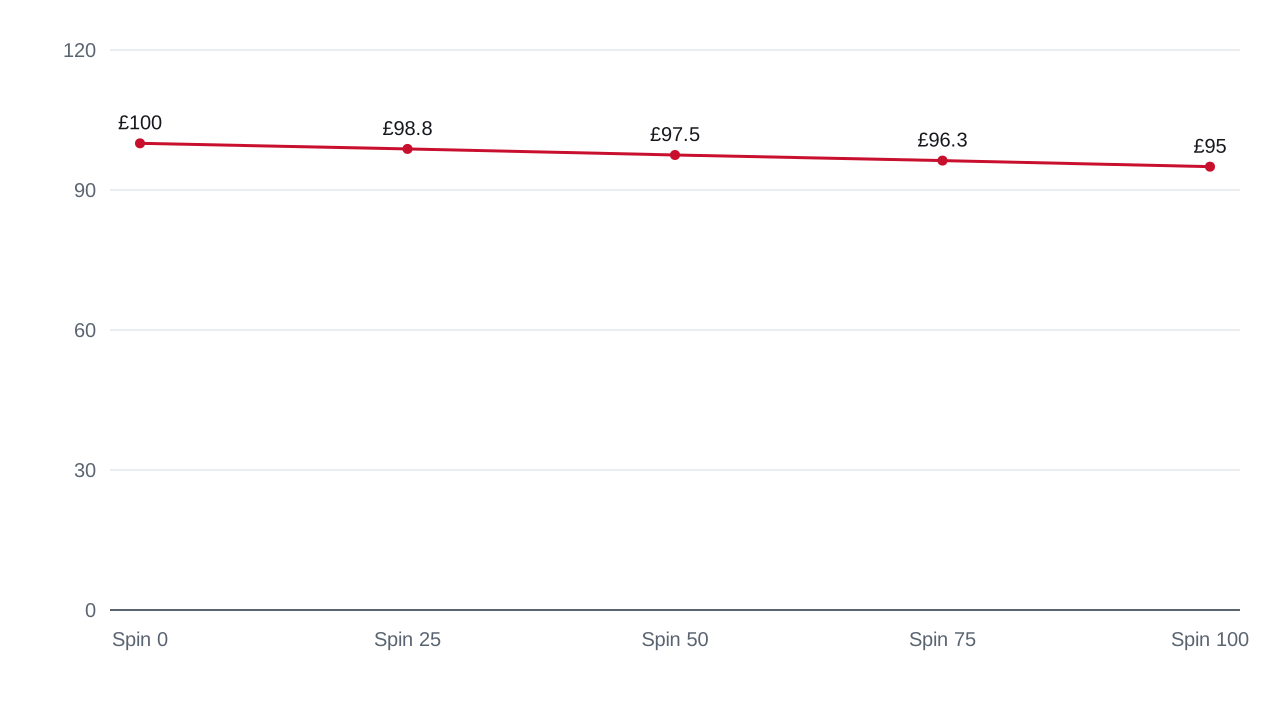
The balance is a coin count, so its pounds value moves with the market while you play. The modelled line on this page takes £100 of play value across 100 spins under a five percent fall and lands at £95, before any result of the reels is added. That slope is a stated assumption rather than a forecast, and real prices jump in both directions, sometimes inside a single hour.
As an assumption band rather than a measurement, crypto transfers at this end of the market are commonly described as clearing in minutes to a few hours once approved, against 1 to 3 banking days for a debit card. The clock usually starts after approval, and verification sits before it. Every operator sets its own minimum withdrawal and fee per transfer, so the cashier's own published figures are the ones that count.
Usually both, and they vary by operator. Caps on what a spins package can pay out commonly run between £50 and £500, with £100 the working assumption on this page, and expiry windows stretch from a few days to a month. Miss the window and the spins, or the winnings attached to them, typically lapse. Both lines sit in the operator's own terms, so confirm them before opting in rather than after.
A reader who already holds coin, already accepts price movement as part of the position, and wants slot play funded from that balance rather than from a bank account. It fits nobody who wants a balance priced once and left alone, because the pounds value moves between spins whether the reels do or not. If a second variable riding alongside the reels sounds like a complication rather than a feature, a pound cashier removes it entirely.
A Gambling Commission licensed casino takes pounds, sits on the public register, offers an approved dispute resolution route, takes part in GAMSTOP self-exclusion and works under the British credit card ban, with games tested by approved houses. You give up coin rails and the fast settlement they promote, and you get a regulatory framework around the money instead. The register lookup takes a minute and settles the licence question before any deposit.
Offers of this kind hold no UK Gambling Commission licence. That is not a technicality: it is the difference between a market with a public register, a national self-exclusion scheme, approved dispute resolution, a ban on credit card gambling, affordability checks and independently tested games, and a market with none of those guarantees. A dispute at a licensed operator goes to an approved scheme; an offshore dispute goes to the operator itself. Nothing on this page is an exception to that. If self-exclusion matters to you, GAMSTOP covers licensed operators only, and no tool on this page changes that.
Gambling can harm. For free, confidential support in the UK, call the National Gambling Helpline on 0808 8020 133 or contact BeGambleAware.
Keep reading
UK Gaming Club. Independent modelling of casino offers for British readers. No operator pays for a word on this page; board placement is bought and disclosed on the How We Are Paid page. 2026.