#1
Night Luck
8.2Editorial score
Casino welcome bonus 805% up to €6,400 + 280 FS
- MuchBetter · VISA · Apple Pay
- Crypto welcome 140% up to 1,600 USDT
- VIP pack 800% up to €14,500
Terms change often. Verify on the operator's own page.
Offers modelled before you claim
18+. Betting carries risk. Never stake more than you can afford to lose.
A 30 times requirement is the same £900 on a phone as on a desk, but a 15 minute session divides it differently, which is why session sizing decides whether a mobile offer is worth holding.
The board is editorial and its placement is bought, which the disclosure page covers. Terms move without notice, so verify each line on the operator's own page.
Casino welcome bonus 805% up to €6,400 + 280 FS
Terms change often. Verify on the operator's own page.
Welcome bonus €/£5,000 + 500 FS
Terms change often. Verify on the operator's own page.
Welcome pack €5,000 + 500 FS + €650 free bet
Terms change often. Verify on the operator's own page.
Welcome package 300% up to €/£1,000 + 150 FS
Terms change often. Verify on the operator's own page.
On this page
Mobile casinos stopped being a shrunk desktop site some years ago, and by 2026 the split is clean: an app on the home screen, or a browser tab running the same account. Both doors open the same wallet, the same lobby and the same terms. Nothing about the licence position, the bonus arithmetic or the payout rules changes with the door you pick.
What the app changes is friction. A saved login, a space on the home screen, a prompt on the lock screen: each shaves seconds off the trip back in. Seconds sound trivial until they are multiplied by the return visits a week produces. The browser asks more: an address, sometimes a password, occasionally a forgotten one. That friction is not a defect. If the honest problem with a phone is stopping, the slower door carries a value the faster one does not.
The small screen changes play in ways worth naming. Reels run portrait, sized for a thumb. Rounds restart in a second or two, quicker than most desk lobbies. The cashier collapses to a tap and a biometric check, and a deposit completes before the kettle boils. None of this alters the mathematics of an offer: a 30 times requirement on a £30 bonus is £900 of staked turnover, drawn on whatever canvas the screen provides.
So this page treats the phone as a cost question rather than a novelty. The requirement does not care where you sit. The session does, because the session is the thing a phone shortens, and the session is where the money actually moves. Two doors, one arithmetic: that is the state of mobile casinos in 2026, and it is why the rest of this page is about session sizing rather than screens.
Take the working example for the whole page: a £30 bonus carrying a 30 times requirement. That is £900 of staked turnover, and the figure is identical on a six inch screen and a thirty inch one. The requirement is a number, and numbers do not know what they are running on. What differs is the shape of the visits. A desk session tends to run long: an evening, or hours in fragments that behave like one. A phone session runs from unlock to interruption.
The interruptions are the honest part. A bus arrives at its stop. A queue starts moving. A message lands and the lock screen does its job. Fifteen minutes is a generous ceiling for many sittings, and it is the length this page models throughout. At the mid pace used below, six rounds a minute at 50p a round, a quarter hour stakes £45. That is an assumption, stated because every figure on this page needs one; real sittings wobble around it in both directions.
Divide the requirement by the sitting and the picture appears. £900 cleared at £45 a sitting takes twenty sittings, before exceptions. And exceptions matter: terms usually weight games, with most slots counting in full and other games counting partly or not at all. The model here assumes full contribution, which is the friendliest reading available. Where a game counts half, the twenty sittings become forty.
This is the quiet cost of the small screen. Not a worse offer: a slower clearing schedule, and if the terms carry an expiry measured in days, the schedule has to fit inside it. Short sittings are not a flaw in themselves. They simply move the workload into more days, and the terms, not the thumb, set the deadline.
Everything in this section is a model, and the assumptions are listed so they can be argued with rather than discovered later. The bonus is £30 carrying 30 times, so the requirement is £900. The pace is six rounds a minute. The stake is 50p a round in the table below and £1.50 in the calculator example. The expected cost of play is taken as 2 per cent of everything staked, a working figure for the house edge rather than a measurement of any named game. Contribution counts in full. A sitting runs a fixed length, start to finish.
The table divides the same £900 by sitting length. The middle column is turnover, not loss: at a 2 per cent expected cost, a £45 sitting carries about 90p of drift and a £90 sitting about £1.80. The last column is the arithmetic that matters: twenty fifteen minute sittings to turn £900, or thirty ten minute ones, and the shorter the sitting the more calendar the requirement quietly occupies.
| Session length | Stakes at mid pace | Share of a £900 requirement | Sessions needed |
|---|---|---|---|
| 10 minutes | £30 | 3.3% | 30 |
| 15 minutes | £45 | 5% | 20 |
| 20 minutes | £60 | 6.7% | 15 |
| 30 minutes | £90 | 10% | 10 |
The calculator under this section runs the same model at a heavier stake. Set the bankroll to £60, the stake to £1.50 a round, the edge to 2 per cent and the plan to twenty sittings. At six rounds a minute, a fifteen minute sitting stakes £135. Twenty of them stake £2,700 in total, and 2 per cent of that is £54: expected drift that would consume most of a £60 bankroll without a single extreme result. The edge works on turnover rather than deposits, and that is the whole reason pace and stake get the attention this page gives them.
Expectation is not a schedule. A real run of sittings lands above or below the drift, sometimes far above it, occasionally below. What the drift sets is the direction and the slope, and on a £60 bankroll the slope is steep enough to see without a spreadsheet.
Expected loss per session £1.20.
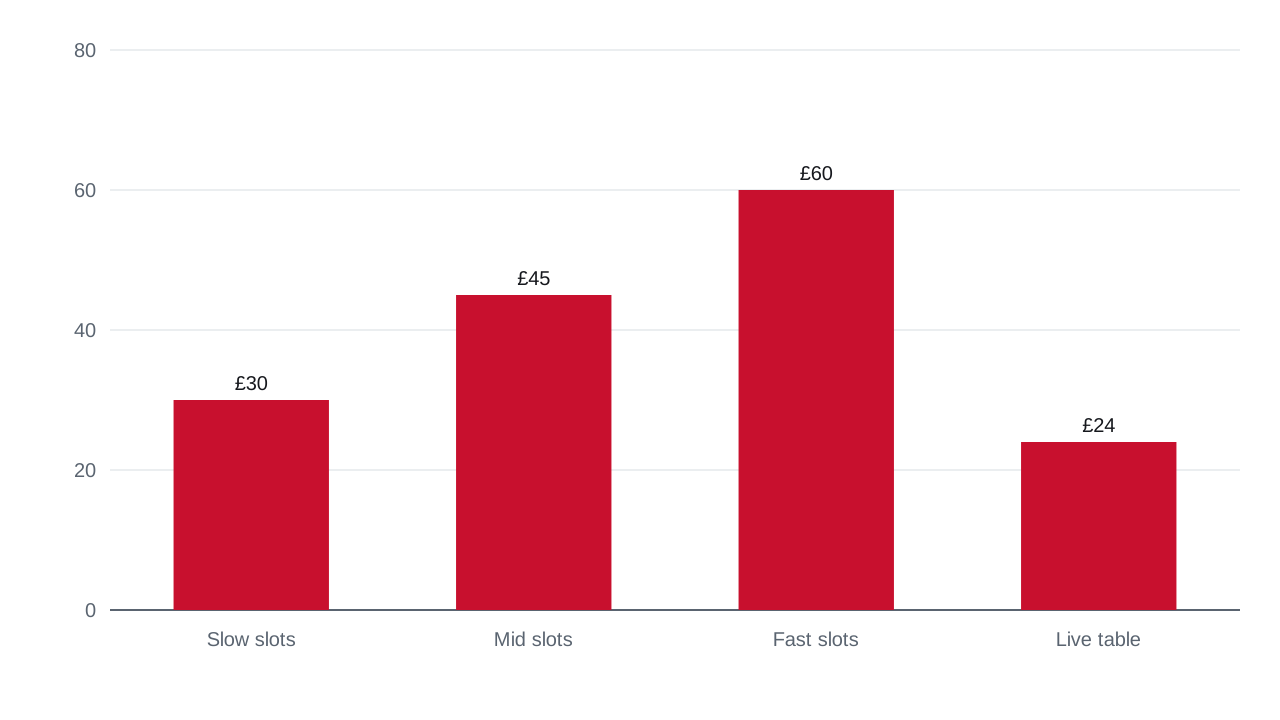
Expected loss across 20 sessions: £24.00.
Assumptions: spins return 90 percent of face value before wagering; session cost uses the stated house edge as expected loss of bankroll per session.
The Gambling Act 2005 aims its offence provisions at operators and advertisers, not at individuals, so a player who uses an unlicensed overseas site commits no offence. What the player loses is protection: no British register entry, no GAMSTOP coverage, no approved dispute route. Legality is not the question to ask; the question is which protections you are doing without.
The arithmetic is identical: 30 times on a £30 bonus is £900 of staked turnover on any screen. What changes is the sitting. Short sessions stake less per visit, so the same requirement needs more visits, and if the terms carry an expiry the shorter sitting schedule has to beat it. The multiplier never changes; the calendar around it does.
Usually, at licensed British operators, yes: both wallets front an underlying debit card and pass a tokenised payment to the cashier. The credit card ban applies to the card behind the wallet, so a credit card cannot ride inside it at a licensed site. Withdrawals typically route to the underlying card or another named method rather than back through the wallet, so check the cashier's withdrawal list first.
The terms set one expiry per offer, whatever the screen: commonly a number of days from credit, and at this end of the market that window can be short. A phone does not shorten it, but short sittings spread the work across more days, so expiry bites sooner in practice. Read the expiry line before opting in and size the sitting plan against it.
People who treat the phone as a five to fifteen minute screen and want the cost of a session known in advance. The model on this page fits that reader: a fixed sitting, a fixed stake and a stated expectation. It fits badly for anyone chasing a large requirement across a weekend, because short sittings clear a big requirement slowly and expiry rarely allows it.
A public register entry you can check, GAMSTOP self-exclusion across all licensed sites, an approved alternative dispute resolution route if a complaint stalls, the credit card ban, affordability checks and games tested by approved houses. None of it travels with an offshore offer. The offer can look identical on a screen; the protections behind it are the difference that matters when something goes wrong.
It depends on the game. A live dealer table streams video for the whole sitting, so it is the heaviest thing in the lobby by some distance. Animated reels are lighter but they redraw constantly, and neither is free on a capped connection. On wifi the cost is invisible; on mobile data it counts. If data is tight, short sittings help twice over.
Whatever length you can hold to, decided before the app opens rather than after. This page models fifteen minutes because it matches the interruptions a phone attracts, and a quarter hour at a mid pace stakes £45 at 50p a round. Ten minutes or twenty work the same way; the point is a fixed length, a timer, and ending on the timer rather than on the balance.
Offers of this kind hold no UK Gambling Commission licence. That is not a technicality: it is the difference between a market with a public register, a national self-exclusion scheme, approved dispute resolution, a ban on credit card gambling, affordability checks and independently tested games, and a market with none of those guarantees. A dispute at a licensed operator goes to an approved scheme; an offshore dispute goes to the operator itself. Nothing on this page is an exception to that. If self-exclusion matters to you, GAMSTOP covers licensed operators only, and no tool on this page changes that.
Gambling can harm. For free, confidential support in the UK, call the National Gambling Helpline on 0808 8020 133 or contact BeGambleAware.
Keep reading
UK Gaming Club. Independent modelling of casino offers for British readers. No operator pays for a word on this page; board placement is bought and disclosed on the How We Are Paid page. 2026.