#1
Night Luck
8.2Editorial score
Casino welcome bonus 805% up to €6,400 + 280 FS
- MuchBetter · VISA · Apple Pay
- Crypto welcome 140% up to 1,600 USDT
- VIP pack 800% up to €14,500
Terms change often. Verify on the operator's own page.
Offers modelled before you claim
18+. Betting carries risk. Never stake more than you can afford to lose.
Seventy spins without wagering on the winnings return their expectation whole, about £6.30 at 10p on the 90 percent assumption, and the label is only as clean as the cap line beside it.
The board is editorial and its placement is bought, which the disclosure page explains. Terms move without notice, so verify each line on the operator's own page.
Casino welcome bonus 805% up to €6,400 + 280 FS
Terms change often. Verify on the operator's own page.
Welcome bonus €/£5,000 + 500 FS
Terms change often. Verify on the operator's own page.
Welcome pack €5,000 + 500 FS + €650 free bet
Terms change often. Verify on the operator's own page.
Welcome package 300% up to €/£1,000 + 150 FS
Terms change often. Verify on the operator's own page.
On this page
The phrase 70 free spins no deposit no wager makes three promises at once. Seventy spins arrive on registration. No deposit, and usually no card, stands between the reader and the set. The winnings carry no wagering, which means whatever the set pays lands as withdrawable cash rather than as bonus funds locked behind a turnover target.
The third promise is the one worth money. Wagering is the machinery that turns a headline figure into a sticky balance: a multiple applied to the bonus or the winnings, contribution tables that decide which games count, a progress bar that empties as quickly as it fills. A no-wagering label removes that machinery entirely, and the difference is not cosmetic. On this page’s arithmetic it is worth about £4.10 on a set of this size, which the section on the two shapes works through.
What the label does not govern is where the catch usually sits. A no-wagering claim speaks to one variable only. It says nothing about the cap, the largest amount the spins may convert to cash. It says nothing about expiry, the deadline by which the spins must be used. It says nothing about the withdrawal floor, the smallest sum a cashier will release. Those three lines live in the terms rather than the headline, and a reader who stops at the label reads none of them.
So the page prices the label instead of admiring it. The working model takes spins worth 10p each, the middle of the 5p to 20p band that registration offers typically run, and a 90 percent return, deliberately below the range most published games carry. On those two assumptions the set is worth £6.30 before any cap, clock or floor gets a say. The sections that follow chase that figure through each obstacle in turn.
Start with the stake the operator is giving away. Seventy spins at 10p each is £7.00 of play, staked by the operator and returned to the player as winnings under the model’s assumptions. That £7.00 is the whole budget for the exercise, so every figure on this page is a slice of it.
The return assumption does the next work. Published return to player figures commonly sit between 94 and 96 percent, set per game by the operator, and games chosen for spins lists do not always sit at the top of that band. The model takes 90 percent, which is deliberately cautious, and 90 percent of £7.00 is £6.30. That is the expectation the set carries: across many runs of the same seventy spins, the average paid back approaches £6.30, with individual results scattered widely on either side.
The 70p gap between stake and expectation is the operator’s expected margin on the set, and it is the price of the marketing. Nothing about it is owed to any one player. A single run can return very little or several pounds; the expectation is a property of the set, not a forecast for anyone’s evening.
With no wagering attached, the £6.30 has a clean route out. The spins pay, the winnings sit as cash, and the cashier is the only door between them and a bank account. How much of the figure survives that door depends on three lines the label does not carry: the cap, the expiry and the floor. The next section puts a number on the largest of those costs by comparing two term shapes built from the same spins.
Offers of this kind arrive in two shapes. The first is the clean one this page is about: no wagering on the winnings, so the kept amount equals whatever the set pays, subject to a cap and to the cashier’s floor. The second attaches a turnover multiple to the winnings, and the multiple changes the arithmetic at the root, because the balance has to circulate before any of it can move.
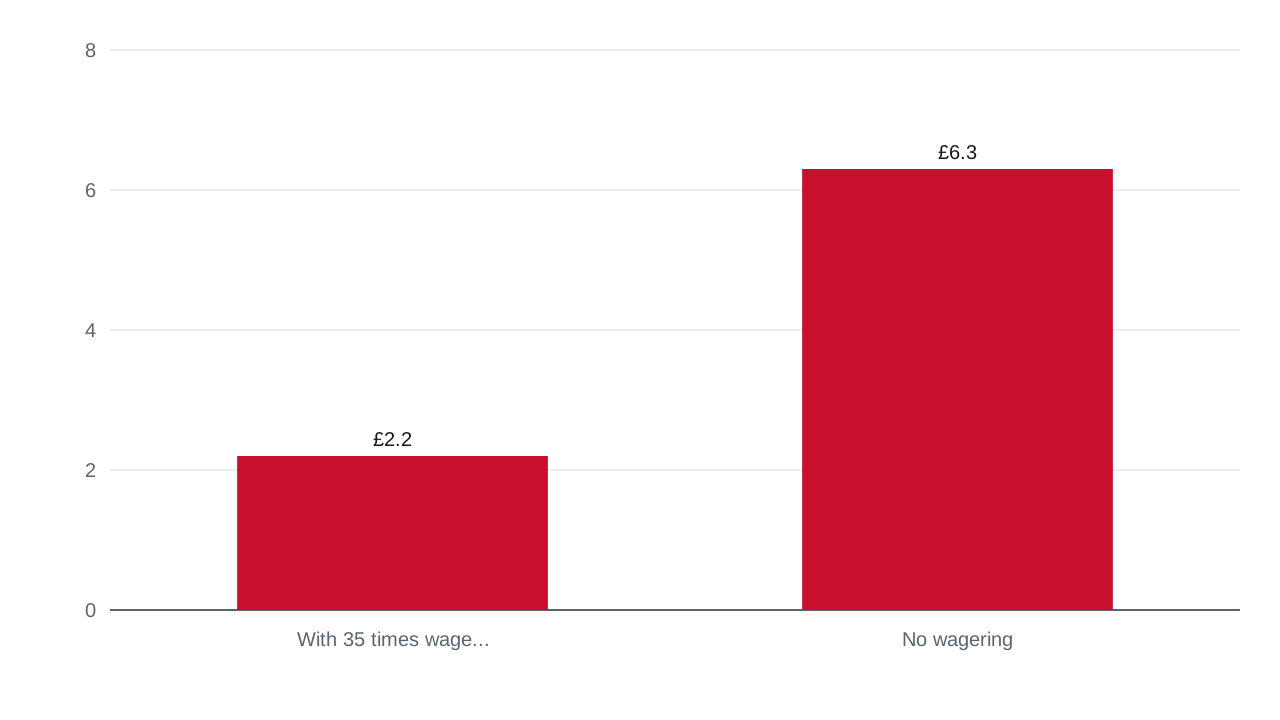
Take the wagered shape at 35 times, the working midpoint of the 20 to 50 band that this part of the market asks. 35 times on £6.30 is a £220.50 turnover target. The model, running the same 10p spins and the same 90 percent return against that target, prints about £2.20 kept. Against the £6.30 the clean shape carries, the wagering shape costs about £4.10, or roughly 65 percent of the expectation. That gap is what the chart below plots: two bars, one for each shape, drawn from the same seventy spins.
The table gathers four shapes, including a £3 cap row invented purely to show how a tight ceiling slices the same expectation, and a 20 times row for a gentler multiple. Read the final column as the obstacle that actually binds in each case. With no wagering and no cap, the withdrawal floor stands between the £6.30 and the exit. With a cap, the cap binds. With wagering, the expiry clock frames the turnover and decides whether the target is ever reached.
| Term shape | Wagering | Expected kept | Obstacle left |
|---|---|---|---|
| No wagering, no cap | none | £6.30 | Withdrawal floor |
| No wagering, £3 cap | none | £3.00 | The cap |
| 35 times on winnings | £220.50 target | about £2.20 | Expiry |
| 20 times on winnings | £126.00 target | about £3.00 | Expiry |
Spins face value £7.00.
Estimated winnings before wagering £6.30 at a 90 percent return.
Wagering £0.00.
Cashable £6.30.
Assumptions: spins return 90 percent of face value before wagering; session cost uses the stated house edge as expected loss of bankroll per session.
Legality sits with the operator, not the player. Serving British consumers without a Gambling Commission licence breaches the regime the Gambling Act 2005 sets up, and the offence falls on operators and advertisers. The Act creates no offence for an individual who plays on an unlicensed overseas site. What a player gives up there is protection: no register entry, no dispute route, none of the checks a licence requires.
Wagering is the turnover a bonus demands before winnings move into cash. On a typical wagered shape the requirement attaches to the winnings or the bonus, and each pound staked erodes the balance. With no wagering, whatever the spins pay lands as withdrawable cash at once, so the only things between a win and a withdrawal are the cap, the expiry and the cashier's floor.
The model takes seventy spins at 10p each, which is £7.00 of play, and assumes 90 percent returns to the player, a deliberately cautious figure below the 94 to 96 percent range commonly published. Ninety percent of £7.00 is £6.30. That number is an expectation for the set before any cap, expiry or withdrawal floor applies, not a prediction for any single session.
Cashout caps on no-deposit offers typically run between 50 and 500 pounds, with 100 pounds the working assumption, so a cap rarely bites on a £6.30 expectation. Expiry is the sharper edge: spins usually carry a short deadline named in the terms, and unused spins lapse quietly. Winnings can carry their own clock in some terms, so both dates are worth reading.
Debit cards on Visa and Mastercard rails are the usual baseline, and most British-facing cashiers add PayPal, with Apple Pay or Google Pay common alongside. Skrill and Neteller appear often, though some terms exclude e-wallet deposits from offers. Offshore cashiers lean harder on crypto rails. The working band for payouts runs from e-wallets inside 24 hours to bank transfer over several banking days, an assumption band rather than a measurement.
It suits a reader who wants to see a cashier work before paying anything, and who accepts that the money involved is small. Seventy spins at 10p is a look around a lobby, not a bankroll. It also suits anyone wary of wagering arithmetic, because there is none to track. It suits least those hoping for a large cashout, since caps and floors frame the outcome.
A Gambling Commission licence brings a public register entry, GAMSTOP self-exclusion across licensed sites, an approved dispute resolution route, the credit card ban, affordability checks and fairness testing through approved test houses. An offshore site offers none of that package. If the choice is between seventy spins on a licensed brand and more spins offshore, the protections are the difference worth weighing.
Registration offers of this sort usually need only an account, and terms name any code explicitly when one applies. Verification is the step people forget: licensed operators confirm age and identity, and spins often sit behind that check. A card should not be required for a genuinely no-deposit offer, and a demand for card details to release free spins is a term worth questioning.
Offers of this kind hold no UK Gambling Commission licence. That is not a technicality: it is the difference between a market with a public register, a national self-exclusion scheme, approved dispute resolution, a ban on credit card gambling, affordability checks and independently tested games, and a market with none of those guarantees. A dispute at a licensed operator goes to an approved scheme; an offshore dispute goes to the operator itself. Nothing on this page is an exception to that. If self-exclusion matters to you, GAMSTOP covers licensed operators only, and no tool on this page changes that.
Gambling can harm. For free, confidential support in the UK, call the National Gambling Helpline on 0808 8020 133 or contact BeGambleAware.
Keep reading
UK Gaming Club. Independent modelling of casino offers for British readers. No operator pays for a word on this page; board placement is bought and disclosed on the How We Are Paid page. 2026.