#1
Night Luck
8.2Editorial score
Casino welcome bonus 805% up to €6,400 + 280 FS
- MuchBetter · VISA · Apple Pay
- Crypto welcome 140% up to 1,600 USDT
- VIP pack 800% up to €14,500
Terms change often. Verify on the operator's own page.
Offers modelled before you claim
18+. Betting carries risk. Never stake more than you can afford to lose.
Fifty spins at signup stake £5.00 of face value at the usual 10p, and the model keeps about a quarter of it after wagering, which is the honest size of the welcome mat.
The board is editorial and its placement is bought, which the disclosure page explains. Terms move without notice, so verify each line on the operator's own page.
Casino welcome bonus 805% up to €6,400 + 280 FS
Terms change often. Verify on the operator's own page.
Welcome bonus €/£5,000 + 500 FS
Terms change often. Verify on the operator's own page.
Welcome pack €5,000 + 500 FS + €650 free bet
Terms change often. Verify on the operator's own page.
Welcome package 300% up to €/£1,000 + 150 FS
Terms change often. Verify on the operator's own page.
On this page
A 50 free spins sign up offer is a bundle of rounds credited to a new account before any money moves from the reader to the operator. Each round carries a stated value, usually between 5p and 20p, and 10p is the working assumption throughout this page. Fifty rounds at that assumed stake represent £5.00 of play at face value: fifty rotations of one named slot, paid for by the house, delivered the moment registration completes. The count in the headline is usually the only number a promotion prints.
The bundle is a grant, not a gift of cash. It arrives locked to a single game, the stake per spin is fixed by the terms rather than chosen by the player, and anything the rounds win lands as bonus funds instead of withdrawable money.
Between the account and the rounds sits a claim step, and the shape of that step varies more than most headlines admit. Some operators credit the spins automatically once signup ends. Others ask for an opt in on a promotions tab, and a minority park the rounds behind a first deposit, which quietly turns a registration offer into a deposit offer.
Two properties define the category, and both belong in the decision. The first is that the stake comes from the operator, so the reader’s exposure at the moment of grant is personal data and time, not money. The second is that everything of value sits behind conditions: a turnover multiplier on the winnings, a ceiling on the cashout, a short expiry, and identity checks before any withdrawal clears. The rest of this page prices those conditions against the £5.00 of face value and follows the money through each stage, because an offer’s real size lives in its conditions, not in its count of rounds.
Registration is the entry fee, and it is paid in personal data. A British operator asks for full name, date of birth, home address, email and a mobile number, and it must confirm that a player is 18 or older before play is allowed. Those checks are licence conditions rather than courtesy, and they arrive in two waves: light checks at signup, deeper document checks before or shortly after the first withdrawal. The form is short; the document request later is not.
The claim step comes in three shapes, and the terms name which one applies. The lightest credits the spins automatically at the end of signup, so the only action is opening the named game before the clock runs out.
The middle shape asks for an opt in, a toggle or a button on a promotions page, and this is where a large share of grants quietly die, because a reader who never visits the tab never triggers the credit. The heaviest shape parks the rounds behind a first deposit of £5 to £10, which converts the registration offer into a deposit offer wearing a no deposit label. The distinction matters to anyone who specifically wants to try a site without funding it first.
Verification then asks for more than the form did. Expect a photograph of a passport or driving licence, sometimes a recent bill for the address, and a payment method registered in the player’s own name. Offshore cashiers request the same documents without the same framework behind them, and the difference shows when a withdrawal stalls and no approved complaint route exists to take it to. A reader who is uncomfortable assembling that bundle of documents should treat the grant as expensive at any headline value, because data is the real currency at the claim step.
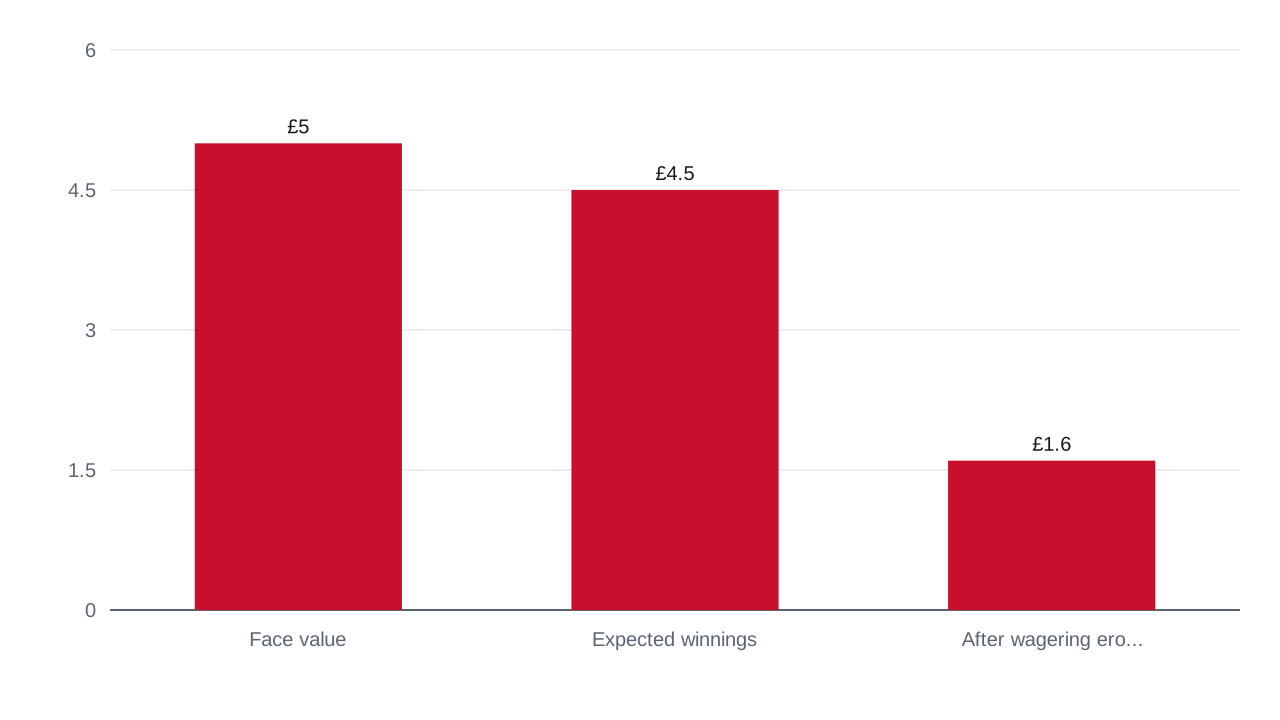
Four figures describe the life of the bundle, and each moves under a different lever. The grant is worth £5.00 at face value, built from fifty spins at the assumed 10p stake. Expected winnings come to £4.50, which follows from a 90 percent return assumption on the named game; the published return of the actual slot moves this figure in either direction.
The wagering target is £157.50, thirty five times the winnings, taken from the midpoint of the market’s usual 20 to 50 times band. The residual, the model’s estimate of what survives the clearing run, is £1.60, and it sits far below the £100 cashout cap, so the cap never comes into play at these numbers.
The chart below draws three of those stages as bars: the £5.00 face value, the £4.50 of expected winnings, and the £1.60 that the model expects to survive wagering erosion. Read the bars in order and the shape of the category appears: the grant shrinks at the return line, then shrinks again across the run. The drop from the first bar to the third is the price of the conditions, and it is the number to carry in mind whenever a headline quotes a round count as though rounds were pounds.
| Stage | Figure | How it was reached | What can change it |
|---|---|---|---|
| Face value | £5.00 | 50 times 10p | Stated spin value |
| Expected winnings | £4.50 | 90 percent assumption | The named game return |
| Wagering | £157.50 | 35 times the winnings | Multiplier band |
| Cashout | min of balance and cap | printed ceiling | The cap line |
Spins face value £5.00.
Estimated winnings before wagering £4.50 at a 90 percent return.
Wagering £1.58.
Cashable £4.50.
Assumptions: spins return 90 percent of face value before wagering; session cost uses the stated house edge as expected loss of bankroll per session.
Nothing leaves your balance at the point of grant, because the spins are credited at registration before any deposit is made. The real cost sits in the conditions: wagering on the winnings, a cashout ceiling, a short expiry and, at some operators, a verification deposit before withdrawal. Priced at face value, fifty spins at 10p are five pounds of play; the worked model on this page estimates what survives the clearing run.
Rarely in full. The usual pattern attaches a turnover multiplier to the winnings, commonly between 20 and 50 times, and only the balance left after that run converts to withdrawable cash. On the worked numbers here, thirty five times the expected winnings is £157.50 of play, and the model expects most of the balance to erode across it. Check whether the multiplier applies to winnings or to the bonus before you register.
The cap exists because the operator is giving away play rather than money, and the gift is meant to have a ceiling. A typical no deposit cap runs between £50 and £500; anything above the printed line stays with the house when the balance converts. At this page's worked set the cap sits at £100, far above the expected residual, so it only bites when an unusually good run pushes the balance up.
Short clocks are the norm at this end of the market. Spin grants commonly expire within 24 hours to 7 days of credit, and any unused rounds disappear at the deadline without compensation. The wagering window can run on a separate clock, sometimes 7 to 30 days after the spins settle. Write the dates down when you register, because operators rarely extend a missed deadline and the terms rarely oblige them to.
Registration itself usually takes no payment, but withdrawal does, and identity checks often ask for a card or wallet in your own name. Debit cards from Visa and Mastercard are the standard rails at licensed British operators, with PayPal, Apple Pay and Google Pay common alongside. Offshore cashiers add crypto options such as Bitcoin and Tether. Payout speeds differ by rail: e-wallets settle fastest, cards take one to three banking days.
British law aims the offence at the operator, not the player: the Gambling Act 2005 penalises businesses that provide or advertise gambling facilities without a licence, and it creates no offence for an individual who plays on an unlicensed overseas site. What you lose by playing there is protection, not legality. No British register entry, no approved complaint route and none of the licensed operator's duties sit behind the account.
It suits a reader who wants to see a slot's mechanics without committing money, and who treats any cashout as a bonus rather than a plan. It suits nobody who needs the money back, because the model on this page expects most of the face value to erode during wagering. Skip it if a verification deposit would stretch your budget, or if short expiry windows and identity checks sound like friction you will not finish.
An operator holding a Gambling Commission licence. The register confirms the licence status, GAMSTOP covers self-exclusion across every licensed site, the credit card ban applies, complaints can reach an approved dispute resolution provider, and game fairness is tested by approved test houses. Registration spin offers exist inside that regime too, usually with clearer terms and a smaller headline. The protections are the difference the licence is there to carry.
Offers of this kind hold no UK Gambling Commission licence. That is not a technicality: it is the difference between a market with a public register, a national self-exclusion scheme, approved dispute resolution, a ban on credit card gambling, affordability checks and independently tested games, and a market with none of those guarantees. A dispute at a licensed operator goes to an approved scheme; an offshore dispute goes to the operator itself. Nothing on this page is an exception to that. If self-exclusion matters to you, GAMSTOP covers licensed operators only, and no tool on this page changes that.
Gambling can harm. For free, confidential support in the UK, call the National Gambling Helpline on 0808 8020 133 or contact BeGambleAware.
Keep reading
UK Gaming Club. Independent modelling of casino offers for British readers. No operator pays for a word on this page; board placement is bought and disclosed on the How We Are Paid page. 2026.