#1
Night Luck
8.2Editorial score
Casino welcome bonus 805% up to €6,400 + 280 FS
- MuchBetter · VISA · Apple Pay
- Crypto welcome 140% up to 1,600 USDT
- VIP pack 800% up to €14,500
Terms change often. Verify on the operator's own page.
Offers modelled before you claim
18+. Betting carries risk. Never stake more than you can afford to lose.
Phone billing deposits in fixed steps of £3, £5 or £10 charged to a monthly bill, and no carrier rail can pay a withdrawal out, so the exit is always another cashier.
The board is editorial and its placement is bought, which the disclosure page explains. Terms move without notice, so verify each line on the operator's own page.
Casino welcome bonus 805% up to €6,400 + 280 FS
Terms change often. Verify on the operator's own page.
Welcome bonus €/£5,000 + 500 FS
Terms change often. Verify on the operator's own page.
Welcome pack €5,000 + 500 FS + €650 free bet
Terms change often. Verify on the operator's own page.
Welcome package 300% up to €/£1,000 + 150 FS
Terms change often. Verify on the operator's own page.
A pay by phone casino is a cashier that has handed the payment leg to your mobile network. You choose a small amount, the charge joins your monthly phone bill or comes straight off prepaid credit, and the money moves without a card, a wallet or a bank entering the frame at any point. The steps are fixed and deliberately low: £3, £5 and £10 on the model this page uses throughout.
The flow at the cashier is short. Pick carrier billing from the deposit list, enter the mobile number attached to your account, confirm the request, and the step lands in the balance at once. Repeat the action to add another rung, and each repeat is its own charge line: a session built from three £10 steps will read as three separate entries when the itemised bill arrives weeks later.
Who actually extends the money depends on the account you hold. On a contract, the network carries the charge for the rest of the billing cycle and collects it alongside calls and data; on prepaid, the balance falls the moment the step is confirmed and there is nothing deferred. That split shapes everything in the budgeting section further down, because one route lends quietly and the other spends in full view.
The steps themselves exist because the rail was built for small digital purchases, where a card form is friction and the amounts are trivial. Gambling borrowed the same plumbing, and the ceilings networks apply to gambling charges are their own decisions rather than anything a cashier requests. Treat the £3 to £10 band as the market’s working pattern rather than a measurement of any particular cashier, and let the cashier’s own deposit page tell you the steps it actually offers.
It is worth being equally clear about what the rail is not. It is not a wallet, it holds no balance of yours, and it cannot receive money back under any circumstances. The network is a collector rather than a bank: it passes the charge to the cashier and prints the same figure on your bill. Nothing in the arrangement gives the network a view of what happens to the funds afterwards, and nothing in it gives you a claim on the network if a session goes badly.
The table below sets the carrier rail against the debit card rail on the four points that decide whether a deposit method feels comfortable in practice: the size of a single step, the ceiling on any one day, the route out when you want winnings, and the speed at the deposit end.
| Feature | Phone billing | Debit card | What it means |
|---|---|---|---|
| Deposit step | 3 to 10 pounds | 5 to 20 pounds | Small |
| Daily ceiling | carrier cap | cashier limit | Carrier decides |
| Exit route | none direct | same card | Second rail needed |
| Speed | instant | instant | Even |
Two of those rows do most of the work. Speed is even, so choosing the carrier rail costs nothing in waiting time when money goes in. The exit row is the one that changes behaviour, because a debit card deposit can usually be paid back to the same card while a phone-billed deposit has nowhere to return to, and that asymmetry drives most of what the rest of this page has to say.
Searchers arrive at this page under several names: pay by phone, pay by mobile, phone billing, carrier billing, sometimes the name of the intermediary that runs the rail. All of them describe one mechanic, a small charge that rides the mobile account. Availability is a network question as much as a cashier question, so the deposit list you are shown is the authority on whether the rail is open to you, and the checks in the final section apply whichever label a cashier prints next to the button.
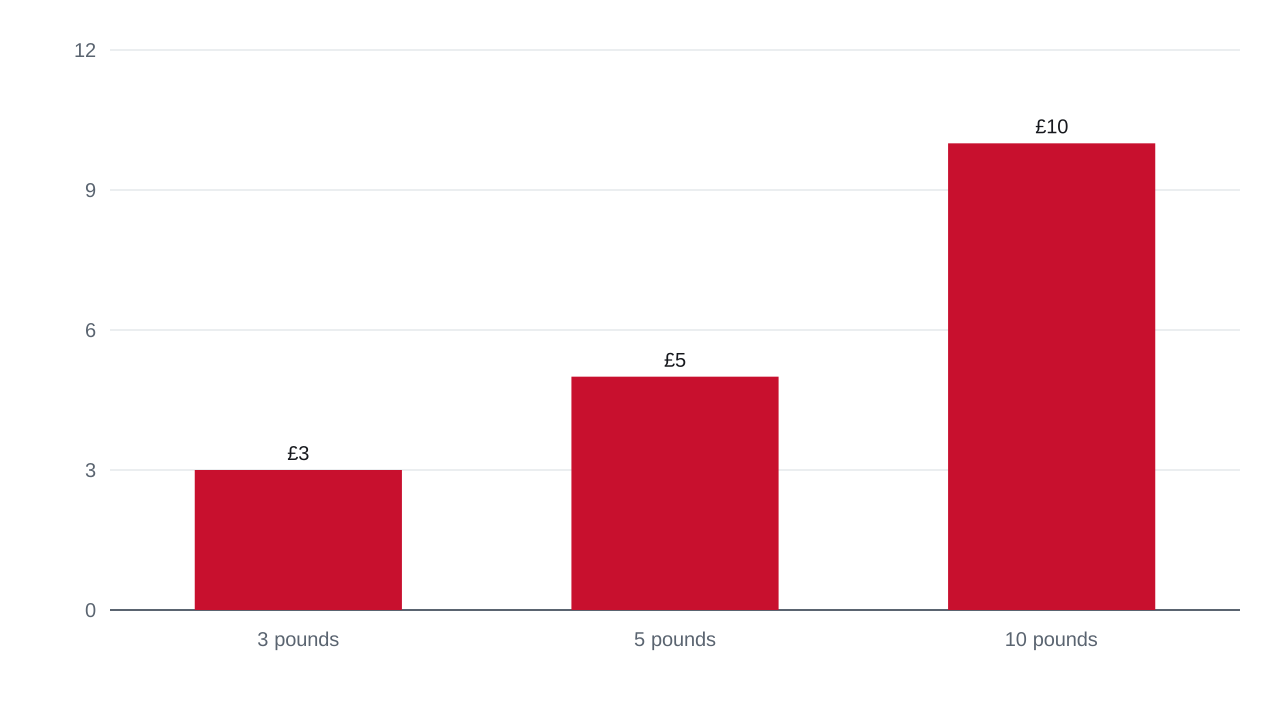
The chart below plots the three rungs of the common carrier ladder: £3, £5 and £10, one bar each, in pounds. The caption carries the model date, and the assumption behind the series is stated rather than hidden: these are the steps most often published at cashiers that take the rail, assembled as a model of the market rather than measured at any single cashier. A cashier can sit below the top rung or publish its own variants, so read the chart as the shape of this part of the market and treat the cashier’s deposit page as the authority on what is actually available.
Small steps are the point of the design, and it is worth saying plainly what that design does. A £3 rung is small enough that the decision to repeat it barely registers, and repetition is the intended behaviour: the rail earns from frequency, not from size. The honest way to read the ladder is not as a menu of small amounts but as a pace. Three £10 steps in an evening is £30. Ten of them is £100, and the only place that total ever appears in a single number is the bill.
The ladder ends at £10 per step on the common model, and the way past a ceiling is repetition rather than a larger single charge. The network’s daily ceiling is the backstop that decides when repetition stops for the day, and that figure belongs to the carrier rather than the cashier. Where the two limits differ, the stricter one governs, which is the same rule that applies to every limit in this market: the lowest number in the chain is the real one.
Set the carrier ladder against a debit card and the difference in granularity is immediate. Card minimums on this page’s model run from £5 to £20, so the card rail starts higher and invites fewer, larger decisions. The carrier rail starts lower and invites more, smaller ones, spaced through a session. Neither rail is automatically cheaper to use; they price attention differently, and the budgeting section assumes you have chosen the rail whose pace you can reconcile after the fact.
A practical rule falls out of the chart. Pick the rung that matches a single session’s budget, decided before the session starts, and stop when the plan says stop rather than when the balance says otherwise. Step size is the only variable on this rail that a reader controls at the moment of deposit, which makes it the natural place to build whatever discipline the monthly figure needs. Everything downstream, the match, the wagering, the exit, is priced off the rung you choose here.
One more reading of the chart is worth a sentence. The bars are equal in a respect the pound figures hide: each rung is a decision point, a moment where the plan either holds or stretches. A ladder of £10 rungs gives you fewer decision points for the same money than a ladder of £3 rungs, and readers who know themselves to be stretchers often prefer the smaller rung precisely because it forces the question more often.
Bonus credit £20.00.
Wagering before cash out £1,200.00 at 40 times.
Wagering per pound deposited 120 times.
Assumptions: spins return 90 percent of face value before wagering; session cost uses the stated house edge as expected loss of bankroll per session.
Yes, for the player: the offence provisions of the Gambling Act 2005 fall on operators and advertisers, not on an individual who plays on an unlicensed overseas site. What you lose is protection rather than legality: no British register entry, no GAMSTOP coverage and no approved dispute resolution route sit behind the offer.
Under this page's assumptions, the multiple applies to the bonus alone: a £10 deposit matched at 200 per cent adds £20 of bonus funds, and 40 times that is £800 in qualifying stakes. Multiples at this end of the market usually land between 20 and 50 times, and some offers apply the multiple to deposit plus bonus, which raises the figure, so read which base the terms use before you count anything cleared.
No. Carrier rails are built to take deposits and cannot push a payout to a phone account, so a second method is needed from the start. Debit card, bank transfer and e-wallet payouts are the usual nominations, and cashiers commonly hold the first withdrawal while identity checks run. Window bands by rail are assumptions rather than promises: e-wallets 0 to 24 hours, debit cards 1 to 3 banking days.
Yes, and it sits with the network rather than the cashier. The common model runs in steps of £3, £5 and £10, each network sets its own daily ceiling on gambling charges, and the cashier may add a lower limit of its own. Whichever ceiling is stricter is the one that binds, so read both before you plan a session around the rail.
It suits contract holders who want to top up in small steps without entering card details, and people who prefer a monthly reconciliation to a running card statement. It fits poorly for anyone without a second verified payout method, for prepaid users close to their balance, and for anyone who finds that a bill arriving weeks later hides the pace of play rather than showing it.
A cashier holding a Gambling Commission operating licence. Some licensed sites take carrier billing alongside debit cards, and every licensee carries the same cover: a public register entry you can check, GAMSTOP self-exclusion, an approved dispute resolution service and the credit card ban. Check the register before the first deposit, because the label on a site tells you nothing on its own.
The cashier usually takes the step at face value, but the network's side of the deal is separate: some carriers itemise a handling charge for carrier billing on the monthly bill, and terms differ between networks. Read the cashier's payments page and the network's terms before the first step, and check the first bill for a line you did not expect.
Decide a monthly figure before the first deposit and count each £3, £5 or £10 step against it, because the ladder is designed to make single steps feel trivial. Use the network's own ceiling as a backstop rather than a plan, diary the bill date, and reconcile the itemised lines when they land. If the pace feels wrong, the National Gambling Helpline on 0808 8020 133 is free and answers at any hour.
Offers of this kind hold no UK Gambling Commission licence. That is not a technicality: it is the difference between a market with a public register, a national self-exclusion scheme, approved dispute resolution, a ban on credit card gambling, affordability checks and independently tested games, and a market with none of those guarantees. A dispute at a licensed operator goes to an approved scheme; an offshore dispute goes to the operator itself. Nothing on this page is an exception to that. If self-exclusion matters to you, GAMSTOP covers licensed operators only, and no tool on this page changes that.
Gambling can harm. For free, confidential support in the UK, call the National Gambling Helpline on 0808 8020 133 or contact BeGambleAware.
Keep reading
UK Gaming Club. Independent modelling of casino offers for British readers. No operator pays for a word on this page; board placement is bought and disclosed on the How We Are Paid page. 2026.