#1
Night Luck
8.2Editorial score
Casino welcome bonus 805% up to €6,400 + 280 FS
- MuchBetter · VISA · Apple Pay
- Crypto welcome 140% up to 1,600 USDT
- VIP pack 800% up to €14,500
Terms change often. Verify on the operator's own page.
Offers modelled before you claim
18+. Betting carries risk. Never stake more than you can afford to lose.
A crypto no deposit bonus usually arrives as a small credit at 40 times wagering, and the network fee takes a larger share the smaller the deposit behind it.
The board carries editorial scores and offers whose terms move without notice. Verify every line on the operator's own page before you act on it.
Casino welcome bonus 805% up to €6,400 + 280 FS
Terms change often. Verify on the operator's own page.
Welcome bonus €/£5,000 + 500 FS
Terms change often. Verify on the operator's own page.
Welcome pack €5,000 + 500 FS + €650 free bet
Terms change often. Verify on the operator's own page.
Welcome package 300% up to €/£1,000 + 150 FS
Terms change often. Verify on the operator's own page.
On this page
A crypto casino no deposit bonus is a credit added to a new account after registration, with no payment asked before it lands. The sums are small. Take the equivalent of £10 to £50 as the usual band in this market, an assumption to work with rather than a measurement, since every operator sets its own figure. The multiplier attached to the credit runs high: 40 times is the working figure on this page, and the terms behind it normally carry a short expiry and a ceiling on what can ever be withdrawn.
The credit itself is rarely withdrawable. Terms treat it as stake money: winnings it produces may be capped, the stake is never returned, and the wagering has to clear before any of it moves. That is the opposite of a cashback, which arrives as money and mostly stays money.
The shape differs from a debit-card welcome in one structural way. A card cashier matches money you put in, so the operator’s exposure grows with your deposit and the headline can stay generous. A no deposit credit is the operator’s money from the first pound, which is one reason the multiplier climbs, the expiry shortens and the withdrawal ceiling drops. The operator is pricing the cost of opening accounts against the small share of them that ever clear the requirement.
There is a second difference, and it is the one this page turns over. In a card cashier the sum is pounds from the first screen. Here the credit lands in a coin or a token, the balance is denominated in that unit, and every movement of value crosses a blockchain network that charges for the crossing. The fee is small in pounds and large as a share when the sums behind it are small. That combination, a small credit, a high multiplier and a fixed transfer cost, is the arithmetic the rest of this page works through.
Start from the licence, because the licence decides the cashier. The Gambling Act 2005 makes it an offence to provide remote gambling facilities to British consumers without an operating licence issued by the Gambling Commission, and the Commission maintains the conditions and licence rules its licensees work under. A site holding one builds its payment page from the rails a British licensee may offer: debit cards, bank transfer, and the e-wallets that pass its checks. Coins do not appear on that list. That is not a design choice any single cashier made. The rail is a feature of the unlicensed end of the market, which is why a crypto casino no deposit bonus and a British licence do not turn up on the same payment page.
The payment method therefore carries information on its own. When a cashier lists Bitcoin, Tether or Litecoin among its deposit options, that cashier is not a Gambling Commission licensee. It appears on no British register, and its British-facing advertising stands outside the rules that bind a licensed operator’s marketing.
The reader’s legal position is separate from the operator’s, and the distinction matters. The offence provisions of the 2005 Act fall on those who provide gambling facilities without a licence and on those who advertise them. The Act creates no offence for the person playing: an individual who uses an overseas site that holds no British licence commits no offence by doing so. What goes missing is protection, not legality. None of the register, the approved dispute route, the self-exclusion scheme or the declared protection of customer funds travels with the account.
For anyone who wants to keep every part of the chain inside British regulation, that line is the whole answer: the licensed market is complete without coins, and a cashier that wants a coin rail has already chosen the other side of it. This page treats all of that as a fact of licensing and nothing more. Nothing in it is a way across the line, and no figure in it should be read as an invitation.
The model here prices a credit the way terms of this shape are usually written: a 150 per cent match, a 40 times multiplier applied to the deposit and the credit together, and a £400 ceiling on the credit itself. Take those three numbers as stated assumptions for the arithmetic, not as a quote from any single operator. Some terms apply the multiplier to the credit alone, which nearly halves the total; the model takes the stricter combined base so the figure errs high rather than low.
Worked on a £50 deposit, the shape runs as follows. A 150 per cent match adds £75, so £125 of play money sits on a £50 payment. Forty times the combined £125 asks £5,000 of stakes before a withdrawal request is open. The network fee, covered in the next section, is a further £2.50 on top of the transfer itself.
A no deposit credit runs the same machinery against a smaller base. There is no deposit behind it, so the match column is empty and the ceiling becomes the binding number. On offers of this kind the cashout cap typically runs between £50 and £500, and £100 is the working assumption here. The multiplier does not soften because the credit was free: 40 times a £30 credit is still £1,200 of stakes, and the expiry clock is usually shorter than it would be on a matched deposit.
The calculator on this page carries the prefills: a £50 deposit, a 150 per cent match, a 40 times multiplier and a £400 cap. Change any of the four and the wagering total moves with it. It is worth running once with the multiplier your own terms state, because that total decides whether the credit is worth the week of capped-stake play it would take.
Bonus credit £75.00.
Wagering before cash out £5,000.00 at 40 times.
Wagering per pound deposited 100 times.
Assumptions: spins return 90 percent of face value before wagering; session cost uses the stated house edge as expected loss of bankroll per session.
Under the Gambling Act 2005, an operator providing remote gambling to British consumers must hold a Gambling Commission operating licence, and a licensed cashier is built from regulated rails such as debit cards, bank transfer and approved e-wallets. Coins are not part of that set, so a payment page listing Bitcoin tells you where the licence sits. The site is on no British register, and the protections that follow a licence do not follow the account.
Multiply the credit by the multiplier in the terms. A £30 credit at 40 times asks £1,200 of stakes before a withdrawal request opens, and some operators apply the multiplier to winnings rather than the credit, which changes the figure again. Read which base the terms use, then check the max bet and the expiry, because those two decide how long the stakes would take to place.
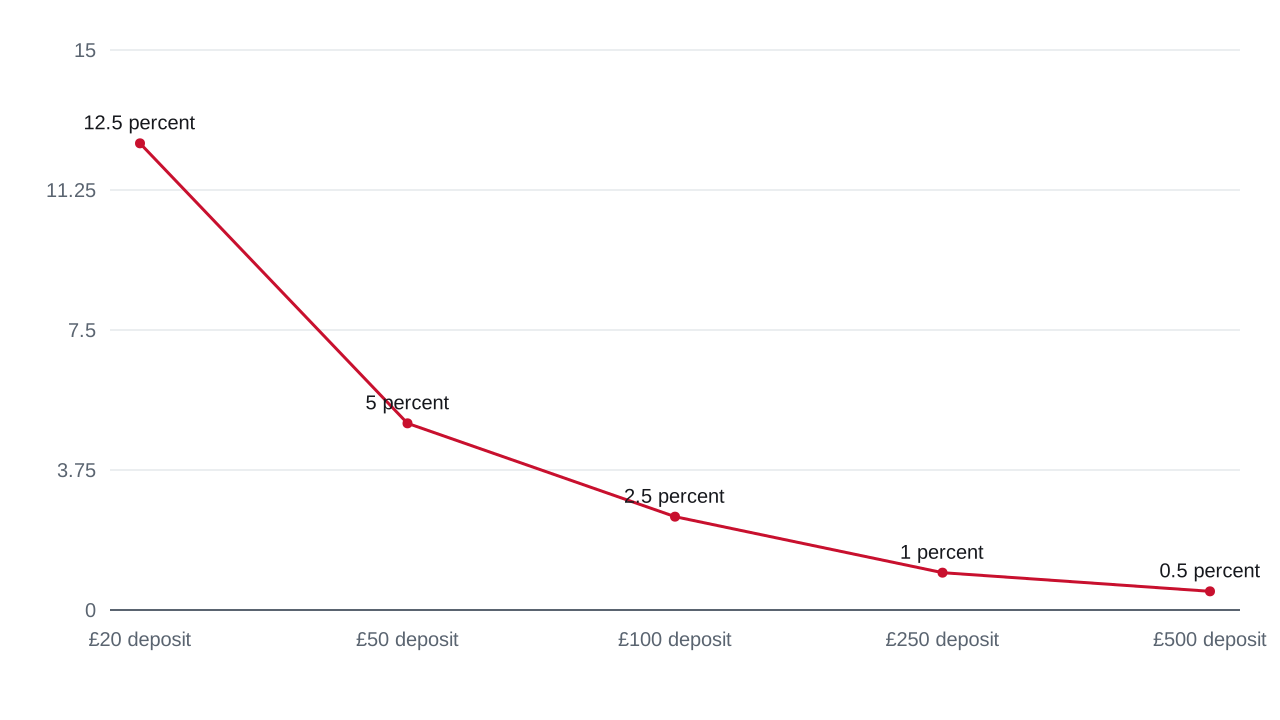
A coin transfer carries a fee set by network congestion, not by the amount moved, so the same few pounds sit against a £20 deposit as against a £500 one. On the model used here that is 12.5 per cent of £20 and 0.5 per cent of £500. The smaller the deposit, the larger the share the fee takes before any stake is placed.
The multiplier stays the same, but the value behind it holds steadier. A credit in a coin that rises and falls can shrink while the wagering runs, dragging the balance down and possibly under the withdrawal minimum before the requirement clears. A stablecoin keeps the arithmetic where you priced it, within the small wobble of the peg, so the finish line stays where the terms put it.
It sets the clock on the whole run. A credit valid for a few days must clear its full wagering inside that window, and anything unconverted when the clock ends disappears with it. On a small credit the stakes are modest, but a short expiry, a capped stake and partial game weighting together can end the run before the requirement is met.
Offshore cashiers commonly ask for proof of identity before a first withdrawal, and the request can arrive after the wagering has cleared rather than at registration. Because the operator sits outside the British regime, there is no approved dispute route if a document request stalls or a payment never arrives. Assume checks take longer than at a licensed cashier, and read the withdrawal terms before the credit is taken.
A Gambling Commission licensed cashier takes debit cards, bank transfer and approved e-wallets, with no coin leg and no network fee on the transfer. The licence brings a public register entry, self-exclusion through GAMSTOP, an approved dispute route, the credit card ban and independently tested games. The welcome offers are no louder than a free credit, but the terms sit under a regulator, which is the difference that shows when a withdrawal stalls.
It is arithmetic on published term shapes, not a record of any account. The calculator takes a £50 deposit, applies a 150 per cent match, multiplies by 40 and applies a £400 ceiling, each an assumption for this part of the market. The chart divides a fixed £2.50 fee across five deposit sizes. Nothing is staked, timed or measured in producing the figures on this page.
Offers of this kind hold no UK Gambling Commission licence. That is not a technicality: it is the difference between a market with a public register, a national self-exclusion scheme, approved dispute resolution, a ban on credit card gambling, affordability checks and independently tested games, and a market with none of those guarantees. A dispute at a licensed operator goes to an approved scheme; an offshore dispute goes to the operator itself. Nothing on this page is an exception to that. If self-exclusion matters to you, GAMSTOP covers licensed operators only, and no tool on this page changes that.
Gambling can harm. For free, confidential support in the UK, call the National Gambling Helpline on 0808 8020 133 or contact BeGambleAware.
Keep reading
UK Gaming Club. Independent modelling of casino offers for British readers. No operator pays for a word on this page; board placement is bought and disclosed on the How We Are Paid page. 2026.