#1
Night Luck
8.2Editorial score
Casino welcome bonus 805% up to €6,400 + 280 FS
- MuchBetter · VISA · Apple Pay
- Crypto welcome 140% up to 1,600 USDT
- VIP pack 800% up to €14,500
Terms change often. Verify on the operator's own page.
Offers modelled before you claim
18+. Betting carries risk. Never stake more than you can afford to lose.
A 50p ticket in a room of 60 players carries an expected return shaped by the prize pool, not the ticket price, and the wagering attached to a bingo bonus runs 2 to 4 times, the lightest in British gambling.
The board is editorial and its placement is bought, which the disclosure page explains. Terms move without notice, so verify each line on the operator's own page.
Casino welcome bonus 805% up to €6,400 + 280 FS
Terms change often. Verify on the operator's own page.
Welcome bonus €/£5,000 + 500 FS
Terms change often. Verify on the operator's own page.
Welcome pack €5,000 + 500 FS + €650 free bet
Terms change often. Verify on the operator's own page.
Welcome package 300% up to €/£1,000 + 150 FS
Terms change often. Verify on the operator's own page.
On this page
A bingo room is a small economy with three moving parts: a ticket window, a prize pool and a clock. You buy tickets at a set price, the room sells them for a fixed period before the draw, and when the game begins every ticket in play competes for the same pot. Nothing about that structure changes between a 5p penny room and a £1 jackpot room. What changes is the size of the pot, the number of tickets chasing it and the arithmetic that links the two.
Start with where the money goes. Every pound of ticket revenue divides between the prize pool and the operator. The pool side is the visible part: the advertised pot for the game, split across one line, two lines and a full house in a 90-ball room, or across the pattern in a 75-ball one. The operator side covers the platform, the staffing, the licensing costs and the margin, and a slice of that margin reaches the Treasury as remote gaming duty, which stood at 21 per cent of British-facing gaming profits at the time of writing.
The pots themselves come in three shapes. Most games run a published pot for that session, funded by ticket sales. Many rooms add a published floor, so the pot pays at least the advertised sum even when sales fall short of covering it. Rooms also feed a share of revenue into progressive jackpots, usually tied to a full house inside a set number of calls, which reset on a win and climb again from a seed. A further slice funds the loyalty schemes and chat prizes that top up balances quietly, which is why the extras on this page belong to the room’s economy rather than standing outside it.
Free rooms sit at the far end of the economy. Entry costs nothing, the pot is a small loyalty-funded sum, and eligibility rather than spending decides who plays. They matter to the model because they add expected return without touching a budget, which makes them a standing line in the routine this page ends with.
Bingo’s economy differs from the slots economy in one structural way. A slot publishes a return figure set per game, and your session is a random walk around that fixed share. A room publishes no such figure, because the return is not fixed by the game at all. It is an outcome of two variables the software cannot pin down: how many players turn up, and how rich the pot is relative to them.
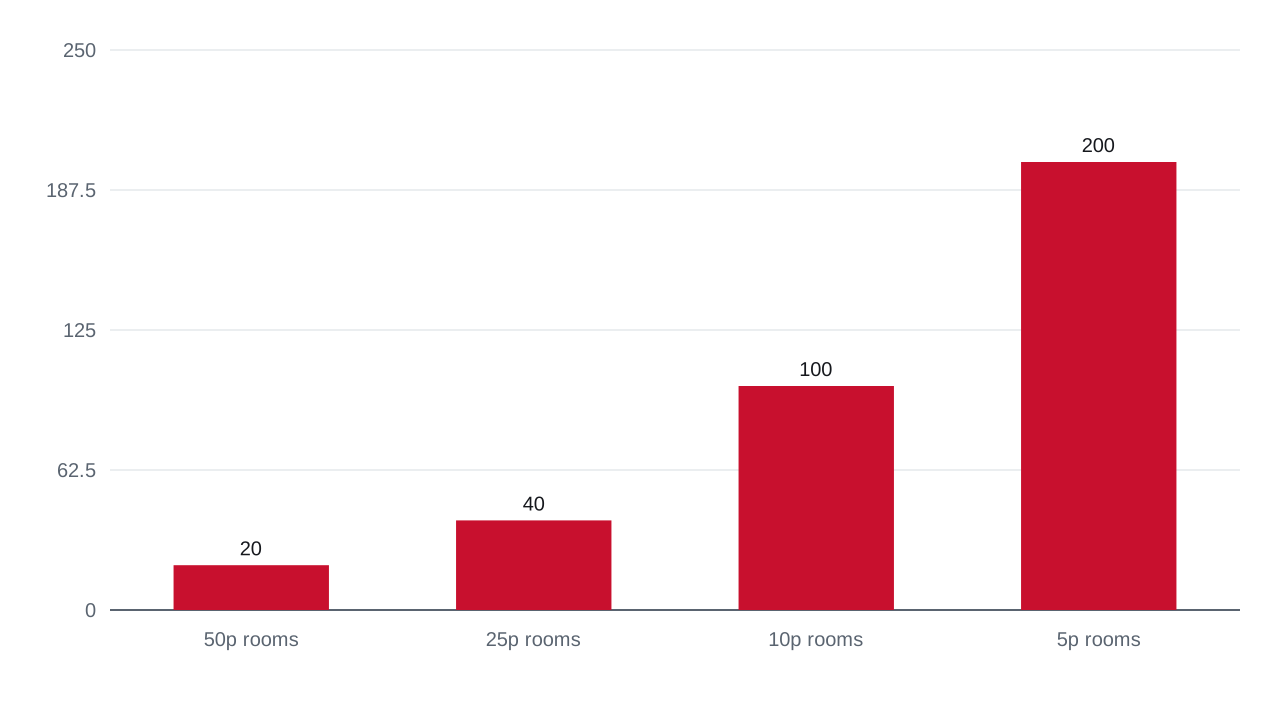
That is why this page models rather than quotes. The chart takes typical ticket prices across four formats and shows what a £10 budget buys in each. The room-format table later on this page pairs typical pots with the variable that decides the value in every case. The calculator takes a bonus at the light end of the market and works the wagering down to tickets. Each figure carries its assumption, and none poses as a measurement of a named room.
Two consequences follow before any numbers are run. First, the ticket price is an entry fee, not a price on the odds: the same 25p ticket is worth more in a quiet room than a crowded one selling the same pot, because each ticket claims a larger slice of the prize money. Second, the pot is the anchor for value, and a £250 pot attached to a 50p game is the number to price against your budget, not the 50p itself. The next section runs that trade with figures on both sides.
Within a single game the arithmetic is simple and unforgiving. Your chance of winning any one prize equals the tickets you hold divided by the tickets in play. If a room has sold 360 tickets and you hold 6, your share is 1 in 60 for every prize the game awards. Ticket price never enters that fraction: a 50p ticket and a 5p ticket in the same room carry identical chances while the game runs, because the price bought a different pot, not a different probability.
Take the opening example and model it properly. Assume 60 players, each holding 6 tickets, with a pot of £120 split evenly across the three standard prizes of a 90-ball game: one line, two lines and a full house at £40 apiece. You hold 6 of 360 tickets, so each prize pays you £40 at odds of 1 in 60. Across three prizes the expected return is £2 against £3 of ticket spend, which is 67 per cent of stakes before chat prizes, side games or loyalty top-ups. Every input is an assumption chosen to resemble a mid-sized room at a mid-peak hour, and the real figure moves with both.
Now hold the pot steady and change the crowd. If 120 players fill the same room at the same £120 pot, your 6 tickets compete against 720 and the expected return halves to £1 against the same £3. If the room empties to 30 players and the pot floor holds, your share doubles. This is the lever most players never pull: the same ticket at the same price in the same room can carry twice the expected return on a Tuesday morning as on a Saturday evening, purely because of who else turned up.
The counterweight is that pots usually scale with sales. A room that takes twice the ticket money often pays twice the pot, in which case the crowd cancels out: your share of tickets and your share of the pot shrink in proportion, and the expected return per pound stays flat. The pot floor is what breaks that cancellation. Where a minimum pot exists, quiet sessions return more per ticket, because the floor funds prizes the ticket sales alone would not cover.
Cheaper tickets deserve a separate note, because the intuition runs backwards. A 5p ticket is not a discount on the odds: within its own game it carries the same chance per ticket as every other ticket there. What the lower price changes is the pot it competes for. Penny rooms fund small pots from high volume, so the expected return per pound tends to sit at the modest end even though the entry cost is trivial. The penny room’s appeal is session length and cost control, not value per pound, and pricing it as anything else is the commonest modelling error a bingo player makes. Dearer rooms run the other way: fewer sales, larger advertised pots, and a value case resting on the pot being rich relative to the crowd.
Bundles bend the fraction in the player’s favour. A strip selling 6 tickets for the price of 5 raises your share of the room without raising your stake, so the same £3 holds a larger slice of the same pot. Every such bundle is upside against a list-price model, and it compounds with a quiet room rather than replacing it.
Prize splitting is the last input the model needs. When two players call a full house on the same ball, the pot divides, and the expected return per ticket falls accordingly. Rooms handle ties differently, so the split rule is worth a glance in the game’s information panel before a budget is committed. The model above assumes no splits, which flatters it slightly.
Assembled, the model gives you a price check that runs on any room: the pot divided by the tickets you expect to be in play, set against your own ticket count. The next section takes the other half of the room’s economy, the bonus, and works its toll in tickets the same way.
Bingo bonuses are smaller and lighter than their casino cousins, and the model on this page takes a deliberately generous example to expose where the levers sit. The prefill runs a £10 deposit, a 200 per cent match, wagering at 3 times, and a £30 cap on how much of the bonus balance can become withdrawable cash. All three figures are model inputs, so the assumptions come first.
Assumption one, the match. Bingo welcome offers at online bingo sites commonly match a first deposit somewhere between 100 and 200 per cent, with the top of the band attached to small deposits and paid as bingo credit rather than cash. The model takes 200 per cent because it makes the cap’s work visible; plenty of real offers would credit £10 of bonus on a £10 deposit instead of £20.
Assumption two, the multiplier. Wagering on bingo bonuses typically runs 2 to 4 times the bonus amount, and the model takes 3 times as the midpoint of that band. The wagering section below explains why the band sits so far below the 20 to 50 times usual on slots offers.
Assumption three, the cap. Light-wagering bonuses usually carry a ceiling on the cash a bonus balance can convert into, and £30 is a small figure typical of the breed. Anything the bonus generates above the ceiling is removed once wagering completes, which makes the cap the binding constraint on upside.
Now the arithmetic. A £10 deposit brings £20 of bonus, so £30 plays in total. The toll is 3 times the £20 bonus, which is £60 of ticket spend: 240 tickets at 25p, or 120 at 50p. At 4 tickets a game that is 30 to 60 games, an evening or two of ordinary play depending on the room’s pace. The deposit cash itself usually stays free of wagering, since the toll attaches to the bonus side only; that split is typical rather than universal, and the offer’s own terms get the final word.
What does the toll cost? Run the room model from the previous section, which put the return near two thirds of stakes. Sixty pounds of tickets carries an expected £40 of prize money back into the bonus balance, wagering clears, and conversion runs into the £30 ceiling, forfeiting £10 of the theoretical return. In this model the bonus is worth £30 at most, the deposit’s own winnings sit outside the cap, and the effective price of the package is the gap between what the room returns and what the ceiling lets through.
The cap reshapes strategy in one specific way. Once the converted balance nears the ceiling, extra ticket play on bonus funds adds nothing, so the sensible move is to finish the wagering on the cheapest tickets the room sells. Where the balance sits well under the ceiling with a short clock, dearer tickets in a quiet room move it faster, because each pound staked carries more expected return. Against a slots bonus the contrast is stark: £20 at 3 times asks £60 of tickets, while the same £20 at the 35 times common on casino offers asks £700 of stake. One clears in an evening; the other takes weeks. The calculator below re-runs the arithmetic with your own deposit, match and multiplier, and the cap scales the ceiling with it.
Bonus credit £20.00.
Wagering before cash out £90.00 at 3 times.
Wagering per pound deposited 9 times.
Assumptions: spins return 90 percent of face value before wagering; session cost uses the stated house edge as expected loss of bankroll per session.
Under the Gambling Act 2005, the offence falls on operators and advertisers, not on an individual who plays on an unlicensed overseas site. What you lose is protection rather than legality: no British register entry, no GAMSTOP coverage, no approved dispute resolution route, and no credit card ban at the cashier. Winnings stay free of tax either way. Checking the public register before depositing is the practical step.
It means staking three times the bonus amount in tickets before the bonus balance and its winnings convert to withdrawable cash. On a £20 bonus that is £60 of ticket play, which is 240 tickets at 25p or 120 at 50p. Bingo tickets usually count in full toward wagering, unlike slots in a casino bonus, which is why the multipliers here are the lightest in the market.
Debit cards on the Visa and Mastercard networks are standard, and PayPal is widespread across licensed British bingo sites, with Apple Pay, Paysafe and bank transfer common alongside. Credit cards cannot be offered by licensed operators, so a cashier taking them signals the site sits outside the British regime. Withdrawals typically reach e-wallets within a day and debit cards within one to three banking days, though each operator publishes its own windows.
Most do. Bonus credit, free tickets and chat prizes usually carry a validity window, commonly between a week and a month from crediting, and anything unspent when the window closes is removed along with winnings still attached to it. Wagering left incomplete at expiry usually forfeits the balance too. The exact figure sits in each offer's terms, so the clock is worth checking before you opt in rather than after.
Players working with a modest budget who want a long session rather than a large single bet. Low ticket prices stretch £10 across forty tickets or more, the light wagering makes a small bonus genuinely clearable, and the chat layer adds entertainment the casino lobby does not. Anyone chasing slots-scale jackpots or table game depth will find the format slow, and a straight casino match would serve them better.
Any site holding a Gambling Commission operating licence, which you can confirm on the public register in seconds. The licence brings the protections an offshore operator does not: GAMSTOP self-exclusion across all licensed sites at once, approved dispute resolution, the credit card ban, affordability checks and tested game fairness. If the choice is between a larger headline bonus and that safety net, the register is where the decision gets made.
Within a single game, no. Your chance of a prize depends on your share of the tickets in play, so a 5p ticket and a 50p ticket in the same room carry the same probability. The cheaper ticket competes for a smaller pot funded by volume, which lowers the expected return per pound, not the odds per ticket. Price and probability are separate variables, and the pool is what connects them.
Usually not, and the terms say so directly. Bingo bonuses typically count tickets at full value while slots and instant games contribute a low share or nothing, so playing side games with bonus funds burns the clock without moving the wagering. Check the contribution table in the offer terms before staking any bonus balance away from the bingo room. Deposit cash is yours to spend wherever the site allows.
Offers of this kind hold no UK Gambling Commission licence. That is not a technicality: it is the difference between a market with a public register, a national self-exclusion scheme, approved dispute resolution, a ban on credit card gambling, affordability checks and independently tested games, and a market with none of those guarantees. A dispute at a licensed operator goes to an approved scheme; an offshore dispute goes to the operator itself. Nothing on this page is an exception to that. If self-exclusion matters to you, GAMSTOP covers licensed operators only, and no tool on this page changes that.
Gambling can harm. For free, confidential support in the UK, call the National Gambling Helpline on 0808 8020 133 or contact BeGambleAware.
Keep reading
UK Gaming Club. Independent modelling of casino offers for British readers. No operator pays for a word on this page; board placement is bought and disclosed on the How We Are Paid page. 2026.