#1
Night Luck
8.2Editorial score
Casino welcome bonus 805% up to €6,400 + 280 FS
- MuchBetter · VISA · Apple Pay
- Crypto welcome 140% up to 1,600 USDT
- VIP pack 800% up to €14,500
Terms change often. Verify on the operator's own page.
Offers modelled before you claim
18+. Betting carries risk. Never stake more than you can afford to lose.
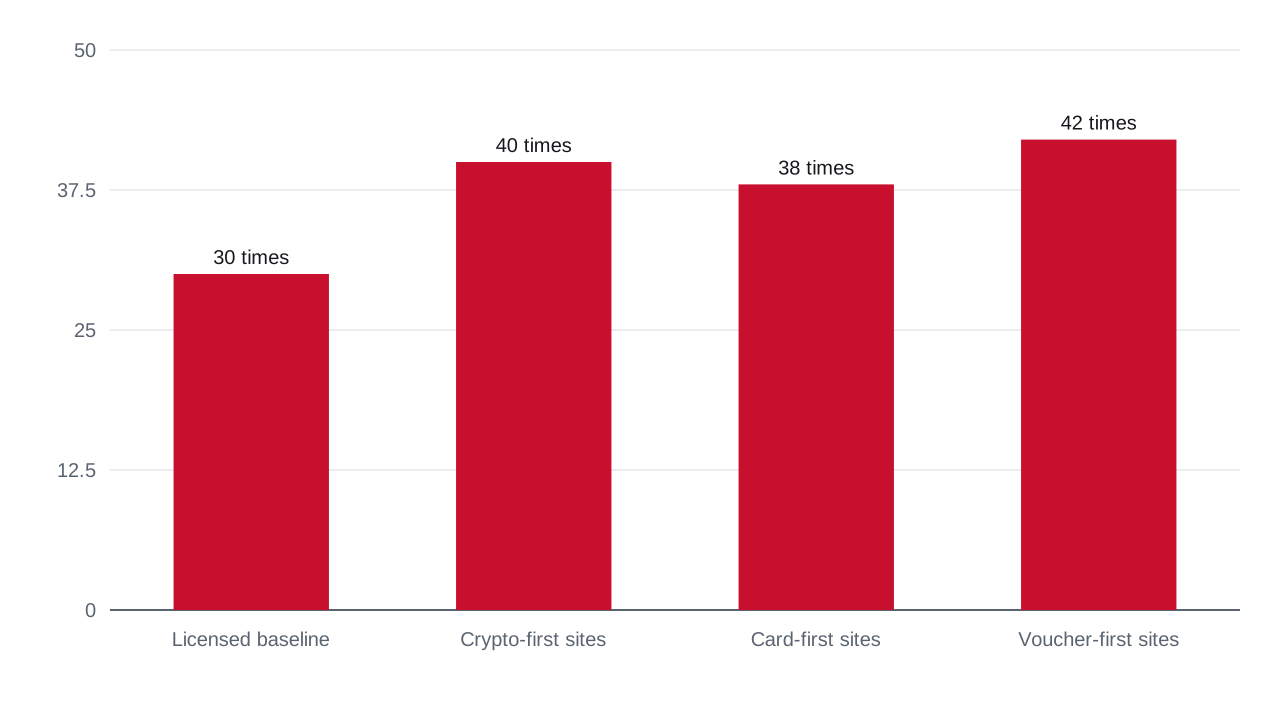
A list of offshore sites is only as honest as its licence column, and the wagering column beside it usually runs 35 to 50 times where the licensed baseline prints 20 to 35.
The board is editorial and its placement is bought, which the disclosure page explains. Terms move without notice, so verify each line on the operator's own page.
Casino welcome bonus 805% up to €6,400 + 280 FS
Terms change often. Verify on the operator's own page.
Welcome bonus €/£5,000 + 500 FS
Terms change often. Verify on the operator's own page.
Welcome pack €5,000 + 500 FS + €650 free bet
Terms change often. Verify on the operator's own page.
Welcome package 300% up to €/£1,000 + 150 FS
Terms change often. Verify on the operator's own page.
On this page
A page gathering non Gamstop casino sites saves you a search and then asks for your trust, and only two columns of it deserve that trust. The licence column says which rules touch your money. The wagering column says what the bonus on the next screen will cost you in staking. Star ratings, themed screenshots and headline percentages are furniture: they move nothing and they settle nothing.
The licence column works like a switch. Where it reads as a UKGC licence, the operator sits inside the British regime, with a public register entry, an approved dispute route and the payment rules that follow from the Act. Where it does not, the operator sits outside, whatever its own footer claims, and the honest wording beside the name is the short one: no UK licence. A list that blurs that line is not saving you time, it is renting your attention.
The wagering column works like a price tag. At this end of the market the working band runs 35 to 50 times the bonus, against a licensed baseline that usually prints 20 to 35 times. The gap is money, not style. On a £20 deposit matched at 150 per cent, moving a multiplier from 30 times to 45 times adds £450 of required staking to the same headline, before a single pound can be withdrawn.
The table below sets out the shelf in exactly those two columns, with the rail each class leads with and the permit each carries. Treat it as a map of assumptions: the bands are typical for each class, stated so you can argue with them, not measurements taken anywhere.
| Site class | Rails first | Typical wagering | Typical permit |
|---|---|---|---|
| Crypto-first | coins | 35 to 45 times | offshore permit |
| Card-first | debit and credit | 35 to 50 times | offshore permit |
| Voucher-first | vouchers | 40 to 50 times | offshore permit |
| Licensed baseline | debit rails | 20 to 35 times | UKGC |
Read the two columns together and most lists sort themselves. A site that checks out in the licence column and prints 40 times in the wagering column is a known quantity with a known price. A site with a vague licence line and a wagering figure it never states is neither, and no amount of design around the name changes that.
A licence claim is a checkable claim, which is what separates it from the rest of a homepage. If a site says it holds a UKGC licence, the Gambling Commission publishes a public register where the company’s status can be looked up. If the register does not back the claim, the claim is a word on a page, and every other promise on that page inherits the problem.
Offshore claims take a second route. Most of the shelf points to Curaçao, which reformed its gambling framework in 2024, moving away from the old master-licence and sub-licence model toward direct licences under restructured supervision. Verification there runs through the operator’s own register pages rather than a British one. That is a weaker check and it should be priced as one: you are trusting the operator’s paperwork to describe the operator.
The label this page prints where status cannot be verified is the plain one: no UK licence. It is deliberately unglamorous. It does not say the site will steal your deposit, and it does not say the games are rigged; it says that the British register has nothing to say about the name, and that the protections described in the section below on what a licence buys stop at that line.
Two habits make the column work. First, check the claim before the deposit, not after a problem; the register is public and the lookup costs nothing. Second, treat silence as an answer. A licence column left blank, or filled with adjectives instead of a jurisdiction, has told you something, and the honest response is to close the tab rather than fill the gap with optimism.
Everything on this page that looks like a figure rests on stated assumptions, so here is the model run once, end to end, on the prefill the calculator ships with: a £20 deposit, a 150 per cent match, a 40 times multiplier and a £500 cap. None of the four numbers quotes any single offer. Each is a working assumption, chosen because it sits inside the typical band for this part of the market and stated so you can change it.
The match comes first. A 150 per cent match on a £20 deposit adds £30 of bonus money, which puts £50 on the table, deposit and bonus together. The multiplier comes second, and the assumption it carries matters more than its size: the model applies 40 times to the bonus alone, so the workload is 40 multiplied by £30, or £1,200 of staking before bonus money and anything it wins turns withdrawable. If a particular offer applies its multiplier to deposit plus bonus, the same inputs produce £2,000, and the terms page is where you find out which base is in use.
The cap comes last, at the exit. Under the model, no more than £500 of what bonus play produces can leave as cash, so a win above the line is clipped to it. A cap does not touch your own deposited stake in this model, but terms vary and some offers word the ceiling differently, which is why the assumption is printed rather than buried.
Run the prefill and the shape of the offer appears: a £20 outlay, £1,200 of staking, £500 of possible upside from the promotion. That shape is the honest version of a headline that reads 150 per cent, and it is the number to budget against. The calculator on this page exists so the same arithmetic runs on your own inputs, whatever the multiplier in front of you turns out to be.
Bonus credit £30.00.
Wagering before cash out £2,000.00 at 40 times.
Wagering per pound deposited 100 times.
Assumptions: spins return 90 percent of face value before wagering; session cost uses the stated house edge as expected loss of bankroll per session.
The offences under the Gambling Act 2005 fall on operators and advertisers, on those providing gambling facilities to British consumers without a licence, not on an individual who plays. Playing is therefore not itself an offence, but what you give up is protection: no entry on a British register, no approved dispute resolution route, and none of the licence conditions that bind a UKGC operator.
Take the prefill on this page: a £20 deposit matched at 150 per cent adds £30 of bonus, and 40 times applied to that bonus is £1,200 of staking before the bonus funds and any winnings become withdrawable. If the offer applies its multiplier to deposit plus bonus, the same inputs produce £2,000. The terms page states which base is in use, and the calculator lets you run either.
It runs by class. Crypto-first cashiers lead with coins and model payouts at minutes to a few hours. Card-first cashiers take debit and, since the British credit card ban binds licensed operators only, may accept credit as well. Voucher-first cashiers sell a one-way rail, so withdrawals leave by a paired rail such as a debit card, typically 1 to 3 banking days under the model bands. The cashier's own terms decide.
Usually both, in this part of the market. A cap limits what bonus play can convert to withdrawable cash; the model here works with £500 as its stated assumption. An expiry sets the clock on bonus funds, and unused funds past it are typically forfeited. Where a term is missing from a promotion, treat it as unknown rather than favourable, and check the bonus terms page before the deposit rather than after.
A reader who has read the licence column, run the wagering arithmetic, and decided that the missing protections are a price worth naming is the honest answer. They suit someone treating a bonus as entertainment budget, sized against a cap and a multiplier, not as income. They do not suit anyone with an active self-exclusion, since the scheme does not cover these operators, and they ask for more term-reading than the licensed market does.
A UKGC licence carries a public register entry you can check, access to an approved dispute resolution provider, the credit card ban in force since April 2020, declared protection levels for customer funds, and games tested through approved test houses. GAMSTOP covers every licensed online operator serving Great Britain. Wagering on the licensed baseline usually sits at 20 to 35 times, against the 35 to 50 times band that dominates the offshore shelf in this model.
No. GAMSTOP covers Gambling Commission licensed operators, and offshore sites as a class do not participate in the scheme, so an exclusion will not block an account at this end of the market. An active exclusion cannot be cancelled before its term ends, and nothing on this site explains how to get around one, because the protection was the point. The National Gambling Helpline on 0808 8020 133 is free and open around the clock.
Split the claim by jurisdiction. A UKGC claim goes to the Gambling Commission's public register, which is free to search and settles the question in minutes. An offshore claim, most often a Curaçao permit since that framework was reformed in 2024, verifies through the operator's own register pages, a weaker check you should price accordingly. Where a claim cannot be checked at all, read the licence column as saying no UK licence.
Offers of this kind hold no UK Gambling Commission licence. That is not a technicality: it is the difference between a market with a public register, a national self-exclusion scheme, approved dispute resolution, a ban on credit card gambling, affordability checks and independently tested games, and a market with none of those guarantees. A dispute at a licensed operator goes to an approved scheme; an offshore dispute goes to the operator itself. Nothing on this page is an exception to that. If self-exclusion matters to you, GAMSTOP covers licensed operators only, and no tool on this page changes that.
Gambling can harm. For free, confidential support in the UK, call the National Gambling Helpline on 0808 8020 133 or contact BeGambleAware.
Keep reading
UK Gaming Club. Independent modelling of casino offers for British readers. No operator pays for a word on this page; board placement is bought and disclosed on the How We Are Paid page. 2026.