#1
Night Luck
8.2Editorial score
Casino welcome bonus 805% up to €6,400 + 280 FS
- MuchBetter · VISA · Apple Pay
- Crypto welcome 140% up to 1,600 USDT
- VIP pack 800% up to €14,500
Terms change often. Verify on the operator's own page.
Offers modelled before you claim
18+. Betting carries risk. Never stake more than you can afford to lose.
A non UK casino can match a licensed headline and still leave the reader without a register entry, a dispute route or a place in the self-exclusion scheme, and that gap has a price the headline never shows.
The board below is editorial and sold, which the disclosure page explains. Terms move without notice, so verify each line on the operator's own page.
Casino welcome bonus 805% up to €6,400 + 280 FS
Terms change often. Verify on the operator's own page.
Welcome bonus €/£5,000 + 500 FS
Terms change often. Verify on the operator's own page.
Welcome pack €5,000 + 500 FS + €650 free bet
Terms change often. Verify on the operator's own page.
Welcome package 300% up to €/£1,000 + 150 FS
Terms change often. Verify on the operator's own page.
On this page
The phrase non UK casinos hides a fork, and the fork decides what a reader keeps. On one side sit companies registered overseas, often in Malta or Gibraltar, that hold a Gambling Commission licence and appear on the British public register. Their head offices are foreign and their British operations are not. On the other side sit operators holding no Gambling Commission licence at all, serving Britain under an offshore regulator, and it is this second group that this page prices.
The distinction is not cosmetic. The Gambling Act 2005 is the primary statute regulating gambling in Great Britain, and providing remote gambling facilities to British consumers requires an operating licence from the Gambling Commission. An operator serving British consumers without that licence sits outside the British regime: no entry on any British register, and advertising that does not answer to the same rules a licensed operator’s advertising does.
Curaçao is the jurisdiction most often behind these sites. Its framework was reformed in 2024, moving from a master-licence and sub-licence model toward direct licences under restructured supervision. Whatever the paperwork now says, the practical point holds: operators licensed there are not Gambling Commission licensees and appear on no British register. Status for any single operator is re-verified at each build, and anything uncertain is labelled plainly rather than guessed at.
The law also draws its line in the reader’s favour. The offence provisions fall on operators and advertisers, on those providing gambling facilities or advertising them without a licence. An individual who plays on an unlicensed overseas site commits no offence; what that player loses is protection, not legality. The minimum age for casino gambling in Great Britain is 18 at either end of the market. The rest of this page costs that protection out in pounds, because the gap is real and the headline never shows it.
A headline match is the thing being sold. The register entry, the dispute route, the exclusion scheme and the payment rules are the things a reader gives up at the offshore end of the market, and each one has a shadow price. The table below sets the two markets side by side and attaches a meaning to every line for a £25 deposit, the figure the calculator on this page works with.
| Feature | Licensed market | Offshore market | What it means for a £25 deposit |
|---|---|---|---|
| Register entry | Public, checkable | None | Trust or nothing |
| Wagering | 20 to 35 times | 35 to 50 times | £1,750 versus £2,000 to £2,250 |
| Dispute route | Approved ADR | Operator only | Leverage ends at support |
| Self-exclusion | GAMSTOP | None | No cross-site protection |
| Credit card | Banned | Issuer decides | Rails narrow |
Read the wagering line with its assumption in view. The cell assumes a 100 per cent match on the £25, so £50 of bonus money is in play where terms wager deposit and bonus together. At the top of the licensed band, 35 times, that base turns over £1,750. At 40 to 45 times, the middle of the offshore band, the same £50 turns over £2,000 to £2,250. Stretch either assumption and both figures move with it; the point is the direction of the gap, not the decimal.
Every other line costs the same way. Something a licensed operator must provide by rule is absent by design at the other end, and the absent thing carries a cash value the reader usually discovers only when it is needed. A dispute route is worth little the day you deposit and a great deal the day a payout stalls. Pricing it before the deposit, while the reading is free, is the whole discipline of this page.
The calculator below this section runs a single model, and every input in it is a stated assumption rather than a measurement. Deposit £25. Match 100 per cent, which makes the bonus £25. Multiplier 40 times, a working figure inside the 35 to 50 times band this part of the market typically publishes. The model applies the multiplier to the bonus alone. Some terms wager the bonus only, others wager deposit and bonus together, and the choice doubles or halves the turnover, so establish which base your terms use before trusting any arithmetic, including the model on this page.
On the bonus-only base, 40 times turns a £25 bonus into £1,000 of play-through before a withdrawal can be considered. The £500 cap in the model is the largest bonus the scheme will credit, and at a £25 deposit it never comes close to binding: the multiplier does all the work. The cap begins to matter only where a deposit would push the bonus past £500, which a 100 per cent match reaches at £500 staked, twenty times the model deposit.
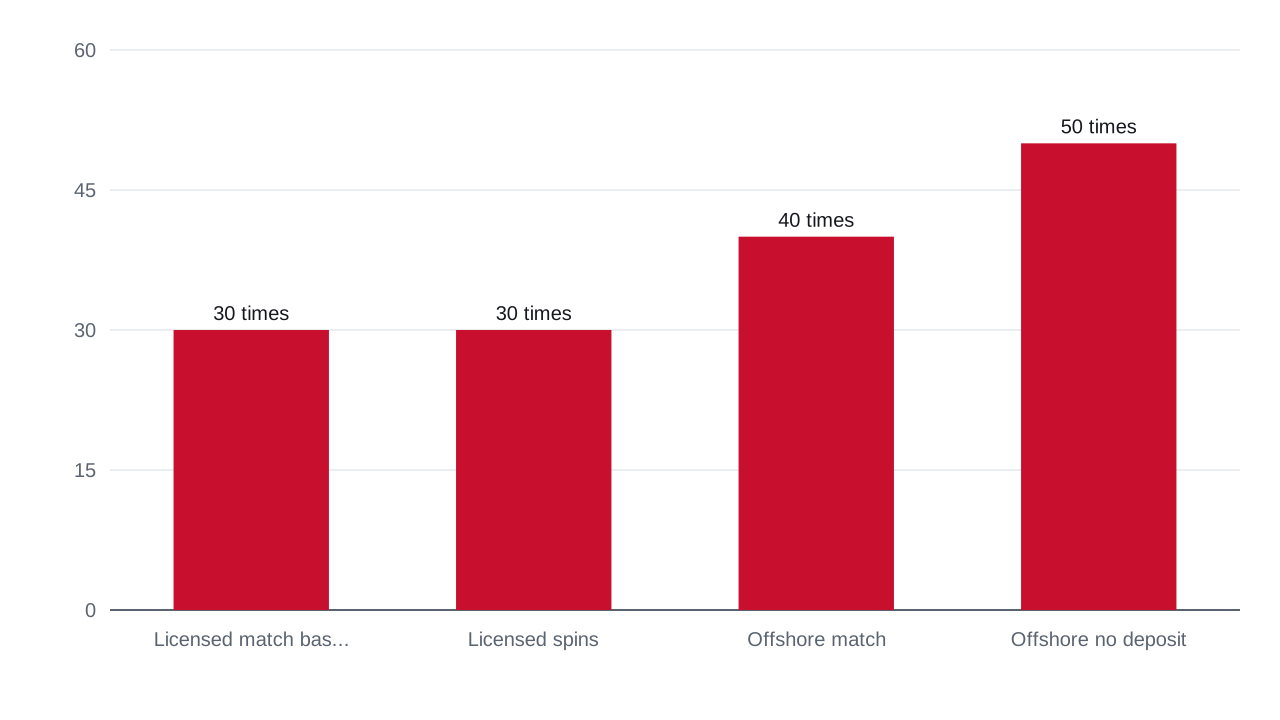
Set the licensed baseline beside it. The chart on this page uses 30 times as the working figure for a licensed match, so the same £25 bonus turns over £750 there. The gap between the two models is £250 of extra play-through behind an identical headline. Where terms wager deposit and bonus together, the same comparison runs £2,000 against £1,500, a £500 gap. Neither figure predicts an outcome; both write the price of the multiplier down where it can be read.
Bonus credit £25.00.
Wagering before cash out £2,000.00 at 40 times.
Wagering per pound deposited 80 times.
Assumptions: spins return 90 percent of face value before wagering; session cost uses the stated house edge as expected loss of bankroll per session.
Yes for the player, with a structural caveat. The offence provisions of the Gambling Act 2005 fall on operators and advertisers, on those providing gambling facilities or advertising them without a licence. An individual who plays on an unlicensed overseas site commits no offence. What that player loses is protection rather than legality: no British register entry, no approved dispute route and no place in GAMSTOP.
The working band at this end of the market runs from 35 to 50 times, and the model on this page uses 40 times as its stated assumption. Licensed offers usually publish 20 to 35 times. Check which base the terms multiply: the bonus alone, or deposit and bonus together, which doubles the turnover behind an identical headline.
Rails vary by cashier. Debit cards, e-wallets and crypto appear most often, with bank transfer at some operators. The British credit card ban does not bind a site without a Gambling Commission licence, so whether a card works is the issuer's decision, and some issuers decline gambling merchants on their own policy. Payout speed follows the rail: the model assumes e-wallets settle within 0 to 24 hours and debit cards within 1 to 3 banking days.
Both live in each operator's terms, and both move without notice. The model on this page assumes cashout caps between £50 and £500 on no-deposit style offers, spin values between 5p and 20p, and a £500 ceiling on the match bonus itself. Expiry windows differ widely between operators, so the only dependable figure is the one in the terms on the day you read them. Read the expiry line before depositing, not after.
No. GAMSTOP covers online gambling operators licensed by the Gambling Commission and serving Great Britain, with exclusion terms running for a minimum of six months and one-year and five-year options available. A site with no British licence sits outside the scheme, so an active exclusion does not follow the reader there. That gap is a structural fact worth pricing before any deposit, and the National Gambling Helpline on 0808 8020 133 offers free, confidential support around the clock.
The offer type suits a reader who has already priced the gap: someone willing to resolve any dispute directly with the operator, to verify terms line by line on the day, and to accept that self-exclusion, dispute resolution and the credit card ban do not reach the site. It suits nobody who wants those protections standing behind the deposit. Price the structure first and the headline second, in that order.
A licensed operator appears on the Gambling Commission's public register, must offer access to an approved alternative dispute resolution provider, participates in GAMSTOP, and operates under the credit card ban and game fairness testing through approved test houses. Welcome terms there typically carry lower wagering, from 20 to 35 times on the working model. The headline is often smaller at the licensed end; the standing protections travel with whatever you claim.
No. Gambling winnings are not treated as taxable income for individual UK gamblers, and that holds regardless of where the operator is licensed, so the licence gap does not change your tax position. Tax is therefore not the difference between the two ends of the market. The difference is protection: a register entry, a dispute route, self-exclusion coverage and the payment rules at the cashier. Price those, not the taxman.
Offers of this kind hold no UK Gambling Commission licence. That is not a technicality: it is the difference between a market with a public register, a national self-exclusion scheme, approved dispute resolution, a ban on credit card gambling, affordability checks and independently tested games, and a market with none of those guarantees. A dispute at a licensed operator goes to an approved scheme; an offshore dispute goes to the operator itself. Nothing on this page is an exception to that. If self-exclusion matters to you, GAMSTOP covers licensed operators only, and no tool on this page changes that.
Gambling can harm. For free, confidential support in the UK, call the National Gambling Helpline on 0808 8020 133 or contact BeGambleAware.
Keep reading
UK Gaming Club. Independent modelling of casino offers for British readers. No operator pays for a word on this page; board placement is bought and disclosed on the How We Are Paid page. 2026.