#1
Night Luck
8.2Editorial score
Casino welcome bonus 805% up to €6,400 + 280 FS
- MuchBetter · VISA · Apple Pay
- Crypto welcome 140% up to 1,600 USDT
- VIP pack 800% up to €14,500
Terms change often. Verify on the operator's own page.
Offers modelled before you claim
18+. Betting carries risk. Never stake more than you can afford to lose.
Since April 2020 no licensed British operator may accept a credit card for gambling, so a cashier that still lists one is announcing where its licence is not.
The board is editorial and its placement is bought, which the disclosure page explains. Terms move without notice, so verify each line on the operator's own page.
Casino welcome bonus 805% up to €6,400 + 280 FS
Terms change often. Verify on the operator's own page.
Welcome bonus €/£5,000 + 500 FS
Terms change often. Verify on the operator's own page.
Welcome pack €5,000 + 500 FS + €650 free bet
Terms change often. Verify on the operator's own page.
Welcome package 300% up to €/£1,000 + 150 FS
Terms change often. Verify on the operator's own page.
On this page
Type the phrase credit card casino into a search box and the results describe a product licensed Britain stopped selling. The change has a date and a source: on 14 April 2020, following a government announcement, the Gambling Commission’s prohibition on credit card gambling came into force, and it covers online and offline play alike. From that day, an operator holding a British licence has been unable to accept a credit card for any stake, whether the stake is placed on a phone or across a counter in a betting shop.
The rule binds the operator, not the cardholder. It sits in licence conditions, which means it is enforced against the business: breach it and the licence itself is the thing at risk. It is also not a courtesy an operator can switch off at busy times, because it attaches to the licence rather than to policy, and a credit card stake at a licensed cashier is precisely the kind of breach a regulator exists to catch. A reader does not have to take any operator’s word for where it stands either, because licence status is a matter of public record, a point this page returns to more than once.
What the ban did not do is quietly rebrand the market. Debit cards, wallets and vouchers all remained, and licensed cashiers kept working, funded by money the player already holds. What disappeared is a single rail: the one that turned a losing evening into a balance that invoices again next month. When a site still advertises card-funded credit play to a British reader today, the funding list is not describing convenience. It is describing the licensing position, and it is doing so accurately.
The case was argued with evidence at the time, and the shape of that argument can be stated at market level without borrowing a single figure from it. A stake funded from a credit line is money the player has not earned yet, so a loss is never finished when the session ends: it continues as a debt with a running interest charge attached. Borrowed play also removes the natural pause between wanting to stake and being able to afford it, which is precisely the pause that lets a person stop. And the costs stack in one direction: interest arrives whether the session won or lost, it compounds while the balance is carried, and it has no return attached to offset it. The ban answers that shape by removing the option at the point of sale instead of asking restraint to hold in the moment. It treats borrowing and gambling as a combination with a known failure mode, and it takes the combination off the licensed market entirely.
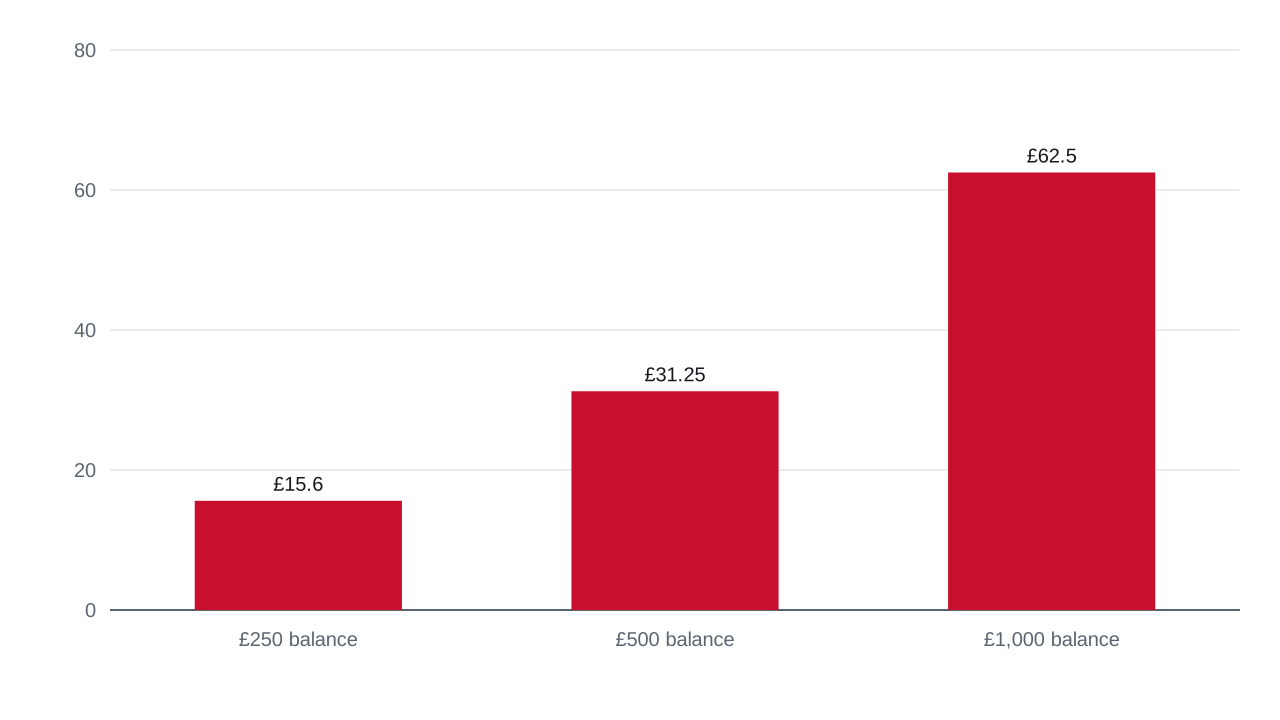
Interest is the quiet half of the cost, and it is worth pricing before any other number on this page matters. The chart below models it. It takes three carried balances, £250, £500 and £1,000, holds each for three months, and applies simple monthly interest at an assumed 25 percent APR. On those inputs the balances accrue £15.60, £31.25 and £62.50 respectively, and the amounts grow in a straight line with the size of the balance.
The rate is an assumption, held flat for the model rather than quoted from any card agreement, and the reader can rerun the arithmetic with a different figure; the shape of the result is the point. The three-month window is also an assumption, and a generous one. It leaves out fees, it leaves out compounding beyond simple monthly interest, and it leaves out the minimum-payment pattern that stretches a carried balance well past a quarter of a year, so the chart describes the cheapest plausible version of the cost.
Set the interest against a wager and the difference is structural. A losing stake resolves at once: the money is gone, the outcome is known, the account moves on. A carried balance invoices again every month, and nothing about a winning session cancels the invoice. Nothing in the model assumes the reader loses, either, because interest is charged on the balance rather than on the result, which is why it sits outside the usual conversation about odds. This is the cost the 2020 ban removed from the licensed market, not by improving anyone’s arithmetic but by taking the credit line out of the cashier altogether.
Expected loss per session £2.00.
Expected loss across 10 sessions: £20.00.
Assumptions: spins return 90 percent of face value before wagering; session cost uses the stated house edge as expected loss of bankroll per session.
For a licensed operator the category cannot exist, because the Gambling Commission has prohibited licensed sites from accepting credit cards for gambling since 14 April 2020, online and offline. A site trading on the phrase is therefore either unlicensed or misdescribing itself. Playing on an unlicensed overseas site is not an offence for the individual; the offence provisions fall on operators and advertisers. What a player gives up on such a site is protection, not legality.
The British ban binds licensed operators, and offshore sites sit outside it, so a cashier there can display card options a licensed site may not show. Whether any transaction completes depends on the issuer's policy, and issuers set those policies themselves. This page offers no route for card funding at an unlicensed cashier. The refusals are part of how the protection works, and none of the licence protections travel with an offshore account.
Debit cards, e-wallets and prepaid vouchers are the ordinary routes at licensed British cashiers, and all of them spend money you already hold. E-wallet withdrawals commonly sit in a 0 to 24 hours band and debit card withdrawals in 1 to 3 banking days, though these are assumption bands for modelling rather than measurements. A voucher makes the ceiling structural, because it holds only the amount loaded onto it.
Wagering is calculated on the bonus or on winnings, not on the rail that funded the deposit, so a debit-funded offer carries the same multiplier as any other. Typical multipliers sit between 20 and 50 times, and the figure depends on whether the terms apply it to the bonus or to winnings only. Read the bonus terms for the exact number before accepting an offer, and treat the models on this page as assumptions.
Yes, and they live in the terms rather than at the cashier. No-deposit offers commonly carry cashout caps between 50 and 500 pounds, registration spins usually expire within days of being credited, and match offers sometimes cap what a bonus can convert to. Because terms move without notice, the cap and the expiry need checking on the operator's own page at the moment you take an offer, not at the moment you first read about it.
Readers who want the credit card ban working in their favour: money staked from a current account rather than a credit line. It suits people who value a public register they can check, GAMSTOP coverage if self-exclusion is ever needed, and an approved dispute route if a withdrawal stalls. It also suits anyone treating gambling as paid entertainment with a fixed ceiling. A reader who finds the ceiling hard to respect would be better served by the helpline details.
A Gambling Commission licensed operator, confirmed on the public register and funded by debit card, e-wallet or voucher. The licence brings the credit card ban, GAMSTOP self-exclusion, approved alternative dispute resolution and tested game fairness, none of which follows the player offshore. Winnings are not taxable income for individual British gamblers wherever the operator is licensed, so the licence changes the protection rather than the tax position. The register lookup is free and takes minutes.
On the model in the chart, simple monthly interest at an assumed 25 percent APR adds £15.60 over three months to a £250 balance, £31.25 to £500 and £62.50 to £1,000. That cost arrives whether the sessions win or lose, and it grows the longer the balance is carried. The session calculator prices the expected cost of the play itself, so the interest is a second bill alongside it, and no winning spin settles it.
Offers of this kind hold no UK Gambling Commission licence. That is not a technicality: it is the difference between a market with a public register, a national self-exclusion scheme, approved dispute resolution, a ban on credit card gambling, affordability checks and independently tested games, and a market with none of those guarantees. A dispute at a licensed operator goes to an approved scheme; an offshore dispute goes to the operator itself. Nothing on this page is an exception to that. If self-exclusion matters to you, GAMSTOP covers licensed operators only, and no tool on this page changes that.
Gambling can harm. For free, confidential support in the UK, call the National Gambling Helpline on 0808 8020 133 or contact BeGambleAware.
Keep reading
UK Gaming Club. Independent modelling of casino offers for British readers. No operator pays for a word on this page; board placement is bought and disclosed on the How We Are Paid page. 2026.