#1
Night Luck
8.2Editorial score
Casino welcome bonus 805% up to €6,400 + 280 FS
- MuchBetter · VISA · Apple Pay
- Crypto welcome 140% up to 1,600 USDT
- VIP pack 800% up to €14,500
Terms change often. Verify on the operator's own page.
Offers modelled before you claim
18+. Betting carries risk. Never stake more than you can afford to lose.
Twenty spins on big bass bonanza carry £2.00 of face value, and on a collect format that holds most of its return in a rare feature the twenty spin sample is a lottery ticket with published odds, not an income line.
The board is editorial and its placement is bought, which the disclosure page explains. Terms move without notice, so verify each line on the operator's own page.
Casino welcome bonus 805% up to €6,400 + 280 FS
Terms change often. Verify on the operator's own page.
Welcome bonus €/£5,000 + 500 FS
Terms change often. Verify on the operator's own page.
Welcome pack €5,000 + 500 FS + €650 free bet
Terms change often. Verify on the operator's own page.
Welcome package 300% up to €/£1,000 + 150 FS
Terms change often. Verify on the operator's own page.
On this page
Offers of this sort do two things at once. They name a single game, and they grant a small batch of spins that run on that game and nowhere else. The lock is the defining feature of the type: there is no picking through a lobby, no moving the spins to a different reel set and no swapping the game if the mood takes you. Registration grants of this kind are common enough that the shape is worth learning once, because everything the offer can be worth flows from the one title the operator has attached to it.
The attached title belongs to the collect class of slots, and the shape of the class is easy to describe. Money symbols land on the reels carrying printed values. A feature round opens when enough scatter symbols arrive, and inside that round a character symbol steps onto the screen, gathers every money symbol in view and adds their values to a running pot. A second collector inside the same round repeats the gather, and the round can extend itself when further scatters land. Between features, the base game returns comparatively little, which is exactly why the feature has to be rare.
That pairing, one fixed game and a collector mechanic, is also why the small print reads differently here than on a matched deposit bonus. A format that pays in lumps turns a twenty spin batch into an all or nothing window: either the feature opens inside it or it does not. The spin value, the wagering and the cap all sit on top of that single fact, so read the mechanic first and the numbers second.
The word fixed does more work than it looks like it should. Because the spins cannot be moved, a comparison between two offers of this class is really a comparison between two formats: a collect game with its lumpy distribution on one side, a steadier paytable game on the other, and the same twenty spins behaving entirely differently on each. The offer’s value is not in the count of spins. It is in the game they are chained to and in what that game does with rare outcomes.
Twenty spins is a thin slice of any slot, and on a collect format it samples the quiet end of the distribution. What the window shows honestly: the reel layout, the values printed on the money symbols, the pace of the base game and whether the scatter symbols arrive at all. What it cannot show: how often the feature triggers across hundreds of spins, how the collector behaves when a round extends, or the long run return the game was set to before it left the test house. None of that is a criticism; it is what a small sample is.
The variance profile explains the gap between those two lists. Collect formats park most of their return inside a single round, which forces the round to be rare: a game that opened its feature every few spins would pay out far more than it took in. Set against that design, a twenty spin window sits almost entirely in the base game. The likeliest single outcome is a window that closes with the feature unseen, catching it once is the notable exception, and catching it twice inside twenty spins is a tail event.
A longer window changes the picture gradually rather than suddenly. A few hundred spins start to show the feature’s rhythm; a few thousand begin to approach the published return. Twenty spins shows none of that, which is why every claim on this page stays at the level of the class rather than the level of a measured session.
The model on this page handles the uncertainty by working in averages and labelling them as averages. A 90 per cent return assumption spread across twenty 10p spins gives £1.80 of expected winnings, but that figure is assembled from a mass of empty outcomes and a handful of large ones. Averaging is a fair way to compare one offer with another and a poor way to predict any single window, which is the honest limit of every figure that follows.
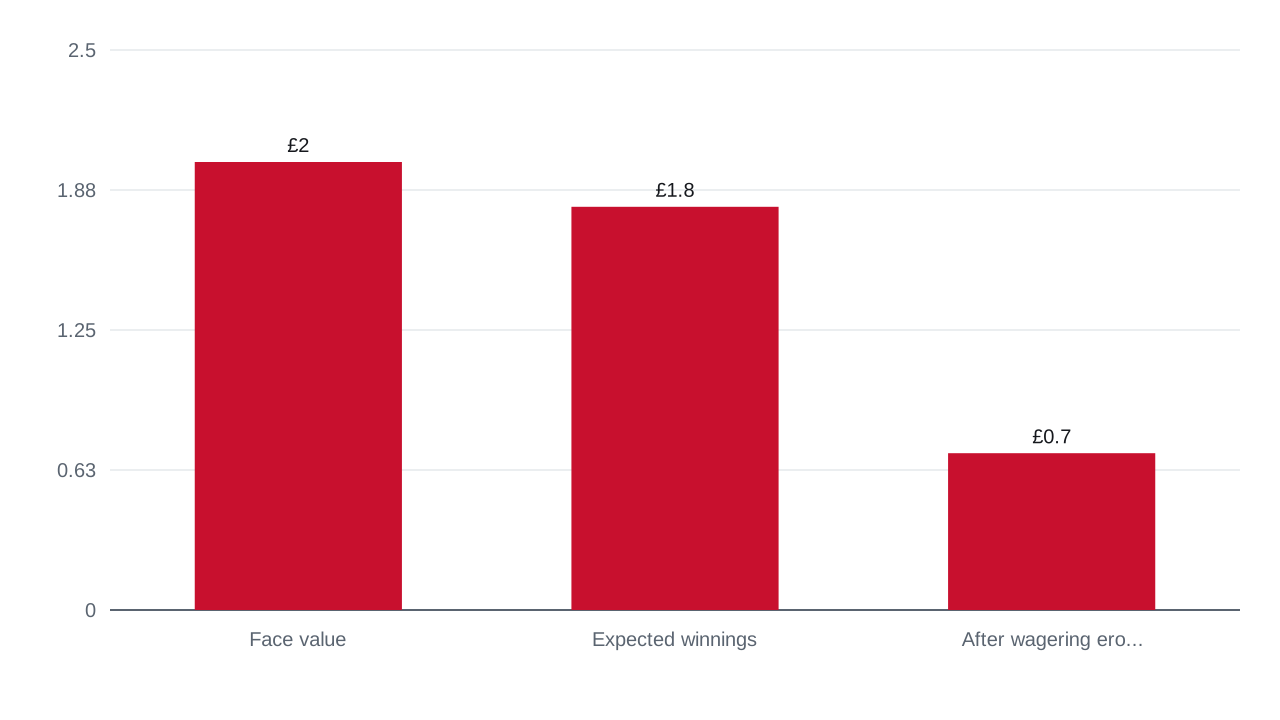
Four figures describe the whole set, and each depends on the one before it. The face value comes first: twenty spins at a stated 10p carry £2.00 of stake money, which is everything the batch can be said to hold before the game has spoken. Expected winnings come second: apply a 90 per cent return assumption and the batch holds £1.80 in expectation. The wagering round comes third: the model plays through £63.00, 35 times the winnings, and reports £0.70 as the expected remainder. The printed £40 ceiling sits above all three, relevant only to outcomes the model does not expect to see.
The chart below draws the three money bars in order, face value through expected winnings to the remainder after wagering, with the ceiling marked for scale. The drop from the first bar to the second is the house margin doing its work. The drop from the second to the third is the wagering round doing its work. Neither toll is optional, and neither is visible in the headline count of spins. Read left to right, the chart is the offer’s value passing two gates, and the second gate takes the larger toll.
The table sets out the same four stages with the arithmetic behind each figure and the levers that can move it.
| Stage | Figure | How it was reached | What can change it |
|---|---|---|---|
| Face value | £2.00 | 20 times 10p | Stated spin value |
| Expected winnings | £1.80 | 90 percent assumption | Feature rarity in the sample |
| Wagering | £63.00 | 35 times the winnings | Multiplier band |
| Cashout | min of balance and cap | printed ceiling | The cap line |
Spins face value £2.00.
Estimated winnings before wagering £1.80 at a 90 percent return.
Wagering £0.63.
Cashable £1.80.
Assumptions: spins return 90 percent of face value before wagering; session cost uses the stated house edge as expected loss of bankroll per session.
The Gambling Act 2005 places the offence on operators and advertisers, not on the player: an individual who plays on an unlicensed overseas site commits no offence under it. What you give up is protection, because no British register entry, no approved dispute route and no GAMSTOP coverage travel with such a site. Checking a company's licence status on the public register takes seconds.
The multiplier grips what the spins win, not a deposit. On this page's model, twenty spins at 10p are £2.00 of face value and £1.80 of expected winnings, so 35 times sets £63.00 of required play before any withdrawal. Which games count towards the round and how fast they contribute are printed in the offer's own terms, and they move the total more than most readers expect.
Some cashiers will pay a no deposit balance straight out once verification is done; others require a small deposit to open the rail, and many set a minimum withdrawal, commonly near £10. A modelled remainder of 70p sits under that sort of floor, which is one reason tiny sets so often end as play money. Read the cashier's own lines first.
Terms at this end of the market commonly give spins a short life, often around seven days from credit, and unused spins simply disappear when the window closes. Winnings already credited usually stay on the bonus balance with their wagering and cap intact, but nothing new is won. Set a reminder for the printed date rather than relying on an email nudge.
It suits a reader who wants a free look at a collect format: the reel layout, the money symbols and the pace of the base game, with a lottery ticket attached. It does not suit anyone treating the set as income, because the expected remainder after wagering sits under a pound. If the mechanics interest you, the sample is cheap at the price.
Licensed British sites run their own registration spin sets, usually smaller in headline size but attached to a Gambling Commission licence, a public register entry, GAMSTOP self-exclusion and an approved dispute service. The comparison table on this page puts the two classes side by side: the British rows trade a bigger headline for protections that hold when something goes wrong.
The phrase names one fixed collect-format game, and offers of this kind lock the spins to a single title chosen by the operator. That lock matters: the game's variance profile and its feature rarity set everything the model on this page describes. If a promotion attaches its spins to a different game, run the same arithmetic again, because the numbers will not carry over.
Only in the tail. Twenty spins at 10p would need the collect feature to open early, gather repeatedly and push the balance to 40 times the set's face value before the window closed. The model on this page never reaches the ceiling, so the cap costs the average player nothing; it only trims outcomes that were already unusual. Check the printed line all the same.
Offers of this kind hold no UK Gambling Commission licence. That is not a technicality: it is the difference between a market with a public register, a national self-exclusion scheme, approved dispute resolution, a ban on credit card gambling, affordability checks and independently tested games, and a market with none of those guarantees. A dispute at a licensed operator goes to an approved scheme; an offshore dispute goes to the operator itself. Nothing on this page is an exception to that. If self-exclusion matters to you, GAMSTOP covers licensed operators only, and no tool on this page changes that.
Gambling can harm. For free, confidential support in the UK, call the National Gambling Helpline on 0808 8020 133 or contact BeGambleAware.
Keep reading
UK Gaming Club. Independent modelling of casino offers for British readers. No operator pays for a word on this page; board placement is bought and disclosed on the How We Are Paid page. 2026.