#1
Night Luck
8.2Editorial score
Casino welcome bonus 805% up to €6,400 + 280 FS
- MuchBetter · VISA · Apple Pay
- Crypto welcome 140% up to 1,600 USDT
- VIP pack 800% up to €14,500
Terms change often. Verify on the operator's own page.
Offers modelled before you claim
18+. Betting carries risk. Never stake more than you can afford to lose.
The no deposit shelf splits into three products, credit, spins and bingo bundles, and their true cost at 40 times runs from £200 to £2,500 of stakes for a two figure ceiling.
The board is editorial and its placement is bought, which the disclosure page explains. Terms move without notice, so verify each line on the operator's own page.
Casino welcome bonus 805% up to €6,400 + 280 FS
Terms change often. Verify on the operator's own page.
Welcome bonus €/£5,000 + 500 FS
Terms change often. Verify on the operator's own page.
Welcome pack €5,000 + 500 FS + €650 free bet
Terms change often. Verify on the operator's own page.
Welcome package 300% up to €/£1,000 + 150 FS
Terms change often. Verify on the operator's own page.
On this page
No deposit casino offers look simple from the outside: a grant lands in the account, no card is asked for, and the reader plays. The simplicity is real on the deposit side and absent everywhere else. What a reader actually signs up for is a small bounded product with three moving parts: what arrives, what the terms demand in stakes, and where the ceiling sits.
The shelf holds three products, and they behave differently enough to be worth separating. Credit is bonus money credited to a balance on registration, usually £5 to £30, with a wagering multiplier applied to that credit. Spins are a batch of free rounds on slots, commonly 50 to 200 of them, with the wagering attached not to the spins but to whatever the spins win. Bingo bundles hand out room tickets plus a little bonus credit, and their multipliers sit far below anything the first two ask for.
The table below sets out the usual shape of each product. The figures are category-typical, compiled from the terms operators publish, and they are the model this page works from: wherever a number is needed in the arithmetic, it comes from a column here, with the assumption named in the sentence that uses it.
| Product | Usual grant | Usual terms | Usual ceiling |
|---|---|---|---|
| Credit | £5 to £30 | 40 to 60 times | £50 to £100 |
| Spins | 50 to 200 | 30 to 40 times on winnings | £50 to £150 |
| Bingo bundle | tickets plus credit | 2 to 4 times | £20 to £50 |
| Demo play | unlimited | none | nothing |
Demo play sits on the same shelf and behaves differently from all three: unlimited rounds, no wagering, and a ceiling of nothing. It earns its line in the catalogue because it is the only product here that can never cost anything, and equally the only one that can never pay. Everything above it in the table trades effort for a bounded prize; demo play trades nothing and returns the same.
The ceiling is the least glamorous figure in the terms and the only one that bounds the outcome. A grant tells you what arrives. A multiplier tells you what the terms demand. The ceiling tells you the most the product can ever pay, and every other number reads best against it.
That is because the ceiling converts the offer into a bounded product. A spins batch with a £150 ceiling is not a route to a windfall; it is a ticket with a printed maximum. Framed that way, the other columns change meaning. A stake requirement of £400 set against a £100 ceiling is a different proposition from the same £400 of stakes set against a £500 ceiling, and the difference stays invisible if the wagering figure is read alone.
The ratio matters more than either number on its own. Divide the stake target by the ceiling and the result is the effort the terms ask per pound of possible withdrawal. A credit grant of £10 at 40 times asks £400 of stakes against a £100 ceiling: four pounds of staking for each pound the product can pay. The bingo bundle inverts the picture, since £30 of stakes against a £50 ceiling is the only ratio on the shelf that lands below one.
Note what the ceiling is not. It is not a promise of a payout, and reaching it is never the likely result; the terms give it as a limit, not an expectation. Its job on this page is arithmetic. It closes the top end of the model so the cost side can be compared against something fixed.
With the shelf mapped and the ceiling given its place, the cost by product can be set out. The measure used here is the stake target: the total the terms ask you to stake before a withdrawal becomes possible. It is not money handed over, because no deposit is made. It is money pushed through the games, one round at a time, at the mercy of whatever return those games are set to pay.
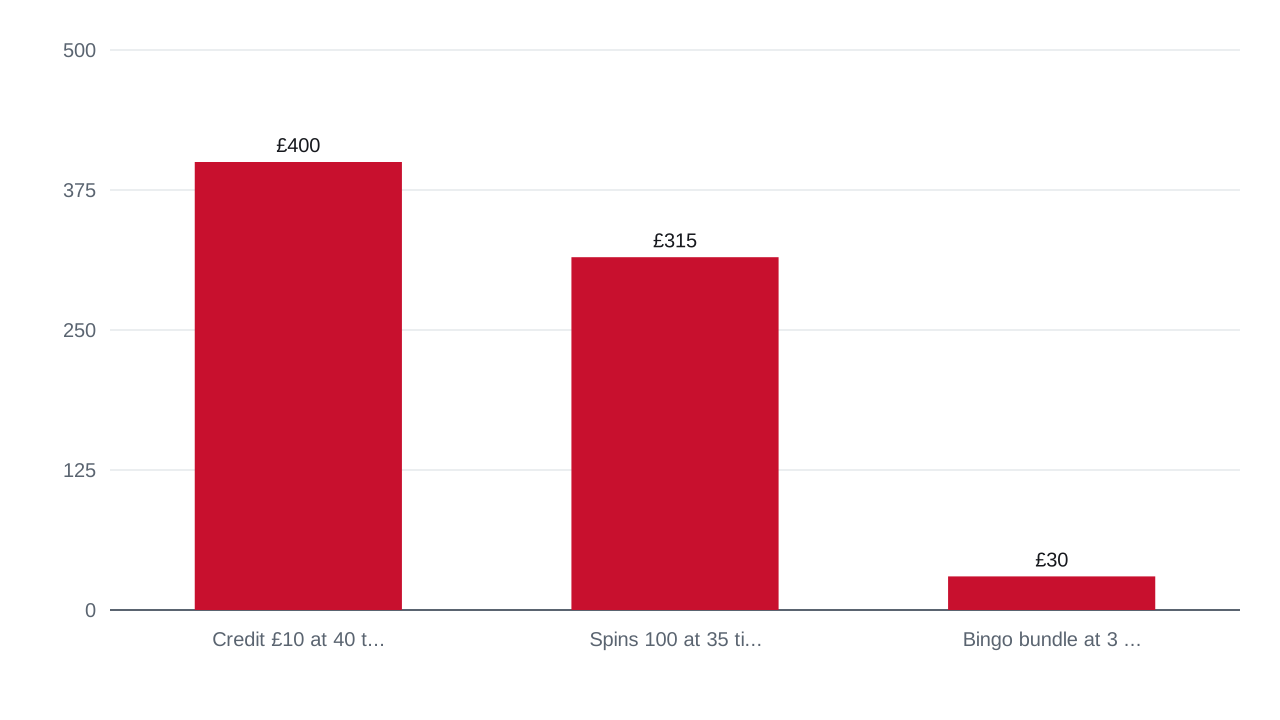
Three worked figures, one per product, at terms usual for each. Credit: a £10 grant at 40 times asks £400 of stakes. Spins: 100 spins at 10p each carry £10.00 of face value, the model takes their winnings at nine tenths of that, £9.00, and 35 times on winnings asks £315. Bingo: a bundle worth £10 at 3 times asks £30. The chart below plots the three bars on one axis, and the spread is the story: the heaviest product asks more than thirteen times the stakes of the lightest, for prizes that differ by a good deal less.
That spread is why no deposit casino offers are compared by cost rather than by generosity. Two grants that look close in a headline, £10 of credit or 100 spins, sit £85 apart in stake terms at the model’s figures. The caption under the chart carries the model date, October 2026, because terms drift and the bars move with them. Where an operator’s terms differ from the usual ones printed here, its own numbers replace these, and the arithmetic keeps its shape.
Spins face value £10.00.
Estimated winnings before wagering £9.00 at a 90 percent return.
Wagering £3.15.
Cashable £9.00.
Assumptions: spins return 90 percent of face value before wagering; session cost uses the stated house edge as expected loss of bankroll per session.
Yes, for the player. The Gambling Act 2005 aims its offence provisions at operators and at advertisers, not at players. It creates no offence for the person playing on an unlicensed overseas site. What that player loses is protection rather than legality: no register entry, no approved dispute route and no British rules standing behind the terms.
It costs stakes, not deposits. The rule asks you to stake 40 times the figure the terms name, usually the bonus credit, before a withdrawal is permitted. A £10 grant at 40 times therefore means £400 of stakes, pushed through the games at whatever weighting the terms set. Read which figure the multiplier attaches to: on spins the wagering usually falls on winnings instead, which changes the total.
Not everything, as a rule. The terms carry a ceiling, the most the offer will convert to cash, and on this page's model the usual band for spins runs from £50 to £150. Winnings above that line are removed when you withdraw. This is why the ceiling column leads the reading here: it bounds the outcome before the wagering begins, and it applies however well the spins happen to run.
Fewer than you might expect, at first. A no deposit grant needs no card at all, and a rail only matters when you withdraw. Debit cards and e-wallets are the common routes. Since April 2020, licensed operators cannot accept credit cards for gambling, so a cashier that asks for one is not operating under the British ban. Check the withdrawal list, not just the deposit one, before you register.
Whatever the terms set, and they differ from one operator to the next, so read the two clocks separately. The first expires the grant itself: if the spins or credit vanish before you start, nothing else in the terms matters. The second is the window for clearing the wagering. If the stake target needs more staking per day than the window allows, the ceiling is out of reach on the terms as written.
Readers who want to test a platform's software, lobby and cashier without putting their own money into a balance, and who accept that a two figure ceiling is the entire prize. That suits cautious starters and players sampling a new room. It does not suit anyone hoping for a meaningful withdrawal, because the ceiling and the stake target together make the arithmetic unforgiving by design.
A grant from an operator that holds a Gambling Commission licence, which you can confirm on the public register in a minute or two. The licence carries the protections this page describes: the credit card ban, approved dispute resolution and self-exclusion through GAMSTOP if you need it. Several licensed bingo and slots brands run registration spins with light or no wagering, so a like-for-like search rarely takes long.
No. Winnings from gambling are not taxed as income for a UK player, and that holds wherever the operator is licensed, so the licence gap leaves your tax position unchanged. The duty that does exist falls on operators, charged on their British-facing gaming profits, not on the person withdrawing. Your withdrawal is yours as far as the tax rules are concerned.
Offers of this kind hold no UK Gambling Commission licence. That is not a technicality: it is the difference between a market with a public register, a national self-exclusion scheme, approved dispute resolution, a ban on credit card gambling, affordability checks and independently tested games, and a market with none of those guarantees. A dispute at a licensed operator goes to an approved scheme; an offshore dispute goes to the operator itself. Nothing on this page is an exception to that. If self-exclusion matters to you, GAMSTOP covers licensed operators only, and no tool on this page changes that.
Gambling can harm. For free, confidential support in the UK, call the National Gambling Helpline on 0808 8020 133 or contact BeGambleAware.
Keep reading
UK Gaming Club. Independent modelling of casino offers for British readers. No operator pays for a word on this page; board placement is bought and disclosed on the How We Are Paid page. 2026.