#1
Night Luck
8.2Editorial score
Casino welcome bonus 805% up to €6,400 + 280 FS
- MuchBetter · VISA · Apple Pay
- Crypto welcome 140% up to 1,600 USDT
- VIP pack 800% up to €14,500
Terms change often. Verify on the operator's own page.
Offers modelled before you claim
18+. Betting carries risk. Never stake more than you can afford to lose.
Three hundred spins for a tenner sounds like a thirty to one exchange, until the value per spin of 5p sets the real rate at fifteen to one, and wagering on the winnings narrows it again.
The board is editorial and its placement is bought, which the disclosure page explains. Terms move without notice, so verify each line on the operator's own page.
Casino welcome bonus 805% up to €6,400 + 280 FS
Terms change often. Verify on the operator's own page.
Welcome bonus €/£5,000 + 500 FS
Terms change often. Verify on the operator's own page.
Welcome pack €5,000 + 500 FS + €650 free bet
Terms change often. Verify on the operator's own page.
Welcome package 300% up to €/£1,000 + 150 FS
Terms change often. Verify on the operator's own page.
On this page
A deal pitched as deposit 10 get 300 free spins leads with a count, and a count is the least informative of the three numbers that price it. The full reading multiplies the count by the value per spin, then divides the result by the deposit. On the headline figures that is 300 spins at 5p, which builds £15.00 of face value on a £10 deposit. Counted, the deal hands over thirty spins for each pound. Priced, the same set carries one pound fifty of face value per pound, or, against the ten-pence spins that models of this market usually assume, 150 standard spins: fifteen to the pound. The first rate is the marketing rate. The second is the one the terms support.
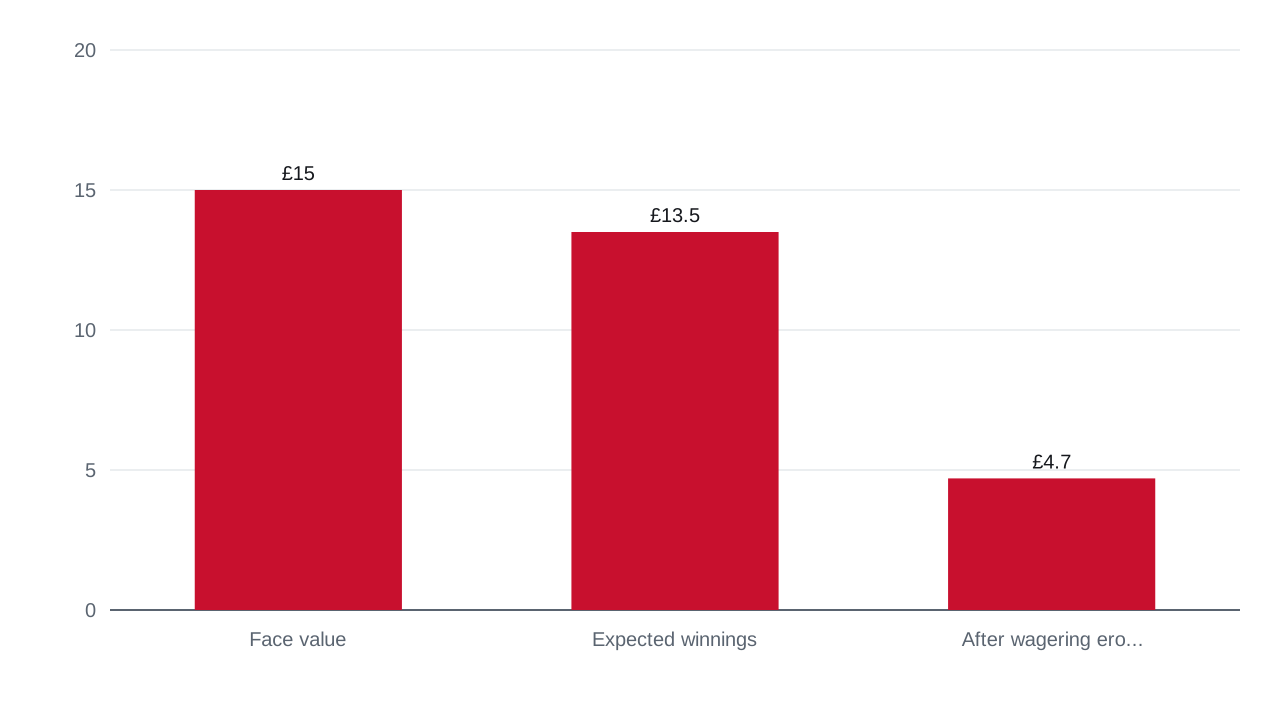
The third number is the one wagering reaches. Face value is not winnings: it is the sum of the stakes the spins will place. Apply a ninety per cent return, the assumption this page’s model carries throughout, and the expected winnings from the set come to £13.50. Everything the terms attach to those winnings then narrows the rate again, and the model’s final station sits at £4.70, which later sections work through.
Three rates therefore hang on one headline. Thirty to one on the count. Fifteen pounds to one tenner at face value. A fraction of that once the wagering has been priced. None of the three is a promise and none is luck either: the rates are arithmetic, and the same arithmetic prices any offer of this shape in a couple of minutes. Run it before the deposit, because afterwards the only number left to read is the balance.
Spin values on free spin offers usually sit between 5p and 20p, with 10p the working figure much of the market models on. At a count of three hundred, the printed value almost always lands at the floor of that band. The reason is bookkeeping rather than generosity: the cost of the promotion to the operator is count times value, and the count is the number being advertised. Three hundred spins at 20p would cost four times as much to fund as three hundred at 5p, so large counts and small values travel together.
The value is usually fixed to one named game, and 5p is commonly that game’s minimum stake. That detail is worth absorbing: the spins are not vouchers for any reel the player fancies, they are a block of minimum bets on a single title the terms name. Where the value is not printed at all, the named game’s stake floor is the default reading, and the terms usually grant it a line of its own.
The arithmetic of the value line is steep. At 5p the set carries £15.00 of face value. At 10p the same count carries £30.00. At 20p it carries £60.00. The count never moves and the value line triples the set twice over. It matters twice as well: a higher value raises the expected winnings, and because the requirement usually multiplies those winnings, a higher value raises the turnover alongside them. The exchange narrows in both directions at once, which is why this page prices the value before it prices anything else.
The model tracks one set of spins through three stations. The first is the stake: 300 spins at 5p, £15.00 of face value in total. The second is the expectation: with the return on the named game assumed at ninety per cent, the winnings the set should produce come to £13.50. The third is the survivor: the balance expected to remain once the 35 times requirement on those winnings has been played through, which the model prices at £4.70.
Two assumptions carry the working and both are stated rather than measured. The ninety per cent return sits a step under the 94 to 96 per cent band that published slot returns commonly occupy, which keeps the model on the cautious side. The requirement is taken to sit on the winnings, the usual base for spin offers, at 35 times, with the cap set at £150. The table records each station, how its figure was reached and what would move it.
| Stage | Figure | How it was reached | What can change it |
|---|---|---|---|
| Face value | £15.00 | 300 times 5p | Stated spin value |
| Expected winnings | £13.50 | 90 percent assumption | The named game return |
| Wagering | £472.50 | 35 times the winnings | Multiplier band |
| Cashout | min of balance and cap | printed ceiling | The cap line |
The chart below draws the same three figures as bars, and the shape tells the story: a tall first bar of face value, a second bar trimmed by the return assumption, and a third that keeps only a fraction of the first. The distances between the bars are the costs the offer attaches, and each distance traces back to a line in the terms: the value per spin to the first, the named game’s return to the second, the multiplier to the third. Read against the tenner, the first bar stands at one and a half times the deposit, the second just over a third above it, the third at less than half of it. Face value and expected cashout are different quantities, and the distance between them is the entire subject of this page.
Spins face value £15.00.
Estimated winnings before wagering £13.50 at a 90 percent return.
Wagering £4.73.
Cashable £13.50.
Assumptions: spins return 90 percent of face value before wagering; session cost uses the stated house edge as expected loss of bankroll per session.
The Gambling Act 2005 puts the offence on operators and advertisers, not on the player: an individual who plays on an unlicensed overseas site commits no offence. What the player gives up is protection. An operator outside the Commission's regime appears on no British register, offers no approved dispute route and follows no British advertising code. The gap is protection, not legality.
If 300 spins at 5p return £13.50 in winnings, a 35 times requirement on those winnings sets the turnover at £472.50. That is the amount that must be staked before winnings move to cash. At 5p a spin it works out near 9,450 spins of play. The multiplier, not the spin count, decides how long the clearance takes.
At a licensed British operator, no. The Commission has barred credit card gambling since 14 April 2020, so the tenner arrives by debit card or another permitted rail. Operators without a UK licence are not bound by that ban, which is one of the quiet differences the licence gap makes. A debit card keeps the spend visible on a statement you already watch.
Spin values on offers of this kind typically run between 5p and 20p, and the count alone says nothing about worth. At 5p, three hundred spins carry £15 of face value; at 20p the same count carries £60. The value line is usually tied to one named game at its minimum stake, so it is worth reading before the deposit rather than after.
A cap is a ceiling in the bonus terms: however high the balance climbs, only the capped amount can convert to withdrawable cash. On the no-deposit cousins of this offer, caps usually sit between 50 and 500 pounds; the model on this page takes 150. In the worked example the eroded balance sits far below the ceiling, so the cap stays dormant unless a strong session lifts the winnings past it mid-requirement.
Drip schedules are the norm at this count: thirty spins a day for ten days, fifty a day for six, or the full set in one block, each pattern set by the operator. Many schedules attach a short expiry to every tranche, often a day or two. Missing a day at fifty spins and 5p a spin drops £2.50 of face value, which is the schedule's real price.
A deposit of ten pounds with spins attached suits a reader who wants a bounded trial: the stake is capped by the deposit, the spins price the games on offer, and the terms teach how wagering behaves. It fits badly for anyone who needs the winnings, since the model's expected cashout is a fraction of the face value. Read it as tuition, not income.
A licensed operator brings the public register, so the licence can be checked before paying; GAMSTOP self-exclusion across every licensed site; approved dispute resolution when a complaint stalls; the credit card ban; and games tested by approved houses. Offers without a UK licence carry none of that coverage, which is the difference the comparison table on this page is built to show.
Offers of this kind hold no UK Gambling Commission licence. That is not a technicality: it is the difference between a market with a public register, a national self-exclusion scheme, approved dispute resolution, a ban on credit card gambling, affordability checks and independently tested games, and a market with none of those guarantees. A dispute at a licensed operator goes to an approved scheme; an offshore dispute goes to the operator itself. Nothing on this page is an exception to that. If self-exclusion matters to you, GAMSTOP covers licensed operators only, and no tool on this page changes that.
Gambling can harm. For free, confidential support in the UK, call the National Gambling Helpline on 0808 8020 133 or contact BeGambleAware.
Keep reading
UK Gaming Club. Independent modelling of casino offers for British readers. No operator pays for a word on this page; board placement is bought and disclosed on the How We Are Paid page. 2026.