#1
Night Luck
8.2Editorial score
Casino welcome bonus 805% up to €6,400 + 280 FS
- MuchBetter · VISA · Apple Pay
- Crypto welcome 140% up to 1,600 USDT
- VIP pack 800% up to €14,500
Terms change often. Verify on the operator's own page.
Offers modelled before you claim
18+. Betting carries risk. Never stake more than you can afford to lose.
The wallet appears on licensed British cashiers and its payouts clear inside 0 to 24 hours once approved, which is why the rail a reader picks at deposit is really a withdrawal decision.
The board is editorial and its placement is bought, which the disclosure page explains. Terms move without notice, so verify each line on the operator's own page.
Casino welcome bonus 805% up to €6,400 + 280 FS
Terms change often. Verify on the operator's own page.
Welcome bonus €/£5,000 + 500 FS
Terms change often. Verify on the operator's own page.
Welcome pack €5,000 + 500 FS + €650 free bet
Terms change often. Verify on the operator's own page.
Welcome package 300% up to €/£1,000 + 150 FS
Terms change often. Verify on the operator's own page.
On this page
The phrase gets used as if the wallet were the product. It is not. In Britain, providing remote gambling facilities to consumers requires an operating licence from the Gambling Commission, and the Gambling Act 2005 is the statute that says so. A cashier that takes PayPal is therefore best read as a licensed operator that happens to offer a fast rail, and the licence is the part that carries the weight. When a reader searches for a PayPal casino, the question underneath the search is rarely about the button at the cashier. It is about what stands behind it: a register entry, a dispute route, and a set of conditions the operator must meet to keep its permit.
The status question settles in two minutes. The Commission maintains a public register, and anyone can look up a company’s licence on it. Take the registered name from the cashier’s own footer, search the register, and confirm the licence is live and covers the site in front of you. If the name cannot be found, the cashier sits outside the British regime, whatever its payment buttons suggest. No choice of rail repairs that gap, because the gap is not about money movement. It is about who answers when something goes wrong.
The wallet itself is an e-wallet: an account that sits between a bank and a cashier and moves money without exposing card details. Deposits arrive at once, and payouts return to the same account without a card processor in the middle. On the model this page uses, the e-wallet band for payouts runs from effectively immediate to 24 hours after approval, the shortest of the common rails. That is the quiet reason the deposit screen matters more than it looks. A reader who funds an account with the slowest rail available has already chosen the slowest exit, because most British cashiers return money by the rail that took it.
The licence does none of the things advertising implies. It does not change the mathematics of the games, it does not make a bonus profitable, and it does not promise that a withdrawal clears quickly. What it buys is a floor: a regulator with a register, conditions the operator must observe, an approved dispute service for complaints, a ban on credit card gambling, and a published statement about how customer funds are held. Those protections are the substance of this page’s seventh section. The wallet is the convenience; the licence is the machinery.
The label also does filtering work. Search results for a PayPal casino mix three kinds of site: licensed British cashiers that take the wallet, overseas cashiers that hold no British licence and may or may not take it, and review pages that discuss all of them at once. The mix matters because the wallet behaves differently across the classes. At a licensed cashier, a wallet payout sits inside the shortest band on this page’s chart and inside a complaints regime with an approved mediator. At a cashier without the licence, none of that machinery applies, whatever the deposit screen implies. Sorting the classes first, before comparing bonuses or windows, stops a reader from comparing things that are not alike.
Every figure on this page is a category-typical band or a stated model assumption, compiled from the terms operators publish, never a measurement of a single cashier and never a promise about a single payout. Where an assumption does the work, the text says so. Where the terms of an offer govern, the text says that instead. The habit worth copying is simple: treat each published band as a question to put to the operator’s own payments page, and treat that page as the only answer that counts.
Five rails cover almost every cashier a British reader will meet: e-wallets, debit cards, prepaid vouchers, bank transfer, and open banking. Each moves money at a different speed in each direction, and the differences are not symmetric. Deposits are nearly instant on four of the five; payouts spread across bands that range from the same hour to the better part of a working week. The table below is the page’s model of those bands, with the floors a cashier typically publishes. It is a compiled picture, not a quote from any single operator, and the operator’s own terms always govern.
| Rail | Deposit speed | Payout window after approval | Usual floor |
|---|---|---|---|
| E-wallets | instant | 0 to 24 hours | 5 to 10 pounds |
| Debit cards | instant | 1 to 3 banking days | 5 to 10 pounds |
| Prepaid vouchers | instant | none direct | 10 pounds |
| Bank transfer | same day | 1 to 5 banking days | 10 to 20 pounds |
| Open banking | instant | 1 to 3 banking days | 10 pounds |
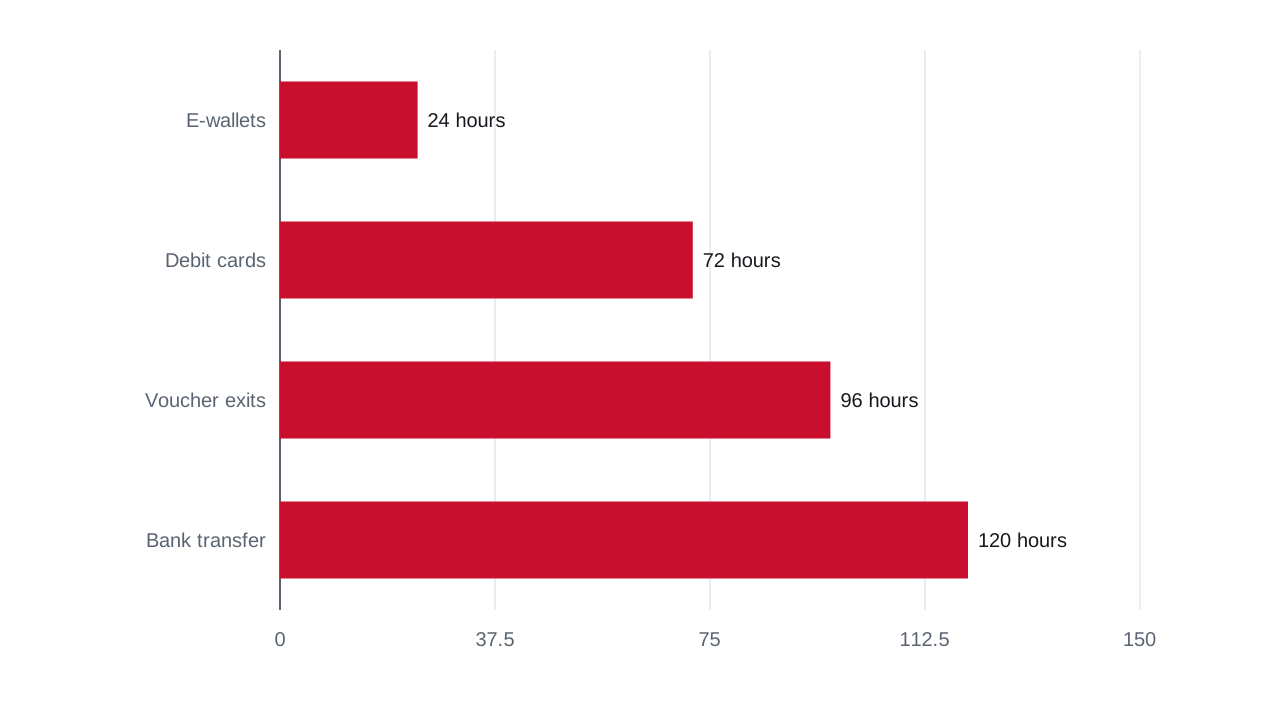
Reading the rows in order. E-wallets: instant in, 0 to 24 hours out once approved, floors usually between £5 and £10. Debit cards: instant in, 1 to 3 banking days out, similar floors. Prepaid vouchers: instant in, and no direct exit at all, because a voucher cannot receive money; a payout on a voucher-funded account has to be routed somewhere else, which is why the chart in the next section carries a voucher bar at all. Bank transfer: same-day deposits in the good cases, 1 to 5 banking days out, and the highest floors in the table, usually £10 to £20. Open banking: instant in, 1 to 3 banking days out, £10 floors, and a rail that is really a card-free way of moving from a bank account.
The mechanics explain part of the spread. A card payout has to travel through the card schemes and the acquiring chain before it reaches a statement, and that chain runs on banking days. A wallet payout moves inside the wallet’s own network, so once the cashier releases it there is no clearing cycle to wait for. Open banking sits between the two: the initial push is instant, but the return leg behaves like a transfer at many cashiers. None of this is hidden information; it is the ordinary plumbing of the rails, and it is why the same cashier can be instant on one rail and slow on another.
Two omissions deserve a word. Crypto does not appear, because the model on this page covers the rails a licensed British cashier typically publishes; crypto bands belong to a different class of cashier and are noted, briefly, in the next section. Cheques have effectively left the market and are not modelled. Neither omission changes the practical read: at a licensed cashier, the wallet row is the one with the shortest exit band, and every other row exists to show what that speed is worth.
A note on floors. The usual floor is the smallest deposit a cashier accepts, and the ranges above describe the market’s habits, not a rule. Some cashiers take £5 on cards and £10 on wallets; some take £10 everywhere; a few take £20 on transfers and nothing lower. The floor also interacts with bonuses, because a minimum qualifying deposit is often higher than the cashier’s own floor. Both numbers sit on the payments page and the promotion’s terms respectively, and a reader who checks only one of them has read half the sentence.
The bank transfer row also carries a quiet asymmetry. Same-day deposit is the best case, and only where the cashier supports faster payments in that direction; where it does not, the row’s deposit speed slips toward the next banking day. The payout side has no such best case to lean on: transfers out run on banking days, so a request filed on a Friday evening waits until Monday at the earliest, whatever the cashier’s status page says about speed. That weekend effect is the biggest single gap between a published band and what a reader experiences, and it applies to every rail that runs on banking days, not only to transfers.
Assumptions first, because the arithmetic is only as honest as they are. The model on this page takes a £10 deposit, a 100 per cent match, and a wagering multiplier of 35 times the bonus amount. The 35 figure is a working midpoint: at this end of the market, multipliers typically sit between 20 and 50 times, and the midpoint keeps the model honest in both directions. The model also assumes a £100 cap on what the bonus can convert to cash, which is the calculator’s working assumption and a shape the market uses often. None of these figures describe a named offer; they describe a category, and a real offer’s terms always replace them.
The arithmetic runs like this. A £10 deposit buys a £10 bonus, so the bonus balance is £10. Thirty-five times £10 is £350, which is the total amount that must be staked before bonus winnings can withdraw. At £1 a spin, that is 350 spins; at 20p a spin, it is 1,750; at £2 a spin, within a typical maximum-stake clause, it is 175. The stake size changes how long the wagering takes, not how much must pass through. The amount is fixed by the multiplier and the bonus, which is why the multiplier is the number to read first in any welcome offer.
Two variants change the total. Some terms apply the multiplier to deposit plus bonus rather than the bonus alone, which turns 35 times £10 into 35 times £20 and doubles the required stakes to £700. Some terms weight games differently: slots commonly contribute their full value, while table games and live games often contribute a fraction, sometimes a tenth, or nothing at all. Weighting stretches the clock rather than the total, but a reader who plays the wrong games can find that hours of stakes have moved the requirement by almost nothing. Both variants are visible in the terms if a reader knows to look for the words “deposit plus bonus” and “game weighting”.
The cap does the quiet damage. If the model’s £100 conversion cap applies, then even a session that runs well converts at most £100 from the bonus, and the difference between a modest match and a huge headline match shrinks to almost nothing. A 100 per cent match to £10 and a 100 per cent match to £500 behave identically once the cap sits below the bonus, because the extra bonus money is money that can be staked, not money that can be kept. Headline figures are marketing; caps and multipliers are mechanics. The calculator below carries the four inputs so the mechanics can be re-run with any numbers a reader is actually looking at.
One honest limit of the model. Wagering requirements describe turnover, not outcome: £350 of stakes is a quantity of play, and the result of that play is not predicted by anything on this page. The model’s use is planning. It converts a promotion’s headline into a quantity of play, and it makes the trade visible: a bonus is paid for with stakes, the stakes take time, and the cap limits the upside. A reader who finds the trade poor at 35 times will find it worse at 45, and a reader to whom the fifth section’s exclusion clause applies will find the trade absent altogether.
Bonus credit £10.00.
Wagering before cash out £700.00 at 35 times.
Wagering per pound deposited 70 times.
Assumptions: spins return 90 percent of face value before wagering; session cost uses the stated house edge as expected loss of bankroll per session.
Yes, in the sense that matters to a player. The Gambling Act 2005 places its offence provisions on operators and advertisers, not on individuals, so no British law makes it an offence to play on an overseas site. What a player gives up at an unlicensed cashier is protection: no register entry, no approved dispute route, no GAMSTOP coverage. Legality is not the issue; the missing protections are.
Take a £10 bonus with a 35 times multiplier: £350 must be staked before bonus winnings can withdraw. If the terms apply the multiplier to deposit plus bonus, the total doubles to £700 on the same £10 deposit. Game weighting changes the clock rather than the total, because table games often contribute a fraction of their stakes. The multiplier's target, bonus or deposit plus bonus, is the single most important line in the terms.
On this page's model, the e-wallet band runs from effectively immediate to 24 hours, counted after approval. Approval is the gate: until identity checks are complete and the request is released, no band applies. Once approved, a wallet payout needs no card processor and no bank clearing cycle, which is why it outruns cards and transfers by days. The cashier's own payments page carries its published window, and the terms govern.
Usually both, and the terms state each one. A conversion cap limits what a bonus can turn into withdrawable cash, whatever the session's result. An expiry window counts down in days from the moment the bonus is credited, and an unfinished wagering requirement at expiry typically takes the bonus and its winnings with it. On registration spins, the per-spin value and the cap sit in the same clause. Read caps and clocks before opting in.
Readers who rank payout speed above bonus size, since the shortest exit band on this page belongs to the wallet. Also readers who prefer to keep gambling money out of their main bank statement, and those who dislike entering card details repeatedly. The fit is worse for readers chasing a first-deposit match, because e-wallet deposits are the methods most often excluded from welcome eligibility. Decide which side of that trade matters first.
A register entry that can be checked, coverage by GAMSTOP self-exclusion, access to an approved alternative dispute resolution provider for complaints, the credit card ban, a published statement on how customer funds are protected, and fairness testing through approved test houses. A cashier without the licence, as a class, carries none of those coverage points, whatever its payments page offers in speed or bonus size. The licence is the difference, and the wallet does not bridge it.
No, and the exclusion clause is where the answer lives. A common pattern in welcome terms lists payment methods that do not qualify for the offer, and e-wallets are the names that appear most often on such lists. A deposit made by an excluded method still plays, but it plays without the match or spins attached. The clause takes a minute to find in the terms, and it decides more than any headline figure.
Verification is standard practice across the licensed market before a first withdrawal: identity documents, proof of address, and sometimes evidence of the source of funds. The checks hold the 18 minimum age line and confirm the account belongs to the person asking for the money. They run once, and completing them early keeps a payout inside the fast bands this page describes. An unverified account is the most common reason a wallet payout waits.
Offers of this kind hold no UK Gambling Commission licence. That is not a technicality: it is the difference between a market with a public register, a national self-exclusion scheme, approved dispute resolution, a ban on credit card gambling, affordability checks and independently tested games, and a market with none of those guarantees. A dispute at a licensed operator goes to an approved scheme; an offshore dispute goes to the operator itself. Nothing on this page is an exception to that. If self-exclusion matters to you, GAMSTOP covers licensed operators only, and no tool on this page changes that.
Gambling can harm. For free, confidential support in the UK, call the National Gambling Helpline on 0808 8020 133 or contact BeGambleAware.
Keep reading
UK Gaming Club. Independent modelling of casino offers for British readers. No operator pays for a word on this page; board placement is bought and disclosed on the How We Are Paid page. 2026.