#1
Night Luck
8.2Editorial score
Casino welcome bonus 805% up to €6,400 + 280 FS
- MuchBetter · VISA · Apple Pay
- Crypto welcome 140% up to 1,600 USDT
- VIP pack 800% up to €14,500
Terms change often. Verify on the operator's own page.
Offers modelled before you claim
18+. Betting carries risk. Never stake more than you can afford to lose.
An e-wallet payout clears inside 0 to 24 hours once it is approved, and approval is where the real window starts, which is why the pending queue matters more than the rail.
The board is editorial and its placement is bought, which the disclosure page explains. Terms move without notice, so verify each line on the operator's own page.
Casino welcome bonus 805% up to €6,400 + 280 FS
Terms change often. Verify on the operator's own page.
Welcome bonus €/£5,000 + 500 FS
Terms change often. Verify on the operator's own page.
Welcome pack €5,000 + 500 FS + €650 free bet
Terms change often. Verify on the operator's own page.
Welcome package 300% up to €/£1,000 + 150 FS
Terms change often. Verify on the operator's own page.
On this page
The label fast withdrawal casinos puts the emphasis in the wrong place, and the missing word is eventually. Every payout has two halves: an approval half, which runs inside the operator’s own office, and a transit half, which runs along the payment rail. Advertised speed describes the second half and stays quiet about the first, because the first is the one nobody can promise.
Transit is the predictable part. Once a request has been approved, an e-wallet payment arrives inside 0 to 24 hours at the top of its usual band, crypto in minutes to a few hours, a debit card in one to three banking days and a bank transfer in one to five. Those bands are model assumptions rather than measurements, and this page treats them that way throughout, but they are stable across the market because they belong to the rails, not to any single cashier.
Approval is the other clock. It covers identity checks, method checks, bonus clearing and whatever manual review a risk team decides to run on the day. Terms commonly reserve a pending window for it, often quoted in banking days, and the reservation is disclosed in the small print rather than the advert. A request can spend its whole reservation sitting in that queue before it ever reaches the rail whose speed the advert was quoting.
The distinction matters because each clock obeys different forces. Transit obeys plumbing: clearing cycles, issuer queues, network congestion, the internal transfer speed of a wallet provider. Approval obeys discretion: whether the account is verified, whether the name on the payment method matches the name on the account, whether the request is large relative to the account’s history, whether a bonus is still unwound. You can shorten the second clock only by preparing properly for the first.
There is a reason the industry quotes the transit half. It flatters, and it is a number a payments team can stand behind. The approval half is variable, staffed and discretionary, so nobody builds a slogan on it. Cashiers that genuinely earn the label are the ones with short approval queues and verification front-loaded into registration, not ones with a secret pipe to the banking system. The difference is invisible from the outside until the first request, which is why the terms, not the banner, are the evidence.
Read the words in the terms with the same care. Pending usually means the request is sitting in the queue. Processing usually means a member of the payments team has picked it up. Approved means it has left the operator and the transit clock has started. Where a cashier defines those words differently, its definitions win; this page uses approved as the start of every band it quotes, which is one reason the numbers here look modest next to the marketing.
A worked reading, using nothing but the bands: a debit card request quoted at one to three banking days with a 48 hour pending window attached is a door to door worst case of five days, and the advert will still say fast. The queue and the rail are quoted in different units, days for one and hours for the other, and converting both to hours before comparing is the single most useful habit this page can teach.
Take the opening figure of this page apart as an exercise. An e-wallet payout clears inside 0 to 24 hours once it is approved: the band belongs to the rail, and the word once carries the entire approval question with it. Read the sentence without the once and you have the advert. Read it with the once and you have the model this page works with, in which the queue is the variable and the rail is the constant. What you control is preparation: a verified account, documents uploaded before the first request, a payment method in your own name and bonus terms cleared before the button is pressed. What you do not control is the risk team’s workload on a Tuesday night. Neither clock rewards impatience, and only one of them rewards preparation.
Picture a payout as a relay with two runners. The first runner is the review: it runs on business hours, staff rotas and risk rules, and it stops for weekends and bank holidays. The second runner is the rail: it runs on clearing cycles and network confirmations, and depending on the rail it may not notice that the calendar said Sunday.
The first runner holds the gate. A request passes through when the account is verified, the method is confirmed as yours, any bonus terms are cleared and nothing about the request trips a review trigger. The usual triggers are predictable: a first ever withdrawal, a payment method that has not been used before, an amount large relative to the account’s history, a betting pattern that changed suddenly, or a source of funds question attached to a sizeable win. None of these means something has gone wrong. They are the places where a queue earns its keep, and they are also the places where preparation shortens the wait.
What reopens the gate matters as much as what opens it. Adding a new card or wallet can send a previously smooth account back through checks. So can a win that stands out against the deposit history, which is the point at which source of funds requests appear in terms across the market. Verification is a state rather than a step: it holds until something changes, and then the queue restarts for the part that changed.
Inside the first runner’s leg sits the reverse window. Some cashiers hold a requested payout in a cancellable state for part of the pending period, during which the balance returns to play with a click. That stretch belongs to the review clock, and it is the part of the queue that most rewards the operator, so it gets its own treatment further down this page.
The second runner is duller and more honest. E-wallet transfers move inside a day at the top of the band, because the money is moving between accounts the provider controls. Card payments wait for scheme cycles and issuer queues, which is why they are counted in banking days. Bank transfers wait for clearing between institutions, which is why the band is wider. Crypto waits for confirmations, and it is the only rail whose transit ignores the weekend entirely, including the bank holidays the first runner observes.
Calendar effects deserve a sentence of their own. Cut-off times, weekend processing policies and bank holiday backlogs all sit on the review side, and they explain most of the difference between a cashier’s best case and its worst case on the same rail. A request approved on Friday evening may travel on a rail that runs all weekend but leave a review desk that does not reopen until Monday, and no chart of rails can price that.
A note on words that travel together: working days, banking days and business days are used loosely across the market, and they generally mean Monday to Friday with holidays excluded. The day-based figures on this page use that convention. A rail quoted in banking days can run slower than its number suggests whenever a weekend or a holiday sits inside the window, which is one more reason the upper bounds are the honest figures to plan around.
When a terms line says withdrawals are processed within three working days, ask which runner it covers. Processed usually means handed to the rail, which makes the line a review promise and leaves the transit clock to add itself afterwards. An advert promising same day payouts is almost always quoting the second runner alone. Neither statement is false; each is one half of the door to door time, and the halves never add cleanly because the first is discretionary. That is the model this page keeps from here on: the chart in the next section measures from approval to arrival, the second runner only, because that leg can be modelled and the first cannot. Treat any cashier’s door to door claim as the sum of a promise and a variable, and the surprises mostly disappear.
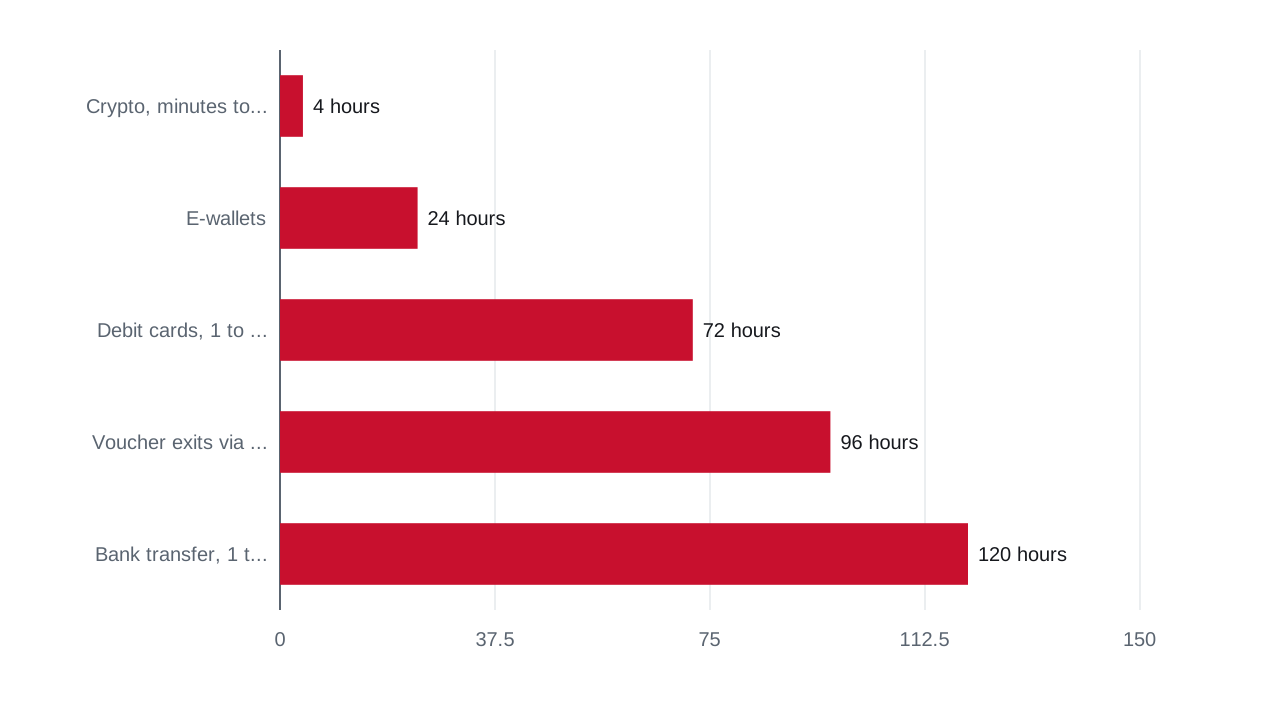
The chart below is a model, and its caption says so: upper bounds of category-typical bands, in hours, from approval to arrival. Five rails, five numbers. Crypto sits at 4 hours, e-wallets at 24, debit cards at 72, voucher exits at 96 and bank transfers at 120. Each number is the top of a band the market usually publishes, not a timing taken from any request, and each is a planning figure: the span a payment can cover when nothing goes wrong but nothing goes quickly either.
Reading the bars in order tells the story of the plumbing. Crypto’s 4 hours is confirmation time, occasionally stretched by network congestion, and it is the only bar that ignores weekends. The e-wallet bar at 24 hours covers the transfer from the operator to the wallet, after which the money is yours to move wherever you keep it. Debit cards carry 72 hours at the upper bound because scheme cycles and issuer queues are counted in banking days, and banking days exclude the weekend that crypto never noticed. Bank transfers carry 120 because clearing between institutions is slower still, and the band stretches across five of those days.
The voucher bar needs its own explanation, because a voucher is inward only. Prepaid codes deposit well and withdraw never: there is no rail back out. An exit therefore borrows a second rail, and the model prices that honestly, stacking the upper bound of an e-wallet leg on the upper bound of a card leg, 24 plus 72, which lands at 96 hours. The table below carries the same warning in its last row, where the window cell reads inward only rather than a number.
Why publish upper bounds rather than averages? Because averages flatter and bounds prepare. The top edge of a band is the figure to hold in mind when a terms line says up to five banking days: it is the tolerance a reasonable request should be granted before a question to support is justified. The typical case is faster, sometimes much faster, and the bound is the contract you are actually agreeing to.
The table sets the rails side by side with their floors and their common delays. Two things are worth noticing. First, the floor column describes getting money in, not out, and the withdrawal floor is a separate number covered later on this page. Second, the delay column mixes both clocks: unverified accounts and source of funds reviews sit on the approval side, while network congestion and issuer queues sit on the transit side. Knowing which side a delay lives on tells you whether to chase your documents or the payment.
| Rail | Deposit floor | Window after approval | What usually delays it |
|---|---|---|---|
| E-wallet | 5 to 10 pounds | 0 to 24 hours | Unverified account |
| Debit card | 5 to 10 pounds | 1 to 3 banking days | Issuer queues |
| Crypto | varies | minutes to a few hours | Network congestion |
| Bank transfer | 10 to 20 pounds | 1 to 5 banking days | Source of funds review |
| Voucher | 10 pounds | n/a inward only | Needs a second rail out |
Assumption, stated plainly: the bands are compiled from operator-published terms at this end of the market and rounded for modelling. No request was timed for this page, no account was opened and no payment was watched. The bands are also deliberately conservative in one direction: they begin at approval, so a cashier with a 48 hour review queue behind a 24 hour e-wallet band quotes a door to door worst case of 72 hours, and the chart will never show that, because the queue is not the rail’s to price. Where a cashier’s own terms quote a different band, the cashier’s terms govern the cashier, and this chart governs only the comparison between rails.
Expected loss per session £4.00.
Expected loss across 6 sessions: £24.00.
Assumptions: spins return 90 percent of face value before wagering; session cost uses the stated house edge as expected loss of bankroll per session.
Under the Gambling Act 2005, the offence provisions fall on operators and advertisers, not on an individual who plays on an unlicensed overseas site. What you lose is protection rather than legality: no British register entry, no approved dispute route, no GAMSTOP coverage, and no advertising rules behind the site's marketing. The operator acts outside the British regime; the player simply carries the risk the licence would have covered.
Wagering is the multiplier attached to a bonus before winnings tied to it can be paid. At this end of the market the usual band runs from 20 to 50 times the bonus or the winnings, and the calculators here assume 35 times unless a page states otherwise. A request made before the multiplier is cleared is typically refused, and the bonus can be forfeited, so clear the terms before you claim anything.
On this page's assumptions, crypto clears in minutes to a few hours and e-wallets inside 0 to 24 hours after approval, while debit cards run one to three banking days and bank transfers up to five. The approval step, not the rail, is where the days usually gather, so the fastest rail still waits behind the slowest queue if the account is not verified.
Cashiers commonly publish a minimum withdrawal and sometimes a maximum per transaction or per day, and bonus terms can cap winnings separately. Model assumptions at this end of the market put no-deposit cashout caps between 50 and 500 pounds, with 100 pounds as the working figure. Caps and floors live in the terms rather than on the cashier screen, so check both before any large request.
Anyone who treats a balance as money rather than entertainment credit, and anyone planning to withdraw regularly rather than redeposit. If the pattern is small stakes and occasional sessions, the rail matters less than the floor and the limits. If a win is meant to leave the account promptly, the approval queue, the verification state of the account and the minimum withdrawal decide satisfaction together, ahead of any slogan about speed.
A Gambling Commission licence brings a public register entry that can be checked in minutes, a declared rating showing how customer funds are protected, access to an approved dispute resolution provider, GAMSTOP self-exclusion and the ban on credit card gambling. Payout windows by rail are broadly comparable. None of these protections travels with an unlicensed offer, which is why the register check should come before any comparison of windows.
Expect to be asked for photo identification, a proof of address with a recent date and evidence that the payment method belongs to you, with the account name matching the method exactly. Uploading these before the first request, rather than after it, removes the most common source of delay. Incomplete or mismatched paperwork sends a request back to the start of the queue, however quick the rail is.
At some cashiers, yes, because the request sits in a pending window during which the balance can be returned to play. That feature suits the operator rather than the player: money on hold stays exposed to the house edge for every extra hour it remains cancellable. Whether cancellation exists, and how long the window runs, is written in the terms, and it is worth reading before the first deposit rather than after.
Offers of this kind hold no UK Gambling Commission licence. That is not a technicality: it is the difference between a market with a public register, a national self-exclusion scheme, approved dispute resolution, a ban on credit card gambling, affordability checks and independently tested games, and a market with none of those guarantees. A dispute at a licensed operator goes to an approved scheme; an offshore dispute goes to the operator itself. Nothing on this page is an exception to that. If self-exclusion matters to you, GAMSTOP covers licensed operators only, and no tool on this page changes that.
Gambling can harm. For free, confidential support in the UK, call the National Gambling Helpline on 0808 8020 133 or contact BeGambleAware.
Keep reading
UK Gaming Club. Independent modelling of casino offers for British readers. No operator pays for a word on this page; board placement is bought and disclosed on the How We Are Paid page. 2026.