#1
Night Luck
8.2Editorial score
Casino welcome bonus 805% up to €6,400 + 280 FS
- MuchBetter · VISA · Apple Pay
- Crypto welcome 140% up to 1,600 USDT
- VIP pack 800% up to €14,500
Terms change often. Verify on the operator's own page.
Offers modelled before you claim
18+. Betting carries risk. Never stake more than you can afford to lose.
An e-wallet payout clears inside 0 to 24 hours once it is approved, and the e-wallet was verified at deposit, which is why this rail is the shortest documented path out of a casino cashier.
The board is editorial and its placement is bought, which the disclosure page explains. Terms move without notice, so verify each line on the operator's own page.
Casino welcome bonus 805% up to €6,400 + 280 FS
Terms change often. Verify on the operator's own page.
Welcome bonus €/£5,000 + 500 FS
Terms change often. Verify on the operator's own page.
Welcome pack €5,000 + 500 FS + €650 free bet
Terms change often. Verify on the operator's own page.
Welcome package 300% up to €/£1,000 + 150 FS
Terms change often. Verify on the operator's own page.
On this page
MuchBetter is an e-wallet: a payment account held in an app that sits between your bank and a casino cashier. You top the wallet up from a debit card, then move money from the wallet to a MuchBetter casino without typing card numbers into that site. The cashier sees a payment provider, the app holds your details, and the two are kept apart.
The reasons cashiers list the rail are practical. Deposits land at once, which puts a playing balance in place without a card screen in between. The rail runs through an app, so the approval step happens on your device rather than in a browser form. And the wallet is a named, checkable account, which matters later: a payout can return to the same place the deposit came from, and the cashier can tie the two together.
That last point is the one that pays off at withdrawal. A MuchBetter casino usually treats the wallet as a checked rail once a deposit has cleared through it, because the wallet was itself verified when you opened it. Deposit and withdrawal then run on a single track, and that single track is the quickest route a cashier documents out of the balance.
Cost is the quieter reason the rail appears so often. Card processing is rarely free for an operator, and some of that cost finds its way into terms elsewhere. E-wallet settlement is comparatively clean for a cashier, which is one reason the rail tends to sit near the top of a deposit menu rather than inside a dropdown.
None of this says anything about the offers attached to the rail. A wallet is plumbing. The match percentages, the wagering multipliers and the conversion caps live in promotion terms, and the arithmetic in the rest of this page applies to those terms, not to the wallet.
The flow is short. You pick MuchBetter in the cashier, enter an amount, and the app takes over: the approval happens on your device, under your lock screen, not in a web form. Once you confirm, the balance lands at once, which the data table further down this page logs in seconds. There is no waiting stage on a deposit by e-wallet, and no point at which the site holds your card details.
Fees are the first thing most readers ask about, and the honest answer is an assumption. The usual cashier takes e-wallet deposits free, and the model on this page assumes no fee, which is stated here because it is an assumption about the ordinary cashier, not a rule of the rail. A minority of operators pass a charge through, and the payments page of the terms, not the promotion banner, is where that line lives.
The deposit floor matters for the match model below. The comparison table on this page shows minimum deposits clustering around £10, and the calculator starts from exactly that figure. Depositing under the floor can mean missing the match altogether, and depositing by a second rail alongside the wallet can complicate the closed loop described further down, so one rail, funded properly, keeps the bookkeeping simple.
The app layer deserves a word of its own. Because the approval happens in the app, a deposit cannot be waved through by a stored card in a browser. Each payment asks for the device. The friction is a few seconds, and it is the same friction that keeps the payout side tidy: the wallet is an account you control, not a card number a site stores.
One habit worth forming at this stage is checking currency. The wallet holds a balance in a chosen currency, and a cashier that settles in a different one will convert at its own rate. Matching the two avoids a quiet conversion spread, which the fees section below takes up in detail.
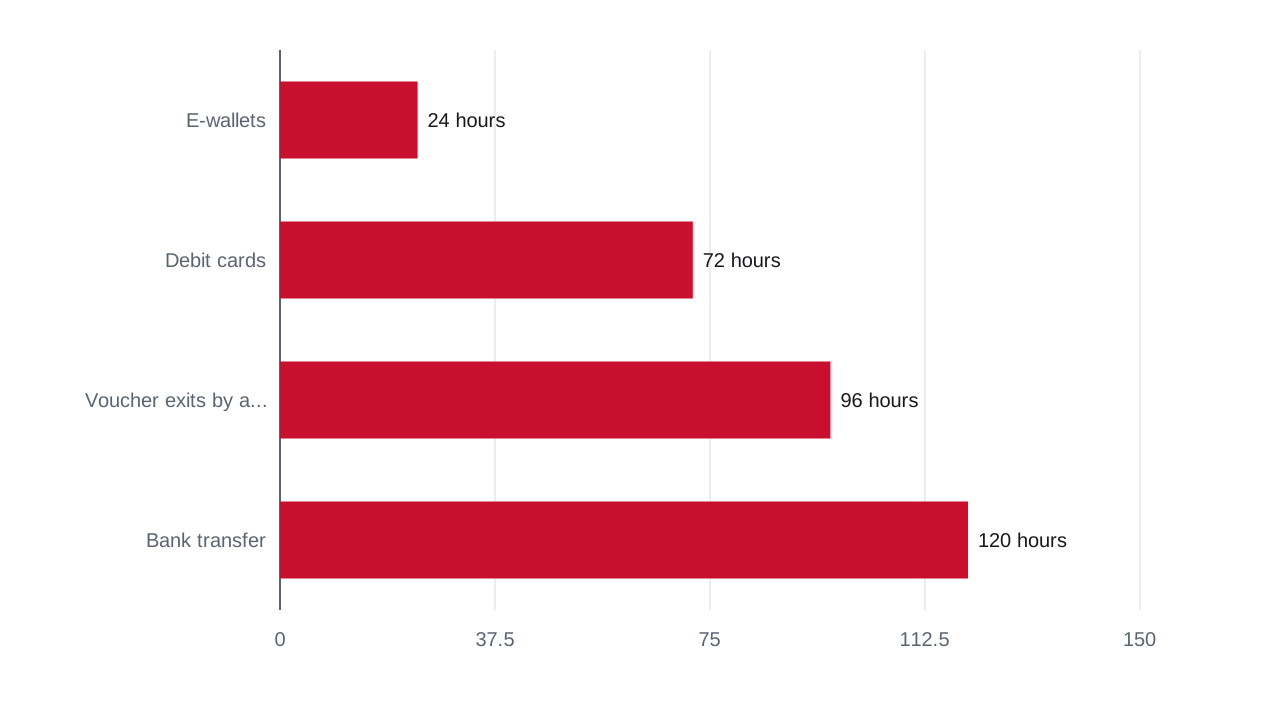
Withdrawal timing is where rails differ most, so this page models it. The chart below plots upper bounds, in hours, for four rails, and every figure on it is an assumption drawn from category-typical bands, not a measurement of any cashier.
| Step | What happens | Usual time | What can hold it |
|---|---|---|---|
| Deposit via e-wallet | Balance lands at once | seconds | None |
| Verification | Documents checked | minutes to a day | File quality |
| Withdrawal request | Pending state starts | 0 to 24 hours | Queue |
| E-wallet arrival | Funds clear | inside 24 hours of approval | Nothing usually |
The numbers run like this. E-wallets carry the shortest band, 0 to 24 hours, so the model draws the bar at 24. Debit cards run 1 to 3 banking days, which converts to an upper bound of 72 hours on the chart’s clock. Bank transfer runs 1 to 5 banking days, an upper bound of 120 hours. The fourth bar covers a gap the terms create: a voucher cannot usually receive a payout, so an exit has to travel by an alternate rail, and the model prices that detour at 96 hours.
Two stated assumptions sit under the conversion. A banking day is treated as 24 hours, and weekends are ignored, so a card payout requested late on a Friday will run longer in real time than the bar suggests. Read the bars as bands, not as promises: an e-wallet payout at its slowest modelled moment still clears inside the fastest plausible card band, and that gap is the case for the rail in one line.
Approval is the pivot the chart hides. The bands run from approval, not from the request, and the queue before approval is the variable a cashier controls. That queue is logged as the hold on the withdrawal row in the table above, and it is the one stage no rail chart can price.
Bonus credit £10.00.
Wagering before cash out £700.00 at 35 times.
Wagering per pound deposited 70 times.
Assumptions: spins return 90 percent of face value before wagering; session cost uses the stated house edge as expected loss of bankroll per session.
The Gambling Act 2005 places the offence on operators and advertisers, not on an individual who plays on an unlicensed overseas site. Playing is therefore not an offence for you. What you give up is protection: no British register entry, no GAMSTOP coverage, no approved dispute resolution and no credit card ban. The trade this page keeps in view is the gap in protections, not the question of legality for the player.
The multiplier applies to the bonus amount the cashier credits. On the model used here, a £10 deposit with a 100 per cent match adds a £10 bonus, and 35 times that bonus is £350 in stakes before bonus-derived funds unlock. Only stakes on eligible games usually count in full, and tables or certain slots often contribute less. 35 times is a working midpoint for offers of this kind, not a fixed rule.
The model band for e-wallet payouts runs from 0 to 24 hours, counted from approval rather than from the request. The pending state at the cashier sits inside that band, and the transfer to the wallet lands within it at the model's upper bound. Verification done at deposit is what keeps the count short. A queue on a busy week can push the approval stage, so read the cashier's own stated window.
Many offers of this kind carry a conversion cap, a figure that limits what the bonus path can turn into withdrawable funds. The model on this page applies a £100 ceiling so the arithmetic has a definite end point. Real caps vary by cashier and by promotion, and expiry dates sit beside them in the terms. Read both lines before opting in, because a cap can bite harder than the wagering.
It suits a player who deposits on a phone, keeps sums small and wants the withdrawal to land in the same place the deposit left. The app handles approvals, the card never reaches the cashier, and the payout band is the shortest of the four rails modelled here. It fits badly if you dislike installing an app, if you deposit by voucher, or if you want withdrawals routed to a bank account directly.
A licence does not change the rails, since e-wallets are widespread among British-facing operators, and the payout bands look similar on paper. What changes is everything around the payment: the cashier sits under a public register entry, self-exclusion through GAMSTOP covers the account, an approved dispute resolution provider exists for stalled withdrawals, and the credit card ban applies at the deposit screen. On the table here, the licensed rows post the shorter windows, the pattern the model expects.
Most cashiers operate a closed loop, meaning withdrawals return to the rail that funded the deposit. Checking the wallet at deposit means the documents are already read when a payout is requested, so the approval stage has less to wait for. Verification left until withdrawal day adds minutes to a day of checking before anything moves. Doing it first costs nothing and removes the commonest hold on the table above.
Winnings from gambling are not taxed as income for an individual in the UK, and that holds wherever the operator is licensed, so the licence gap does not move your tax position. Duty is a charge on the operator, not on the player. What the licence gap changes is protection rather than tax: register entry, self-exclusion, dispute resolution and the credit card ban are the lines that differ.
Offers of this kind hold no UK Gambling Commission licence. That is not a technicality: it is the difference between a market with a public register, a national self-exclusion scheme, approved dispute resolution, a ban on credit card gambling, affordability checks and independently tested games, and a market with none of those guarantees. A dispute at a licensed operator goes to an approved scheme; an offshore dispute goes to the operator itself. Nothing on this page is an exception to that. If self-exclusion matters to you, GAMSTOP covers licensed operators only, and no tool on this page changes that.
Gambling can harm. For free, confidential support in the UK, call the National Gambling Helpline on 0808 8020 133 or contact BeGambleAware.
Keep reading
UK Gaming Club. Independent modelling of casino offers for British readers. No operator pays for a word on this page; board placement is bought and disclosed on the How We Are Paid page. 2026.