#1
Night Luck
8.2Editorial score
Casino welcome bonus 805% up to €6,400 + 280 FS
- MuchBetter · VISA · Apple Pay
- Crypto welcome 140% up to 1,600 USDT
- VIP pack 800% up to €14,500
Terms change often. Verify on the operator's own page.
Offers modelled before you claim
18+. Betting carries risk. Never stake more than you can afford to lose.
A five pound credit at 50 times wagering asks £250 of stakes, five times the headline, and the usual £50 ceiling means the arithmetic must clear every hurdle before it pays for itself.
The board is editorial and its placement is bought, which the disclosure page explains. Terms move without notice, so verify each line on the operator's own page.
Casino welcome bonus 805% up to €6,400 + 280 FS
Terms change often. Verify on the operator's own page.
Welcome bonus €/£5,000 + 500 FS
Terms change often. Verify on the operator's own page.
Welcome pack €5,000 + 500 FS + €650 free bet
Terms change often. Verify on the operator's own page.
Welcome package 300% up to €/£1,000 + 150 FS
Terms change often. Verify on the operator's own page.
On this page
A free £5 no deposit casino offer is the smallest headline in the bonus drawer: five pounds of bonus money, credited to a new account, with no card details taken and no first deposit asked for. The money lands as bonus funds rather than cash. You can open games with it, watch a balance move, and see how a cashier treats a withdrawal request, all before any of your own money exists in the account. As a way of looking around, that is a fair deal. As a way of walking out with cash, it is the most fenced offer in the book, and the fences are the subject of this page.
Credits of this size appear at three moments. Some operators grant the credit the moment an account is verified. Some hold it back until a mobile number or an email address is confirmed, which screens out a share of duplicate signups. A few tie it to a newsletter opt-in or to a first login through an app. The details vary and the shape does not: in every version the £5 is bonus money, it sits behind a wagering requirement, and it converts to a withdrawable balance only if that requirement is met inside the term lines.
Four term lines do nearly all the work, and the table below gathers them in the order they bite. The multiplier sets the stake target. The cashout cap bounds what the credit can ever return. Expiry closes the run on a clock. The max bet rule caps the stake size and therefore the speed of the whole exercise. Read the lines as a set, because operators write them as a set: a friendly multiplier beside a tight cap, or a long expiry beside a heavy multiplier, is a common shape at this size.
| Term line | Usual reading | What it does | Where it bites |
|---|---|---|---|
| Multiplier | 40 to 60 times | Scales the stake target | First |
| Cashout cap | £20 to £50 | Bounds the upside | At withdrawal |
| Expiry | 3 to 7 days | Ends the run | At the clock |
| Max bet | £1 to £2 | Caps stake size | During the run |
The rows carry the ranges this page works with throughout. Where the arithmetic needs a single number, the assumption is stated in the text, and the model draws on the middle and the top of each band rather than the kindest corner of it.
Across the no-deposit market, wagering typically sits between 20 and 50 times, with 35 times as the working midpoint. The smallest credits cluster at the heavy end of that spread, and the working band on this page for a five pound grant is 40 to 60 times, which is what terms at this size usually publish. The reason is structural rather than spiteful. A free credit attracts accounts created only to collect it, and the multiplier is the lever that prices that traffic into the offer.
The base matters as much as the number. With no deposit in the picture, the multiplier almost always attaches to the credit itself, or to the winnings where the offer takes the spins form. There is no deposit-plus-bonus base to dilute it, which is one reason a 50 times line on a £5 grant bites harder than the same number on a £50 match. Five pounds multiplied by fifty is £250 of stakes, and that figure, not the headline, is the honest price of the offer.
Weighting sits on top of the multiplier. Most terms count slots at 100 per cent toward the target and most other games at a fraction of that, so the reachable path runs through the slots lobby whether or not that is where an evening would have gone. The next section prices the credit at two points on the band and shows what each does to the arithmetic.
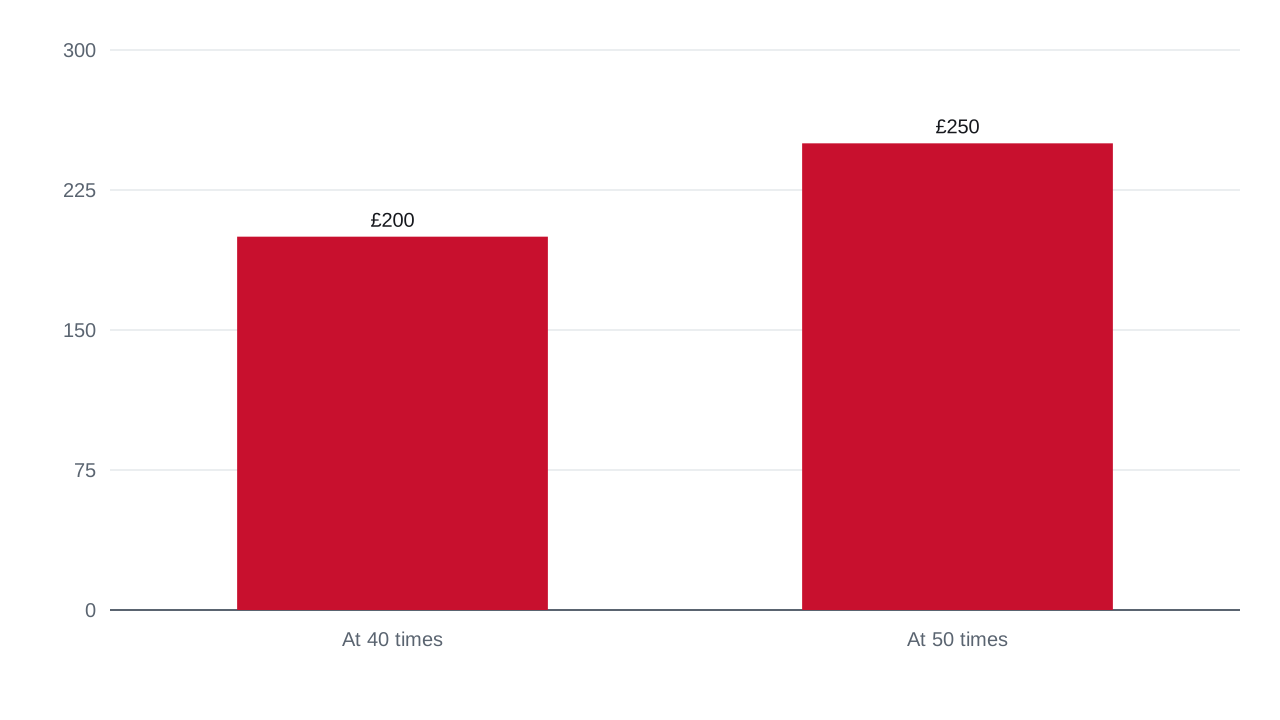
The chart below takes the credit and costs it at 40 times and at 50 times, the two points the model on this page uses. Both are assumptions and are stated as such: we take 40 and 50 because terms on grants of this size usually publish multipliers in that region, and because the two bars show how far a single line of small print moves the price.
At 40 times, £5 asks £200 of stakes before anything converts to cash. At 50 times the same credit asks £250. The ten extra multipliers cost £50 of play, which at a £1 max bet is fifty more rounds placed one after another. Neither figure includes weighting: the bars are drawn before any game-weighting discount, on the assumption that the whole target is met at 100 per cent, which is the cheapest defensible path through the requirement.
Read the bars as a centre of gravity rather than a ceiling. Some terms run heavier still, and the band in the table in the first section carries the wider spread. Nothing in the model says that £200 or £250 of stakes is reachable from a £5 float; a later section explains why the average run falls short of both. What the bars show is the exchange rate between the headline and the workload, and that exchange rate is fixed before you register, not after.
Spins face value £5.00.
Estimated winnings before wagering £4.50 at a 90 percent return.
Wagering £1.58.
Cashable £4.50.
Assumptions: spins return 90 percent of face value before wagering; session cost uses the stated house edge as expected loss of bankroll per session.
Nothing is charged to your card, because no card is needed: the credit arrives on registration and the money at risk is the operator's, not yours. The cost is time and personal data, since verification checks come before any withdrawal. The wagering also spends your evenings, and at 50 times a five pound credit asks £250 of stakes. Free describes the entry, not the workload behind it.
It means the terms require £250 of qualifying stakes before bonus funds or winnings convert to withdrawable cash. You do not add money to reach the figure; the stakes are placed with the credit and whatever it wins while it lasts. Slots normally carry full weighting toward the target, while table games and live tables count far less, which is why the model assumes the slots path throughout.
The cashier still needs a verified account before it pays. Expect identity checks, a withdrawal method in your own name, and a cap that bounds the amount, commonly £20 to £50 at this size. Debit cards and e-wallets are the usual rails, and e-wallets tend to settle fastest. Because no deposit ever existed, there is no deposit to refund, so the delays are the checks rather than the banking itself.
The Gambling Act 2005 aims its offence provisions at operators and at advertisers, not at the individual player, so using an unlicensed overseas site is not an offence for the person who plays. What you lose is protection rather than legality: no British register entry, no GAMSTOP coverage, no approved dispute resolution, and no shelter under the British advertising rules. Lawful for you, uncovered for you, is the honest summary.
The cap exists because the credit costs the operator nothing to grant and the terms must bound the worst case. Without a ceiling, one lucky run on a free float would be unbounded, so terms typically fix the maximum withdrawal between £20 and £50 at this size. The cap applies to winnings from the credit; money you deposit yourself on other offers is not the thing being capped.
Expect a window of three to seven days, and the clock normally starts when the credit is granted rather than when you first play. Check two details in the terms: the start of the clock, and whether unfinished wagering voids the winnings as well as the credit, which is the common outcome. At a £1 max bet, a £250 target means 250 rounds, so the shorter end of the band asks for several sessions inside one week.
Readers who want to see a lobby, a cashier and a terms page before committing any money of their own get the most from it. It suits a cautious first look, or a comparison of how different operators write their small print. It does not suit anyone chasing income, because the modelled arithmetic says the average run ends before the target, and it does not suit anyone registered with GAMSTOP, since offshore offers sit outside that scheme.
Licensed British operators run their own registration offers, typically 50 to 100 free spins or a small games bonus, on terms that read much like the strings this page costs. The difference sits around the offer rather than inside it: a public register entry, the credit card ban, approved dispute resolution, GAMSTOP coverage and tested game fairness. Check a company's licence status on the Gambling Commission's public register before signing up, whichever kind of headline you are reading.
Offers of this kind hold no UK Gambling Commission licence. That is not a technicality: it is the difference between a market with a public register, a national self-exclusion scheme, approved dispute resolution, a ban on credit card gambling, affordability checks and independently tested games, and a market with none of those guarantees. A dispute at a licensed operator goes to an approved scheme; an offshore dispute goes to the operator itself. Nothing on this page is an exception to that. If self-exclusion matters to you, GAMSTOP covers licensed operators only, and no tool on this page changes that.
Gambling can harm. For free, confidential support in the UK, call the National Gambling Helpline on 0808 8020 133 or contact BeGambleAware.
Keep reading
UK Gaming Club. Independent modelling of casino offers for British readers. No operator pays for a word on this page; board placement is bought and disclosed on the How We Are Paid page. 2026.