#1
Night Luck
8.2Editorial score
Casino welcome bonus 805% up to €6,400 + 280 FS
- MuchBetter · VISA · Apple Pay
- Crypto welcome 140% up to 1,600 USDT
- VIP pack 800% up to €14,500
Terms change often. Verify on the operator's own page.
Offers modelled before you claim
18+. Betting carries risk. Never stake more than you can afford to lose.
An Ethereum transfer carries a gas fee that moves with network congestion, so the cost of moving a balance is a variable, and it lands hardest on the small deposits that wagering terms already price hardest.
The board is editorial and its placement is bought, which the disclosure page explains. Terms move without notice, so verify each line on the operator's own page.
Casino welcome bonus 805% up to €6,400 + 280 FS
Terms change often. Verify on the operator's own page.
Welcome bonus €/£5,000 + 500 FS
Terms change often. Verify on the operator's own page.
Welcome pack €5,000 + 500 FS + €650 free bet
Terms change often. Verify on the operator's own page.
Welcome package 300% up to €/£1,000 + 150 FS
Terms change often. Verify on the operator's own page.
On this page
An ethereum casino runs its money over a public network, and the network charges rent for the work it does. That rent is the gas fee. It is paid in ether, it is set by the market for block space rather than by the operator, and it moves hour by hour. When many wallets want attention at once, the fee climbs. When the network sits quiet, it falls back. No cashier can fix it in advance, because no cashier controls it.
The shape of the fee matters more than its size. Gas prices the work of a transfer, not the sum being moved: sending a small balance and sending a large one can carry the same fee, which turns the fee into a fixed cost attached to the move. On a £2,000 transfer, a £3 fee is rounding noise. On a £20 deposit, the same fee is 15 percent gone before a single stake is placed.
That is the first thing to price before funding an account on this rail. The wagering multiplier is written into the terms and is easy to find. The gas fee is written nowhere, because it is not a term: it is a market outcome that lands on top of whatever the terms say. A reader who compares two offers on wagering alone is comparing one line of the cost stack and ignoring the other.
The model on this page takes three states of the network and one transfer size, and turns them into pound figures you can hold against a deposit. The numbers are assumptions, not measurements. The aim is a feel for the order of magnitude, so the fee stops being a surprise at the cashier and becomes a line in the plan.
One more framing helps before the details. The fee is paid twice on the standard run, once to fund the account and once to bring winnings home. A run that looks cheap at the deposit end still carries a second toll at the exit, and the exit fee lands when the balance is at its largest, which is the worst moment for it.
The coin is only one way a balance can exist at this end of the market. Much of the sector credits accounts in tokens issued on the same network, and a large share of those tokens are stablecoins, built to hold a fixed value against the dollar. The distinction matters twice, once for fees and once for risk.
Tokens pay their own way. Moving a token is work the network performs, and the fee for that work is charged in ether, never in the token itself. A wallet holding a fat token figure with no ether beside it cannot move that balance at all. The practical answer is a small ether float kept next to the play balance, sized to cover two transfers at the busy end of the bands on this page. Terms usually name the network a cashier supports, and confirming that match before the first deposit is worth the minute it takes, because sending a token down a route the cashier does not support is the classic way funds go astray.
Stablecoin credits change which risk you carry. A dollar-pegged balance takes the coin price question out of the money you play with: £75 of stablecoin value stays near £75 while the wagering clears. What it does not remove is the fee coin. Gas is still paid in ether, so even an all-stablecoin run keeps one small floating position open, and the bands later on this page price it.
Some cashiers simplify the picture by absorbing the fee on their side, or by crediting through other networks where the fee works differently. Where that is the arrangement, the gas model on this page does not apply to the move, and the arithmetic shrinks to the wagering alone. The assumption running through this page is the plain case: a self-custodied wallet, an ether fee paid by the sender, and a cashier that credits whatever the network delivers. If the terms in front of you describe a different arrangement, price that instead, because the plain case is the one that carries the most moving parts.
Here is the worked example the calculator on this page runs. The prefill takes a £50 deposit, a 150 percent match, a 40 times multiplier and a £400 cap. Each of those four inputs is an assumption, and the assumptions are stated here because the arithmetic moves with every one of them.
The match turns £50 into a £75 bonus, since 150 percent of 50 is 75. The cap sits far above that figure, so it does not bind at this deposit size. It starts to matter near £267: 150 percent of £267 is roughly £400, and past that point the match stops growing while the deposit keeps going. A reader funding £400 would receive £400 of bonus and nothing more, leaving £133 of deposit carrying no match at all, and the effective match percent falling with every pound above the line.
The multiplier is where the cost lives. We take 40 times because it is a figure this part of the market asks, and we apply it to the bonus, which is the usual base. Forty times £75 is £3,000 of stakes before a withdrawal request makes sense. If a cashier applied the multiplier to deposit plus bonus, the same offer would mean 40 times £125, which is £5,000. The gap between the two bases is the single most valuable line to find in the terms, and it is one sentence’s worth of reading.
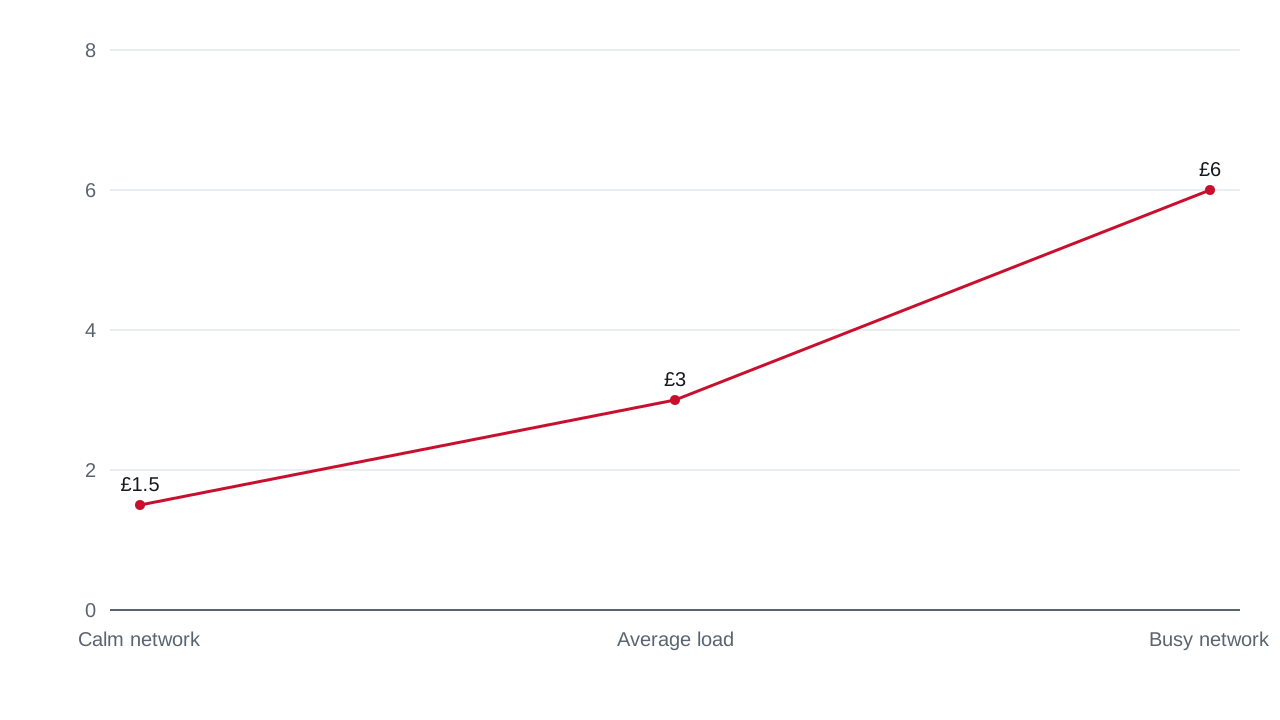
Put the gas bands beside the total. Funding the account costs a few pounds in the model on a £100 transfer, from £1.50 in a calm hour to £6 in a busy one, and the exit costs the same again. Against £3,000 of required stakes, the tolls round away to nothing. Against a small run on the same terms they do not: a £20 deposit carrying a £30 bonus and a £1,200 requirement pays the same fees as the larger run, and those fees are a visibly larger share of the money at stake.
The calculator lets each input move. Deposit, percent, multiplier and cap are the four levers, and the cap is the one readers skip: past the cap, extra deposit buys extra play balance but no extra bonus. Price the offer you are actually reading, not the headline percent.
Bonus credit £75.00.
Wagering before cash out £5,000.00 at 40 times.
Wagering per pound deposited 100 times.
Assumptions: spins return 90 percent of face value before wagering; session cost uses the stated house edge as expected loss of bankroll per session.
The Gambling Act 2005 places its offence provisions on operators and advertisers, not on individuals, so playing on an unlicensed overseas site is not an offence for the player. What the player gives up is protection: no British register entry, no approved dispute resolution, no GAMSTOP coverage and no credit card ban behind the offer. The licence question is about the operator, and the register settles it.
On the page's model, a £50 deposit with a 150 percent match produces a £75 bonus, and 40 times wagering on that bonus means £3,000 of stakes before a withdrawal makes sense. The base matters: if a cashier applies the multiplier to deposit plus bonus, the same offer means 40 times £125, or £5,000. Always find which base the terms name before pricing the offer.
The model on this page prices a £100 transfer at £1.50 in a calm hour, £3 at an average load and £6 when the network is busy, with a peak state near £9. A round trip costs the fee twice. Keep a small ether float sized to the busy band, because a wallet without ether cannot move a token balance at all.
A cap limits the bonus a deposit can earn, so the match stops growing once the cap is reached. On the page's model, a 150 percent match with a £400 cap stops binding deposits past roughly £267, and anything above that buys play balance but no extra bonus. Terms usually also set a clock for clearing wagering, and an expired bonus is typically forfeited, so check both lines.
It can. Wagering requirements at this end of the market are usually written in coin, so the pound value of the required stakes drifts while the market moves, and the withdrawal converts at whatever the rate is on the day. The effect runs both ways, which is the point: it is a variable, not a cost. A stablecoin credit removes the drift from the balance, though gas still floats.
The rail suits readers who already hold ether, are comfortable with a balance whose pound value moves, and can size deposits so the gas fee is a small share of the transfer. It fits poorly for anyone who wants fixed pound costs, is clearing a small budget where fees bite hardest, or would find a moving balance hard to track. The licence gap is a separate question worth its own check.
A British-licensed online casino takes debit cards and established e-wallets rather than coin, runs under the Gambling Act 2005, and can be checked on the Gambling Commission's public register in minutes. The licence brings GAMSTOP self-exclusion, approved dispute resolution, the credit card ban and declared funds protection. Welcome terms differ in shape, typically a match or spins with wagering in the 20 to 50 times range.
Timing is the one lever the reader holds, and the model shows why: the same £100 transfer prices at £1.50 in a calm state and £6 in a busy one, a spread of four times. Quiet hours are a pattern rather than a promise, so the practical version is to check the fee quote in the wallet before sending and to cancel the move if the quote lands in the top band.
Offers of this kind hold no UK Gambling Commission licence. That is not a technicality: it is the difference between a market with a public register, a national self-exclusion scheme, approved dispute resolution, a ban on credit card gambling, affordability checks and independently tested games, and a market with none of those guarantees. A dispute at a licensed operator goes to an approved scheme; an offshore dispute goes to the operator itself. Nothing on this page is an exception to that. If self-exclusion matters to you, GAMSTOP covers licensed operators only, and no tool on this page changes that.
Gambling can harm. For free, confidential support in the UK, call the National Gambling Helpline on 0808 8020 133 or contact BeGambleAware.
Keep reading
UK Gaming Club. Independent modelling of casino offers for British readers. No operator pays for a word on this page; board placement is bought and disclosed on the How We Are Paid page. 2026.