#1
Night Luck
8.2Editorial score
Casino welcome bonus 805% up to €6,400 + 280 FS
- MuchBetter · VISA · Apple Pay
- Crypto welcome 140% up to 1,600 USDT
- VIP pack 800% up to €14,500
Terms change often. Verify on the operator's own page.
Offers modelled before you claim
18+. Betting carries risk. Never stake more than you can afford to lose.
A tenner for a hundred spins at 10p is the market's standard exchange, ten to one on face value, and the wagering clause decides whether the expectation of £9.00 survives contact with the cashier.
The board is editorial and its placement is bought, which the disclosure page explains. Terms move without notice, so verify each line on the operator's own page.
Casino welcome bonus 805% up to €6,400 + 280 FS
Terms change often. Verify on the operator's own page.
Welcome bonus €/£5,000 + 500 FS
Terms change often. Verify on the operator's own page.
Welcome pack €5,000 + 500 FS + €650 free bet
Terms change often. Verify on the operator's own page.
Welcome package 300% up to €/£1,000 + 150 FS
Terms change often. Verify on the operator's own page.
On this page
Look across the slots pages of British-facing casinos and one shape recurs more than any other: put in £10, receive 100 spins, each priced at 10p. The deposit 10 get 100 free spins pattern is not the invention of a single marketing department. It is the compromise the market has settled on, because it balances three pressures at the same time and leaves every party with a number it can live with.
The first pressure is cost. A hundred spins at 10p commits the operator to £10 of face value, small enough to hand out widely and cheap enough to fund from an acquisition budget. The second is the reader’s own arithmetic: a tenner is about the smallest deposit most people consider worth the ceremony of an account, so the offer and the cashier meet at the same figure. The third is the wagering clause, and that is where the commercial work actually happens. The headline exchange reads ten to one; the terms decide what the exchange is worth once the clause has run.
Note the pairing, too. Fifty spins at 20p carries exactly the same £10 of face value, which is why the spin value belongs beside the count wherever the headline is quoted. A hundred is the bigger number and the one the advert leads with; 10p is the figure that prices it. Read the pair as one number split in two, and the offer stops being able to trade on the count alone.
That is why this page treats the deal as a small machine with four moving parts: the spin count, the spin value, the multiplier on winnings and the ceiling on withdrawals. Change any one of them and the machine returns a different answer, even where two headlines read identically. The sections that follow work one set of inputs: 100 spins at 10p, wagering at 35 times the winnings, a £150 ceiling. Those inputs are stated assumptions, chosen because they sit near the middle of what this end of the market asks, and each one can be checked against the terms of any offer you are actually weighing up.
On the surface the arithmetic is tidy. You deposit £10. The operator credits 100 spins worth 10p each, which is £10 of face value. Deposit against spins reads as a straight swap, ten pounds for ten pounds of rounds, a hundred pence of play for every pound staked.
Face value is not money, though. It is the price of the rounds, not the return from them. A 10p spin on a game that gives back, say, 96p per pound wagered carries an expectation of 9.6p, so ten pounds of face value holds an expectation nearer £9.60. This page’s model starts harsher: it assumes 90p comes back per pound, which produces the £9.00 used throughout. Published returns for online slots commonly sit in the 94 to 96 per cent band, so the model opens at a discount, and the discount is the price of not flattering the offer.
Then the terms take their turn. Offers at this price point almost always attach wagering to the winnings rather than to the spin value, and the multiplier is the second number that matters. At this end of the market the multiplier typically runs between 20 and 50 times, with 35 times the working midpoint. Set against £9.00 of expected winnings it demands £315.00 of turnover before anything derived from the spins can be withdrawn. The exchange rate has now moved twice: once from face value to expectation, and again from expectation to whatever survives the turnover. The rest of this page follows the money through both moves and treats neither as a detail.
Every offer of this kind can be described in four figures, and the chart below lines them up in the order the money meets them. The first bar is face value: £10.00, which is 100 spins multiplied by 10p, the number the headline sells and the only one of the four printed in full view. The second bar is expected winnings: £9.00, the face value run through the model’s 90 per cent return assumption. The third bar is the one most advertising leaves out: £3.20, the model’s estimate of what survives once £315.00 of wagering turnover has been played at that same assumed return. The fourth figure does not need a bar because it sits far above the action: the £150 ceiling, the most the terms will release from the deal.
At these inputs the ceiling never comes into play. A hundred 10p spins cannot build a balance that threatens £150, so the cap is a line on the horizon rather than a limit in the path. It starts to matter when the spin value fattens or the count grows, and any decent terms page will state it beside the multiplier. The table sets the stages out with the arithmetic attached, and the last column is where the reading of a real offer should begin: every row in it moves when one specific term moves, and that term is what you confirm before the deposit rather than after.
| Stage | Figure | How it was reached | What can change it |
|---|---|---|---|
| Face value | £10.00 | 100 times 10p | Stated spin value |
| Expected winnings | £9.00 | 90 per cent assumption | The named game return |
| Wagering | £315.00 | 35 times the winnings | Multiplier band |
| Cashout | min of balance and cap | printed ceiling | The cap line |
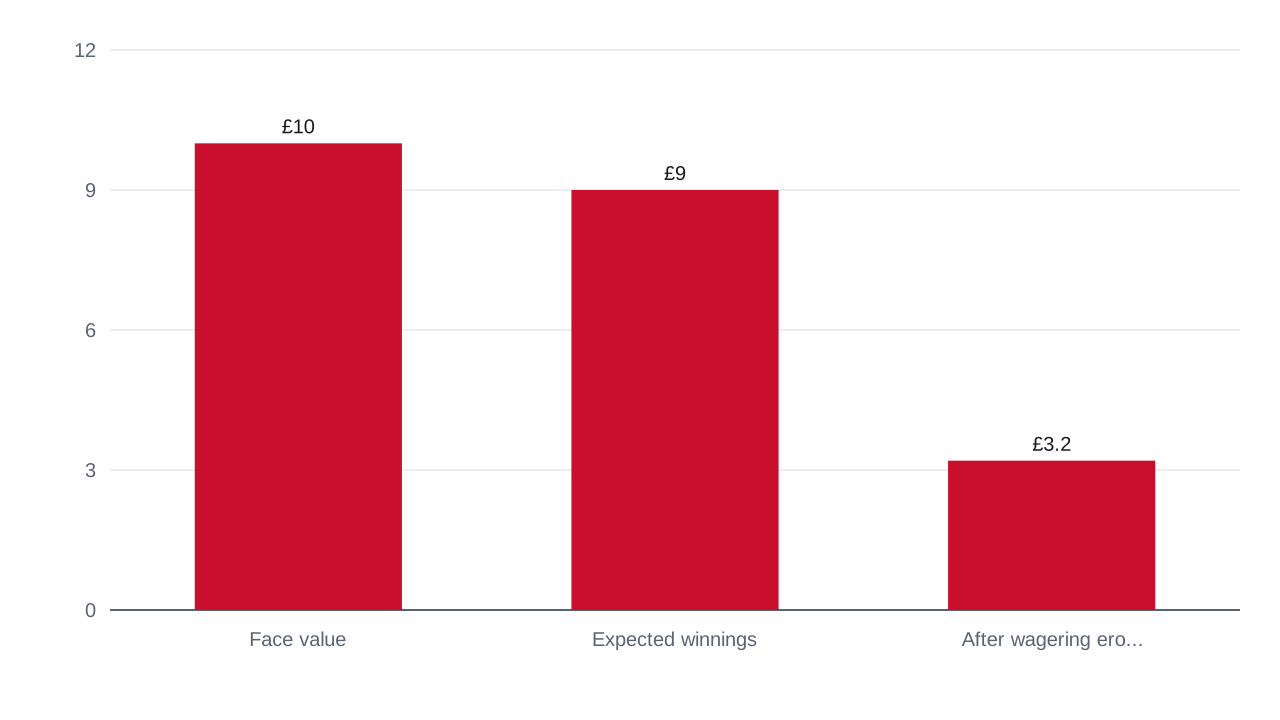
Spins face value £10.00.
Estimated winnings before wagering £9.00 at a 90 percent return.
Wagering £3.15.
Cashable £9.00.
Assumptions: spins return 90 percent of face value before wagering; session cost uses the stated house edge as expected loss of bankroll per session.
The Gambling Act 2005 places the offence on operators and advertisers, not on individual players, so someone in Britain who plays on an unlicensed overseas site commits no offence. What that player gives up is protection: no British register entry, no approved dispute route, no GAMSTOP coverage and none of the Commission's rules on payments or game testing. The lawful choice and the protected choice are the same one.
The multiplier applies to what the spins win, not to what they cost. On this page's model the 100 spins at 10p are expected to leave £9.00, and 35 times that figure is £315.00 of stakes that must be placed before a withdrawal is allowed. The stakes come out of the balance itself, so the turnover erodes the winnings while it runs, which is why the model's surviving figure is £3.20 rather than £9.00.
Not at a licensed British operator. Since 14 April 2020 the Gambling Commission has prohibited licensed operators from accepting credit card gambling, online and offline, so a £10 deposit at a UKGC-licensed casino goes on a debit card or another permitted rail. Sites without a UK licence are not bound by that prohibition, which is one more difference the licence makes, and one more reason the register check comes before the payment.
The usual rule is forfeiture: whatever part of the bonus-derived balance remains when the clock runs out is removed, and only funds that never belonged to the bonus can be withdrawn. Expiry dates sit in the terms, and they commonly run from the moment the offer is granted. Clearing £315.00 of turnover inside the window is the practical challenge of the whole deal, which is why the section on pacing treats the clocks as seriously as the multiplier.
It suits a reader who wants a bounded, low-cost look at a casino: the £10 deposit is a known cost, the spins cost nothing to use, and the most the offer itself can take is the tenner. It suits badly anyone who expects the £150 ceiling to be a target, because the arithmetic on the standard inputs never gets near it. Anyone who finds the turnover clause a chore is better off with a no-wagering deal.
Because the licence is where the protections live. A Gambling Commission licensee appears on the public register, accepts no credit cards, offers approved dispute resolution and takes part in GAMSTOP. An operator with no UK licence offers none of that, whatever its terms say about wagering or payouts. The deal can look identical on the surface; the difference is what happens when something goes wrong.
No. Gambling winnings are not treated as taxable income for individual UK gamblers, and that holds regardless of where the operator is licensed, so the licence gap does not change the tax position. The operator pays duty on its British-facing gaming profits; the player does not file anything on a win from spins, a match credit or the wagering that follows. Any figure the calculator prints is already a gross amount in that sense.
It cannot. What the calculator does is combine the inputs you give it, the spin count, the value, the multiplier and the cap, with a stated return assumption, and print the expectation at each stage. Individual sessions land all over the distribution: some paths empty the balance early, a few finish the wagering with more than the average. The model describes the middle of that spread, and no figure on this page is a prediction of any single session.
Offers of this kind hold no UK Gambling Commission licence. That is not a technicality: it is the difference between a market with a public register, a national self-exclusion scheme, approved dispute resolution, a ban on credit card gambling, affordability checks and independently tested games, and a market with none of those guarantees. A dispute at a licensed operator goes to an approved scheme; an offshore dispute goes to the operator itself. Nothing on this page is an exception to that. If self-exclusion matters to you, GAMSTOP covers licensed operators only, and no tool on this page changes that.
Gambling can harm. For free, confidential support in the UK, call the National Gambling Helpline on 0808 8020 133 or contact BeGambleAware.
Keep reading
UK Gaming Club. Independent modelling of casino offers for British readers. No operator pays for a word on this page; board placement is bought and disclosed on the How We Are Paid page. 2026.