#1
Night Luck
8.2Editorial score
Casino welcome bonus 805% up to €6,400 + 280 FS
- MuchBetter · VISA · Apple Pay
- Crypto welcome 140% up to 1,600 USDT
- VIP pack 800% up to €14,500
Terms change often. Verify on the operator's own page.
Offers modelled before you claim
18+. Betting carries risk. Never stake more than you can afford to lose.
A 100 percent match at 30 times on a £20 deposit costs £1,200 of stakes, and a site earns the word best by making that arithmetic readable, not by shouting the percentage.
The board is editorial and its placement is bought, which the disclosure page explains. Terms move without notice, so verify each line on the operator's own page.
Casino welcome bonus 805% up to €6,400 + 280 FS
Terms change often. Verify on the operator's own page.
Welcome bonus €/£5,000 + 500 FS
Terms change often. Verify on the operator's own page.
Welcome pack €5,000 + 500 FS + €650 free bet
Terms change often. Verify on the operator's own page.
Welcome package 300% up to €/£1,000 + 150 FS
Terms change often. Verify on the operator's own page.
The phrase best gambling sites is printed on thousands of banners, and very few of those banners say what the word is supposed to measure. Payout speed, match size, lobby depth and term fairness all compete for the same adjective, and a page that shouts all four at once has said nothing at all. This page takes a narrower position: a site deserves the word when its paperwork survives five checks, and it loses the word the moment the paperwork hides the figures those checks need.
A ranking is a snapshot. It freezes a set of offers on the day it was compiled, and every percentage inside it can be rewritten before the week is out. A standard is a different object: it describes the method, so the method keeps working when the numbers underneath move. That is why this page is built as a rubric rather than a league table. Five checks, each carrying a weight, each carrying a disqualifier, and one worked deposit at the centre so that every claim can be priced in pounds.
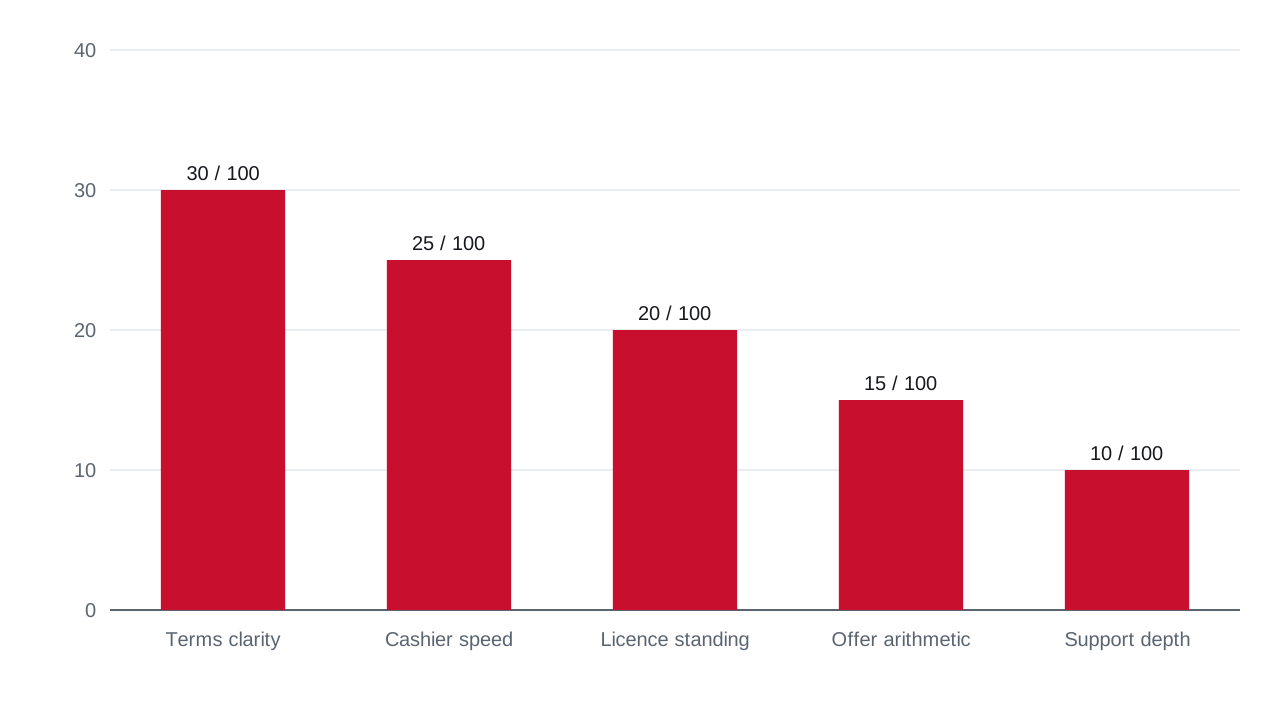
The weights are the page’s model, not a measurement of the market: terms clarity 30, cashier speed 25, licence standing 20, offer arithmetic 15, support depth 10. The order carries the argument. Clarity leads because readable terms are the only guard a reader carries into a promotion. The cashier follows because a win that cannot be withdrawn is the oldest disappointment in this market.
Eligibility comes before scoring. A site with no British register entry is not scored badly; it is not scored at all, for reasons section three sets out. Everything after that line is arithmetic, and arithmetic is the part a reader can reproduce without trusting anybody, including this page.
Take the deposit this page uses throughout: £20. A 100 percent match doubles it, so the bonus is £20 and the playable balance is £40. The multiplier is 30 times. The price of the offer is the total stake the terms demand before a withdrawal unlocks, and that figure turns on a single line: whether the multiplier applies to the bonus alone or to deposit plus bonus. This page assumes the wider base, deposit plus bonus, because that is the heavier and still common shape at this end of the market. On that assumption the requirement is £40 at 30 times, which is £1,200 of stakes.
The cap in the model sits at £200. A cap on a match limits the largest bonus any deposit can earn, so a 100 percent match capped at £200 pays pound for pound until a deposit passes £200, and pays a flat £200 beyond it. A £20 deposit sits far below that line, the match is £20, and the cap never bites. Where a cap does bite, the effective percentage falls and the arithmetic changes shape, which is why the cap belongs beside the percentage in any honest summary.
Two refinements keep the model honest. If the terms weight the bonus only, the same deposit costs £600 of stakes, half the headline figure, which is why the weighting line matters more than the percentage beside it. If the offer attaches spins, those carry their own rules and are priced separately in section six. And the stakes themselves are not free: across the commonly published 94 to 96 percent return band for slots, an assumption of this market rather than a measurement, £1,200 of stakes carries an expected shortfall of roughly £48 to £72.
That last figure is the one to carry out of this section. The bonus is £20. The expected cost of unlocking it, under the assumptions stated, is several times larger. No percentage on a banner changes that shape. Only a lower multiplier, a narrower base or a plainly costed cashback does.
Bonus credit £20.00.
Wagering before cash out £1,200.00 at 30 times.
Wagering per pound deposited 60 times.
Assumptions: spins return 90 percent of face value before wagering; session cost uses the stated house edge as expected loss of bankroll per session.
The offence provisions of the Gambling Act 2005 fall on operators and advertisers, not on individuals. Playing on an unlicensed overseas site is not a criminal act for the player. What you give up is protection: no public register entry, no approved dispute resolution and no British self-exclusion coverage. The lawful question and the protected question have different answers, and this page prices the second one.
It depends on the base the terms name. On a £20 deposit with a 100 percent match, a multiplier applied to deposit plus bonus gives £40 at 30 times, or £1,200 of stakes; applied to the bonus only it gives £600. The weighting line in the bonus terms decides which figure applies, and the cap tells you the largest match a deposit can earn.
The bands this market usually publishes, stated here as assumptions rather than measurements, run: e-wallets 0 to 24 hours, debit cards 1 to 3 banking days, bank transfer 1 to 5 banking days, crypto minutes to a few hours. A window outside those bands is a known cost, and a cashier that publishes no window at all should be treated as the slowest case until the operator writes one down.
Three figures do most of the damage. The match cap limits the largest bonus a deposit can earn. The cashout cap limits what bonus winnings can be converted, typically £50 to £500 on no-deposit offers by assumption. The expiry clock cuts off unfinished wagering. If any of the three cannot be found in the terms, the rubric treats it as a disqualifier rather than a low score.
Readers who have priced the stakes and accepted them. A match at 30 times on deposit plus bonus asks for £1,200 of stakes from a £20 deposit, which only fits a budget that treats wagering as the cost of entry. Smaller budgets usually suit spins on registration or cashback on losses, where the absolute stakes are smaller and the clocks run shorter.
A register entry against a named entity, coverage by GAMSTOP self-exclusion, access to an approved alternative dispute resolution provider, the credit card ban and a published rating for how customer funds are held. An offshore site, as a class, participates in none of those arrangements. The banner can look similar; the protections are the difference the licence column is marking.
No. The rubric measures how readable and workable a site's arrangements are, not what a session will return. Published slots commonly sit around 94 to 96 percent return by assumption, which means staking carries an expected shortfall over time whatever the operator's score. The standard exists so the price and the process are visible before a deposit, not to predict an outcome.
The worked example and the weights are a model, fixed so the arithmetic can be checked. Offer terms are different: they change without notice, and any figure you intend to rely on should be read on the operator's own terms page on the day you deposit. Treat everything else, including the ranges in tables, as a starting point for that check.
Offers of this kind hold no UK Gambling Commission licence. That is not a technicality: it is the difference between a market with a public register, a national self-exclusion scheme, approved dispute resolution, a ban on credit card gambling, affordability checks and independently tested games, and a market with none of those guarantees. A dispute at a licensed operator goes to an approved scheme; an offshore dispute goes to the operator itself. Nothing on this page is an exception to that. If self-exclusion matters to you, GAMSTOP covers licensed operators only, and no tool on this page changes that.
Gambling can harm. For free, confidential support in the UK, call the National Gambling Helpline on 0808 8020 133 or contact BeGambleAware.
Keep reading
UK Gaming Club. Independent modelling of casino offers for British readers. No operator pays for a word on this page; board placement is bought and disclosed on the How We Are Paid page. 2026.