#1
Night Luck
8.2Editorial score
Casino welcome bonus 805% up to €6,400 + 280 FS
- MuchBetter · VISA · Apple Pay
- Crypto welcome 140% up to 1,600 USDT
- VIP pack 800% up to €14,500
Terms change often. Verify on the operator's own page.
Offers modelled before you claim
18+. Betting carries risk. Never stake more than you can afford to lose.
A bitcoin transfer costs roughly the same whether you move the equivalent of £20 or £500, so on small balances the fixed network fee is the first term to price, ahead of any multiplier.
The board is editorial and its placement is bought, which the disclosure page explains. Terms move without notice, so verify each line on the operator's own page.
Casino welcome bonus 805% up to €6,400 + 280 FS
Terms change often. Verify on the operator's own page.
Welcome bonus €/£5,000 + 500 FS
Terms change often. Verify on the operator's own page.
Welcome pack €5,000 + 500 FS + €650 free bet
Terms change often. Verify on the operator's own page.
Welcome package 300% up to €/£1,000 + 150 FS
Terms change often. Verify on the operator's own page.
On this page
Ask what a rail does to a cashier before asking what a promotion does to a balance. Three things change when the deposit leg is a coin transfer. First, a charge arrives that does not scale: a fixed network fee that costs the same whether the transfer carries £20 or £500. Second, the money waits for confirmations before it reaches a balance, and the length of that wait belongs to the network as much as to the operator. Third, the balance itself sits in an asset whose sterling value moves while you play.
None of this changes the arithmetic of a bonus; it changes the order of the reading. On a card cashier the first line to price is the match percent, because the deposit leg rarely carries a visible charge of its own. On a coin cashier the first line is the fee, because at small sizes it takes a visible slice before the match has done anything. On the model used across this page, a £2.50 charge takes 12.5 percent of a £20 transfer and 0.5 percent of a £500 one.
There is a second consequence that is easier to miss. The rail is indifferent to licensing: the same transfer confirms at a cashier regulated in Britain and at one that is not. Speed and cost therefore say nothing about protection, and the two questions need separate answers. The best bitcoin casino question, asked properly, is a cashier question before it is a promotions question: what the rail costs, how long it takes, and what the licence adds. This page answers in that order, and it refuses to let the first answer stand in for the third.
A coin deposit does not land when you press send. It lands when the network has confirmed it, and the operator decides how many confirmations are enough. A confirmation is a block that carries the transaction, or one that builds on the block that carried it, and new blocks arrive on a rhythm measured in minutes that varies around an average rather than to a schedule. That single detail explains most of the waiting a deposit does.
Operators set their own confirmation counts. One confirmation is the fastest a balance can move; asking for three is common in this market; some cashiers want more for larger amounts. Each extra confirmation adds another block interval, so the deposit window at one cashier can run several times the window at another without either being slow. The fee attached to the transfer matters as well: a transfer priced generously tends to be picked up in earlier blocks than one priced at the floor.
The exchange-rate lock is the detail many readers meet only when a balance arrives smaller than expected. Some cashiers convert at broadcast, some at the first confirmation, some at credit. On a quiet stretch of network the differences are pence; on a busy one they can be pounds. The page’s model prices none of this spread, because it moves with conditions, but the spread belongs on the list of what a confirmation window actually contains.
Withdrawals run the same machinery in reverse with one addition: the operator’s approval queue sits in front of the broadcast. As a modelling band, this site treats crypto payouts as minutes to a few hours once approved, and treats anything beyond that as cashier-specific. The honest summary is that the rail is usually quick and never exact, and a cashier quoting a precise minute count is quoting its best case rather than a schedule it controls.
The calculator below opens on a worked model, and the assumptions are the point, so they come first. The deposit is £50. The match is 150 percent, taken because offers of this kind commonly publish matches in the low hundreds and 150 percent sits inside that band rather than at its edge. The multiplier is 40 times, taken because multipliers on offers of this sort typically run between 20 and 50 times and 40 errs toward the heavy end, which is where an example teaches most. The cap is £400, taken because conversion caps in this corner of the market commonly sit in the hundreds of pounds.
Run the model. A £50 deposit with a 150 percent match produces a £75 bonus. The multiplier applies to the bonus unless the terms say otherwise, so the staking requirement is 40 times £75, which is £3,000. At an average turn of £2 that is 1,500 turns; at £5 it is 600. The cap then does its quiet work: however the run ends, £400 is the most that converts into withdrawable funds, and any balance above the line at the end stays behind.
Two details change the arithmetic in practice and neither is in the model. Some terms apply the multiplier to deposit plus bonus combined, which roughly doubles the requirement, so the phrase to find is which balance the multiplier attaches to. Some terms compute the match on the amount that arrives after the network fee rather than on the amount requested, which trims the bonus by the fee’s share. The calculator holds the request at £50 and prices the fee separately; where terms compute on arrival, the worked example on this page runs fractionally generous, and the size of that generosity is the next section’s subject.
Bonus credit £75.00.
Wagering before cash out £5,000.00 at 40 times.
Wagering per pound deposited 100 times.
Assumptions: spins return 90 percent of face value before wagering; session cost uses the stated house edge as expected loss of bankroll per session.
Under the Gambling Act 2005, the offence provisions fall on operators and advertisers, on those providing gambling facilities or advertising them without a licence. The Act sets no offence for a person who plays on an unlicensed overseas site. What you lose is protection rather than legality: no British register entry, no approved dispute resolution route, and none of the obligations a Gambling Commission licence carries.
Take the model on this page: a £50 deposit with a 150 percent match produces a £75 bonus. Forty times that bonus is £3,000 of staked turns before bonus winnings become withdrawable. At an average turn of £2 that is 1,500 turns, at £5 it is 600. The multiplier attaches to the bonus unless the terms state otherwise, so finding which balance it applies to is the reading that matters most.
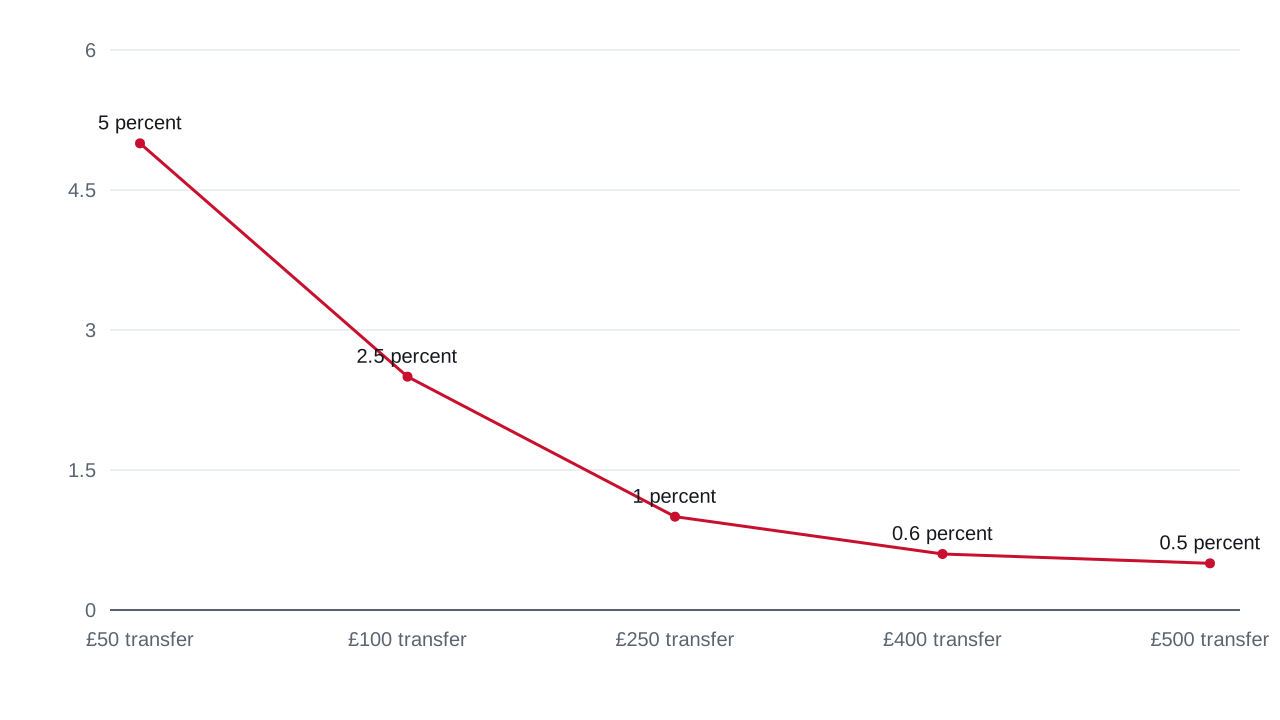
Because the fee is fixed while the deposit is not. On this page's model, a £2.50 charge takes 5 percent of a £50 transfer, 1 percent of £250 and 0.5 percent of £500, and the chart below plots that curve across five sizes. The charge does not grow with the amount, so the smallest transfers pay the steepest share, and the share flattens once the transfer passes a few hundred pounds.
A cap limits what a bonus run can convert into withdrawable funds, whatever the balance reaches on the way. On the model, a £75 bonus at 40 times carries a £3,000 requirement and a £400 ceiling: if the run ends at £600, £400 leaves and the rest stays behind. Caps of this sort commonly sit in the hundreds, and the exact figure always lives in the operator's own terms.
The rail suits a reader who transfers larger amounts infrequently, because a fixed fee shrinks as a share of a bigger transfer, and who is comfortable holding a balance whose sterling value moves while it sits in coin. It suits badly where deposits are small, where the fee share bites hardest, or where a 10 percent swing during a multi-day wagering run would change how you play.
A Gambling Commission licence brings a public register entry, participation in GAMSTOP self-exclusion, access to an approved dispute resolution provider, the credit card gambling ban in force since April 2020, and fairness testing through approved test houses. An offshore cashier carries none of that coverage, whatever its promotions show. The coin rail wins on speed and fee structure; the licensed cashier wins on everything a register can check.
The sterling value falls with it, before any game outcome is counted: a £250 balance in coin becomes £225 on a 10 percent drop. The wagering requirement keeps its size in coin, so the run's duration, not the outcome of any turn, sets how much of the move you carry. Converting sooner, where the cashier holds balances in sterling, and choosing a multiplier you can clear in one sitting both shrink the exposure.
Two clocks run in sequence. The operator approves the payout first, and that queue varies by cashier and by the checks it runs; the modelling band used across this site treats crypto payouts as minutes to a few hours once approved. The network then confirms the transfer, which depends on the fee attached and on block intervals that vary through the day. Floors and fixed payout fees sit in the terms, not in the network.
Offers of this kind hold no UK Gambling Commission licence. That is not a technicality: it is the difference between a market with a public register, a national self-exclusion scheme, approved dispute resolution, a ban on credit card gambling, affordability checks and independently tested games, and a market with none of those guarantees. A dispute at a licensed operator goes to an approved scheme; an offshore dispute goes to the operator itself. Nothing on this page is an exception to that. If self-exclusion matters to you, GAMSTOP covers licensed operators only, and no tool on this page changes that.
Gambling can harm. For free, confidential support in the UK, call the National Gambling Helpline on 0808 8020 133 or contact BeGambleAware.
Keep reading
UK Gaming Club. Independent modelling of casino offers for British readers. No operator pays for a word on this page; board placement is bought and disclosed on the How We Are Paid page. 2026.