#1
Night Luck
8.2Editorial score
Casino welcome bonus 805% up to €6,400 + 280 FS
- MuchBetter · VISA · Apple Pay
- Crypto welcome 140% up to 1,600 USDT
- VIP pack 800% up to €14,500
Terms change often. Verify on the operator's own page.
Offers modelled before you claim
18+. Betting carries risk. Never stake more than you can afford to lose.
Wagering on a fifty spin set applies to the winnings, not the spins, so a £4.50 expectation at 35 times carries a £157.50 stake target, and that single distinction explains most of the disappointment.
The board is editorial and its placement is bought, which the disclosure page explains. Terms move without notice, so verify each line on the operator's own page.
Casino welcome bonus 805% up to €6,400 + 280 FS
Terms change often. Verify on the operator's own page.
Welcome bonus €/£5,000 + 500 FS
Terms change often. Verify on the operator's own page.
Welcome pack €5,000 + 500 FS + €650 free bet
Terms change often. Verify on the operator's own page.
Welcome package 300% up to €/£1,000 + 150 FS
Terms change often. Verify on the operator's own page.
On this page
One clause decides every spin set, and it is not the number of spins. Wagering attaches to the winnings the set leaves behind, not to the spins and not to their face value. Fifty spins at 10p each amount to £5.00 of play, yet that £5.00 never reaches the balance as cash. What reaches it is whatever the spins won, and the model running through this page carries that figure at £4.50. The multiplier then works on the £4.50 alone.
The consequence is arithmetic, and it is gentler than most people expect. A 35 times clause on a £4.50 base does not ask for £175.00 of stakes, which is where a careless reading of the spin value lands. It asks for £157.50. The two readings sit close together here only because the base is small; on a set with richer winnings the gap between the wrong base and the right one widens fast.
Terms at this end of the market usually word the clause so that the winnings carry the multiplier, and everything below assumes exactly that. A minority of offers count the spin value itself as the bonus and wager on that instead, which inflates the target whenever the winnings run below the face value of the play. So the base is the first line to confirm on any terms page: find the sentence that names what the multiplier multiplies, because the target, the session count and the cost of clearing it all inherit that sentence.
The £4.50 is a stated assumption, not a forecast and not a measurement. A small set at a small stake value tends to produce a small winnings line, and £4.50 is an ordinary figure for the shape. Treat it as the model’s load: the page tests what the terms do to that load, not what the spins will do on the day.
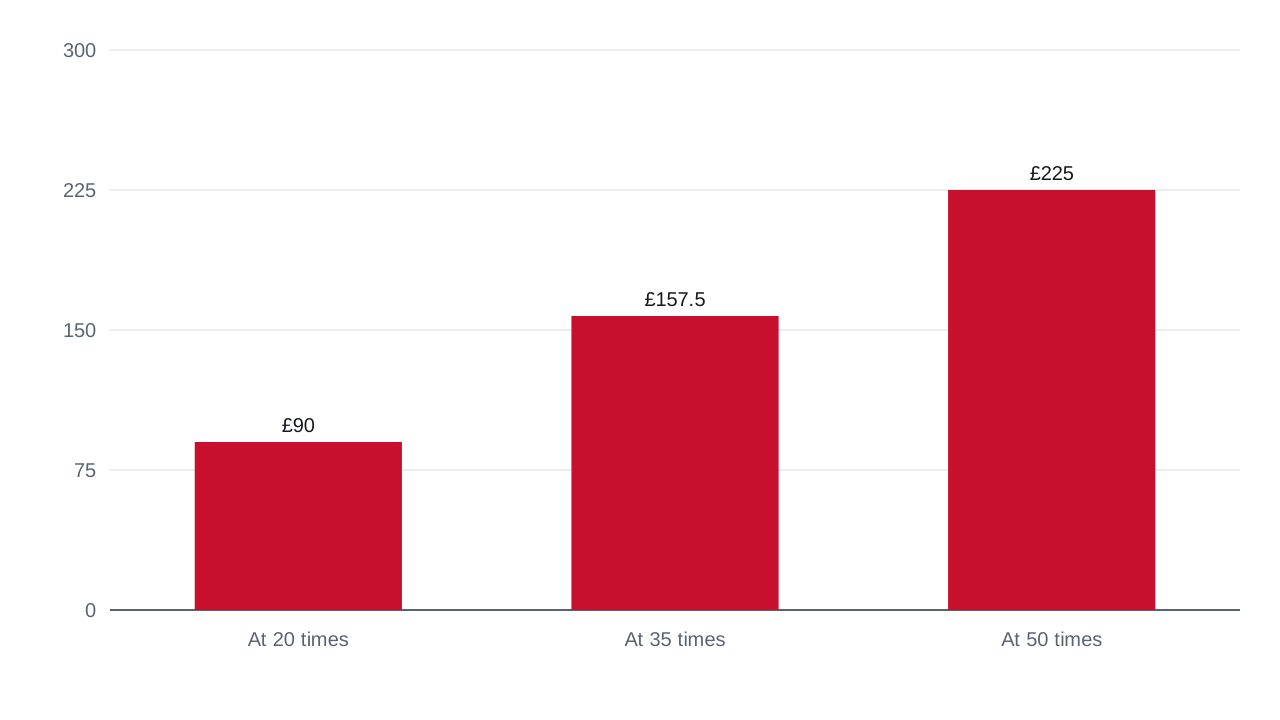
Hold the £4.50 base still and let the multiplier move. At 20 times, the tame end of the ordinary band, the target is £90.00. At 35 times, the midpoint this site uses when it models offers of this kind, the target is £157.50. At 50 times, the fierce end, it is £225.00. The chart below plots the three figures in pounds, and the shape is a straight line, because each additional times adds one more £4.50 of required stake.
| Multiplier | Stake target | Sessions at £10 a session | What erodes it |
|---|---|---|---|
| 20 times | £90.00 | 9 | house edge during play |
| 35 times | £157.50 | 16 | house edge during play |
| 50 times | £225.00 | 23 | house edge during play |
| No wagering | none | 0 | nothing but the clock |
The sessions column divides each target by a £10 sitting, which is an assumption about how the work gets scheduled rather than a recommendation. Nine sittings at 20 times, sixteen at 35 times, twenty-three at 50 times, with the fractions rounded up because a part sitting still costs an evening. The final row is the control case. Where terms put no multiplier on the winnings, the target is nothing, the sittings count is zero, and the only force racing the player is the expiry clock.
Two conclusions fall out of that straight line. First, the multiplier is the strongest term on the page: it moves the required stake by two and a half times between the softest clause and the hardest within the band the market normally offers. Second, nothing else comes close. The count of spins and the value per spin only set the base, and the base is small by design. The multiplier sits on top of it and scales everything, which is why the rest of this page keeps returning to that one number.
Spins face value £5.00.
Estimated winnings before wagering £4.50 at a 90 percent return.
Wagering £1.58.
Cashable £4.50.
Assumptions: spins return 90 percent of face value before wagering; session cost uses the stated house edge as expected loss of bankroll per session.
The Gambling Act 2005 places the offence on operators and advertisers, not on the player: providing or advertising gambling without a licence breaks the law, while an individual who plays on an unlicensed overseas site commits no offence. What you lose is protection, not legality. An unlicensed site appears on no British register, so none of the enforcement machinery behind a licensed offer stands behind it.
On the usual no-deposit shape it applies to the winnings the spins leave behind, not to the spins or their value. Fifty spins at 10p are £5.00 of play, but the clause takes a figure such as £4.50 of winnings and multiplies that. Terms are occasionally worded the other way, counting the spin value itself, so the base is the first line to confirm.
Category-typical windows run from 0 to 24 hours for e-wallets, 1 to 3 banking days for debit cards, and 1 to 5 banking days for bank transfer, with crypto rails often settling in minutes to a few hours where they are offered. These bands are assumptions for modelling, not measurements, and the terms and cashier pages of the site in front of you carry the operative figures.
The ordinary consequence is forfeiture: the winnings from the set, and anything left of the bonus, are removed when the window closes. A minority of terms return whatever portion was already cleared, but most simply expire the whole arrangement. Divide the target by the days available before you start, because a target that is affordable across a month can be unreachable across a week.
Caps exist because a no-deposit set costs the operator very little and a single fortunate spin could otherwise pay out far beyond the cost of the promotion. Typical ceilings run from £50 to £500, and £100 is the working assumption this site models with. The cap limits what can be withdrawn; it does not reduce the stake target, which is set by the multiplier on the winnings.
They suit a reader who wants to see a casino's lobby and cashier without putting money down first, and who treats the winnings as a small, capped sum rather than an income. They also suit anyone comparing how different sites word the same clause. They do not suit anyone chasing a meaningful balance, because the base is small, the target is large by comparison, and the clock is short.
A set from an operator holding a Gambling Commission licence. The British market includes sites that run spin sets with no multiplier on the winnings at all, which removes the stake target entirely, and every licensed offer sits under the register, the credit card ban, approved dispute resolution and GAMSTOP. The terms still need reading, but the protections arrive as standard.
No. Gambling winnings are not treated as taxable income for individual UK gamblers, and that holds regardless of where the operator is licensed, so the licence gap does not change your tax position. Remote gaming duty is charged to the operator on British-facing profits, not to the player. The cost that matters at your end is arithmetic: the stake target and the house edge, not the taxman.
Offers of this kind hold no UK Gambling Commission licence. That is not a technicality: it is the difference between a market with a public register, a national self-exclusion scheme, approved dispute resolution, a ban on credit card gambling, affordability checks and independently tested games, and a market with none of those guarantees. A dispute at a licensed operator goes to an approved scheme; an offshore dispute goes to the operator itself. Nothing on this page is an exception to that. If self-exclusion matters to you, GAMSTOP covers licensed operators only, and no tool on this page changes that.
Gambling can harm. For free, confidential support in the UK, call the National Gambling Helpline on 0808 8020 133 or contact BeGambleAware.
Keep reading
UK Gaming Club. Independent modelling of casino offers for British readers. No operator pays for a word on this page; board placement is bought and disclosed on the How We Are Paid page. 2026.