#1
Night Luck
8.2Editorial score
Casino welcome bonus 805% up to €6,400 + 280 FS
- MuchBetter · VISA · Apple Pay
- Crypto welcome 140% up to 1,600 USDT
- VIP pack 800% up to €14,500
Terms change often. Verify on the operator's own page.
Offers modelled before you claim
18+. Betting carries risk. Never stake more than you can afford to lose.
Twenty five spins at 10p carry £2.50 of face value, and on the usual 90 percent assumption that models to £2.25 of expected winnings before 35 times wagering and a cap decide what any of it is worth.
The board is editorial and its placement is bought, which the disclosure page explains. Terms move without notice, so verify each line on the operator's own page.
Casino welcome bonus 805% up to €6,400 + 280 FS
Terms change often. Verify on the operator's own page.
Welcome bonus €/£5,000 + 500 FS
Terms change often. Verify on the operator's own page.
Welcome pack €5,000 + 500 FS + €650 free bet
Terms change often. Verify on the operator's own page.
Welcome package 300% up to €/£1,000 + 150 FS
Terms change often. Verify on the operator's own page.
On this page
Twenty five spins with nothing to deposit is the smallest package this market hands out on any scale, and it rewards a close reading precisely because of that. The shape is always the same. An account is opened, the spins are credited to it, and they are played on one named slot, occasionally on a short list of two or three games. No card details are requested in the usual wording, and nothing is matched: the grant is a fixed number of rounds at a fixed value per round, funded entirely by the operator.
The number that matters is not the count. It is the value printed beside each spin. Twenty five spins at 2p carry 50p of face value; twenty five at 10p carry £2.50. The headline count is identical and the underlying package differs by a factor of five, which is why a search for 25 free spins on registration no deposit returns offers that look like twins and are not. Count is the advertising. Value is the product.
One more distinction belongs at the top of the page. Winnings from spins of this kind do not usually land as cash. They land as bonus funds, which means they arrive with conditions attached: a wagering multiplier, a deadline, often a cap on what can be withdrawn. The spins themselves cost nothing, and no money of yours is staked at any point in the process. The conditions attached to what they produce are where the value is actually decided, and the rest of this page works through those conditions line by line with every assumption left in the open.
Spin values on registration grants are not plucked from the air, but they are not generous either. Across offers of this kind, the stated value per spin typically sits between 5p and 20p. That band is the first assumption on this page, and 10p is the working figure because it sits in the middle of it: common enough to describe the market honestly, high enough not to flatter the arithmetic that follows.
Two refinements belong here. First, read the wording with care. A term promising spins worth up to 20p is quoting a ceiling, and the actual figure can sit lower; a term stating a flat 10p per spin is the cleaner document and the easier one to model. Second, the value is fixed while the return is not. The paytable of the named game decides what each spin gives back over the long run, and published slots commonly sit around 94 to 96 per cent. The model on this page assumes 90 per cent, deliberately a few points under that band, so that the arithmetic errs against the offer rather than for it.
The reason to fix on value rather than count is that every later number scales from it. Expected winnings are value times count times return. The wagering bill is that figure times the multiplier. Even the cap is read against it, since a cap only binds when a balance climbs past it. A grant of twenty five spins at 10p is a £2.50 machine; the same count at 5p is a £1.25 machine, and every line downstream shrinks in proportion. That is the whole argument for checking the value line before anything else on the terms sheet.
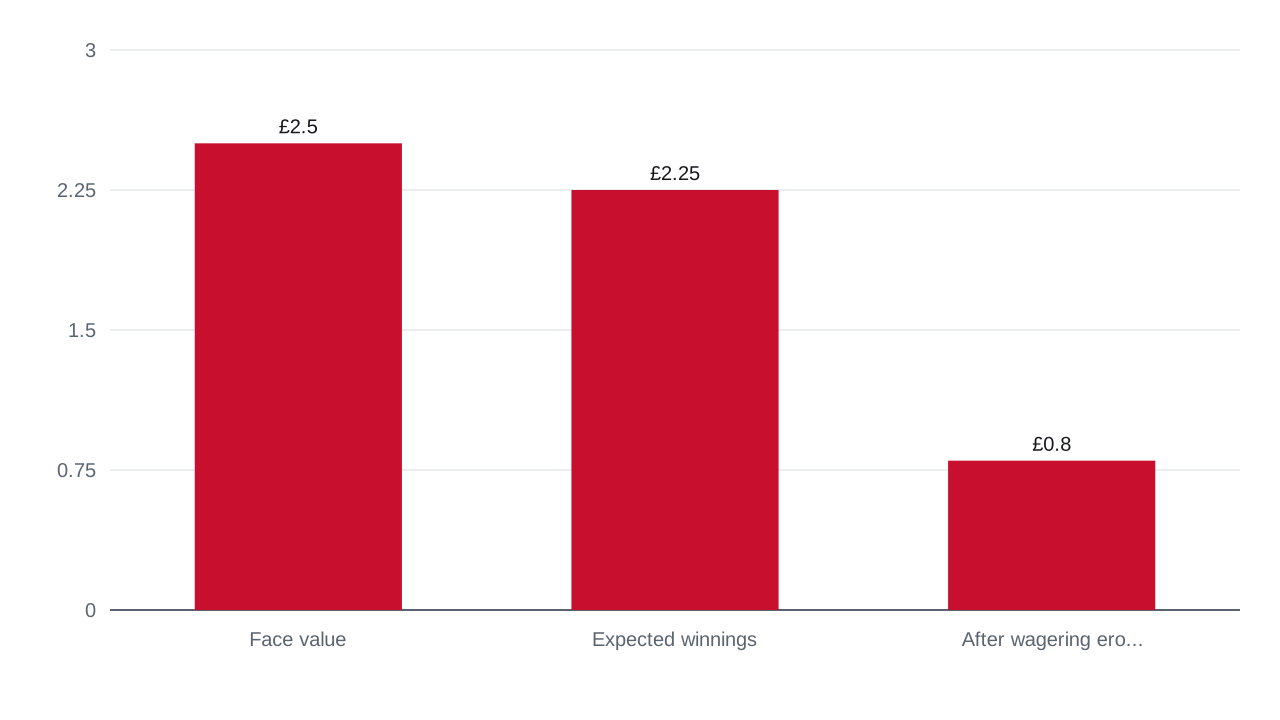
Put the assumptions to work and the package resolves into three figures. The face value is the simplest: twenty five spins at 10p each is 25 times £0.10, or £2.50. Nothing has been won at this stage. That figure is the total stake the operator is putting up on the player’s behalf, and it is the number the offer’s marketing is built around.
Apply the return assumption and the face value becomes expected winnings: £2.50 at 90 per cent is £2.25. This is a long-run average, not a forecast for any single set of spins. Twenty five rounds is a small sample and can land anywhere from nothing to a few pounds over the line; the cap discussed below is what handles the top of that range.
The third figure is the wagering bill. The model takes 35 times the winnings, the midpoint of the 20 to 50 times band typical of such offers, and 35 times £2.25 is £78.75 of required turnover. The model’s erosion step then prices that turnover: it assumes a loss of a little under two pence per pound wagered, which is about £1.45 across the requirement, and that takes the £2.25 down to £0.80.
Two things should be said about that erosion rate. It is an assumption written into the model, not a measurement of any game. And it is the gentlest rate the model could defensibly use. Price the same turnover at the four pence implied by a 96 per cent game, the top of the published band, and the cost comes to £3.15, which is more than the balance being wagered; the expected remainder falls to nothing. Wagering erosion is the stage that can take the whole prize, and any model that pretends otherwise is selling something.
| Stage | Figure | How it was reached | What can change it |
|---|---|---|---|
| Face value | £2.50 | 25 times 10p | A lower stated spin value |
| Expected winnings | £2.25 | 90 percent assumption | Real return of the named game |
| Wagering | £78.75 | 35 times the winnings | Multiplier from 20 to 50 |
| Cashout | up to £50 cap | min of balance and cap | The printed cap |
The chart below draws the three stages as bars: £2.50 of face value, £2.25 of expected winnings, £0.80 after the erosion step. It is the offer in miniature, and the table above records how each bar was reached and which assumption moves it.
Spins face value £2.50.
Estimated winnings before wagering £2.25 at a 90 percent return.
Wagering £0.79.
Cashable £2.25.
Assumptions: spins return 90 percent of face value before wagering; session cost uses the stated house edge as expected loss of bankroll per session.
The spins cost nothing to claim and no deposit is asked for, so no money of yours is staked. What they produce is not free money, though. Winnings usually land as bonus funds with a wagering multiplier, a deadline and often a withdrawal cap attached. On this page's model, £2.50 of face value becomes £2.25 of expected winnings and about £0.80 after wagering erosion, which is the honest size of the prize.
Yes, for the player. The offence provisions of the Gambling Act 2005 fall on operators and advertisers, on those providing gambling facilities or advertising them without a licence, and the Act creates no offence for an individual who plays on an unlicensed overseas site. What a player without a licence loses is protection: no register entry, no GAMSTOP coverage, no approved dispute route and no credit card ban behind the offer.
The multiplier applies to what the spins pay, not to the spins themselves. On this page's model, twenty five spins at 10p produce £2.25 of expected winnings, and 35 times that figure is £78.75 of turnover to complete before the bonus moves to the cash balance. Each pound wagered contributes a pound to the requirement whether it wins or loses, and anything unmet when the deadline passes is usually forfeited.
Debit cards and e-wallets are the usual rails at this end of the market, and category-typical payout windows run from 0 to 24 hours for e-wallets and 1 to 3 banking days for debit cards. Check the minimum withdrawal as well as the method list, because a floor set above a small bonus balance can complicate a modest cashout. Licensed sites cannot take credit cards for gambling.
The cap takes whichever is smaller: the bonus balance or the printed ceiling. On the usual wording, anything above the line is not withdrawable, so a hot session that reached, say, £120 would pay out £50. In the expected case the cap does nothing, because the model's remainder of £0.80 never approaches £50. It is tail insurance for the operator, not a deduction from the average.
Two clocks apply. The spins themselves usually carry a start-by window measured in hours or days from registration, and unplayed spins are removed when it closes. Winnings then sit as bonus funds with their own wagering deadline, and the usual wording forfeits whatever remains unmet when it passes. Both windows are printed in the bonus terms, and the wagering deadline is the one that decides whether a small package survives.
Readers who want to see a lobby and a checkout flow without committing money, and who are content for the expected value to be small. The package suits curiosity rather than income: £2.25 of expected winnings is a sample, not a stake. Anyone who has self-excluded through GAMSTOP should leave offers like this alone, because sites without a British licence sit outside the scheme, and the exclusion is only as strong as its coverage.
The licensed market publishes offers of a similar shape: spins on registration or small no-deposit bundles, on printed terms, from operators holding a Gambling Commission licence. The difference is not the headline, it is the apparatus behind it: a public register entry, GAMSTOP coverage, declared fund protection, approved dispute resolution and the credit card ban. Check a site's status on the register before claiming anything, whatever the offer says.
Offers of this kind hold no UK Gambling Commission licence. That is not a technicality: it is the difference between a market with a public register, a national self-exclusion scheme, approved dispute resolution, a ban on credit card gambling, affordability checks and independently tested games, and a market with none of those guarantees. A dispute at a licensed operator goes to an approved scheme; an offshore dispute goes to the operator itself. Nothing on this page is an exception to that. If self-exclusion matters to you, GAMSTOP covers licensed operators only, and no tool on this page changes that.
Gambling can harm. For free, confidential support in the UK, call the National Gambling Helpline on 0808 8020 133 or contact BeGambleAware.
Keep reading
UK Gaming Club. Independent modelling of casino offers for British readers. No operator pays for a word on this page; board placement is bought and disclosed on the How We Are Paid page. 2026.