#1
Night Luck
8.2Editorial score
Casino welcome bonus 805% up to €6,400 + 280 FS
- MuchBetter · VISA · Apple Pay
- Crypto welcome 140% up to 1,600 USDT
- VIP pack 800% up to €14,500
Terms change often. Verify on the operator's own page.
Offers modelled before you claim
18+. Betting carries risk. Never stake more than you can afford to lose.
A 200 percent match triples the deposit into play money, £20 becomes £60 of balance at 40 times, which asks £2,400 of stakes, and the heavier multiplier is the price of the louder headline.
The board is editorial and its placement is bought, which the disclosure page explains. Terms move without notice, so verify each line on the operator's own page.
Casino welcome bonus 805% up to €6,400 + 280 FS
Terms change often. Verify on the operator's own page.
Welcome bonus €/£5,000 + 500 FS
Terms change often. Verify on the operator's own page.
Welcome pack €5,000 + 500 FS + €650 free bet
Terms change often. Verify on the operator's own page.
Welcome package 300% up to €/£1,000 + 150 FS
Terms change often. Verify on the operator's own page.
A 200% deposit bonus is a match with the dial turned up: the operator adds twice your deposit in bonus money on top of the cash you paid in. Fund an account with £20 and the balance reads £60, of which £40 is bonus and £20 is yours. Every pound deposited becomes three pounds of play money, and the whole lot sits behind a wagering multiplier before any of it can leave as cash. The headline is the multiplication on the way in; the wagering is the multiplication on the way out.
The shape turns up in two places. It anchors first deposit welcomes, where a single payment triggers the deepest match an operator will publish, and it opens multi stage packages that spread smaller matches across several payments. Reload promotions carry it occasionally. The working assumption on this page is that the tripling shape lives at the end of the market that runs without a British licence, where headlines run deepest and multipliers run heaviest, while operators holding a British licence more often publish a flatter match with a modest ceiling. Treat that as a starting expectation and check it against any offer in front of you.
The model behind this page runs two deposits through two depths and holds the multiplier logic steady. At 35 times, the working midpoint for wagering in this part of the market, a 100 percent match asks for the doubled balance to be turned over; at 40 times, the assumption for the deeper match, the same logic applies to the tripled balance. The results sit in the table below.
| Match depth | Deposit | Balance | Requirement |
|---|---|---|---|
| 100 percent | £20 | £40 | £1,400 at 35 times |
| 200 percent | £20 | £60 | £2,400 at 40 times |
| 100 percent | £50 | £100 | £3,500 at 35 times |
| 200 percent | £50 | £150 | £6,000 at 40 times |
Read the last column as the cost line. At £20 deposited, the deeper match adds £1,000 of stakes against the flatter one; at £50 it adds £2,500. The balance grows by half, and the workload grows by roughly seven tenths, because the multiplier stepped up alongside the depth. That trade, more money in exchange for more turnover at a harsher rate, is the subject of everything that follows.
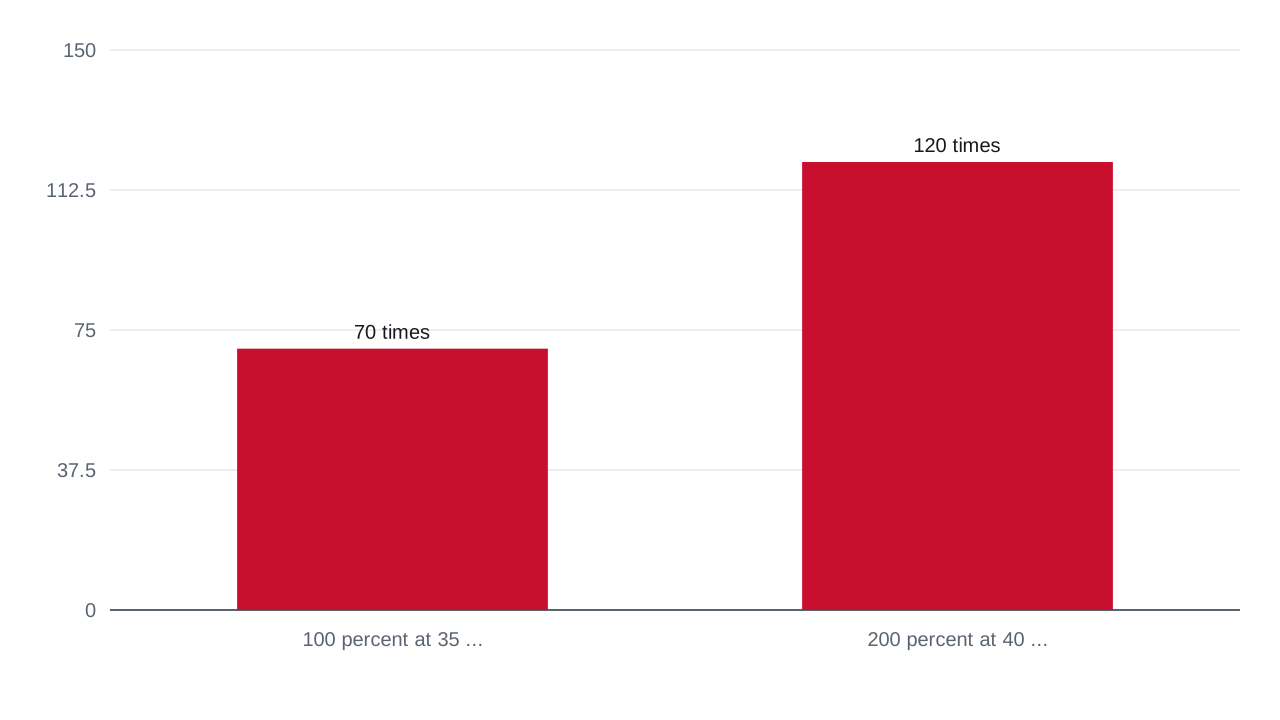
The figure that decides whether depth is worth anything is not the balance granted but the stakes demanded per pound paid in. The arithmetic fits on one line: requirement per pound deposited equals (1 + match depth) × the wagering multiplier. A 100 percent match at 35 times works out as (1 + 1) × 35, which is £70 of stakes for every pound deposited. A 200 percent match at 40 times works out as (1 + 2) × 40, which is £120 of stakes for every pound deposited.
The chart below plots the two bars side by side. The gap between them, £50 of stakes per pound deposited, is the measurable cost of the tripling: at the same deposit, the deeper match asks for roughly 71 percent more turnover in exchange for a balance half again as large.
Per pound deposited is the honest unit because it scales. The £50 rows in the table above land on the same figures, £3,500 and £6,000, which is £70 and £120 per pound once divided out, exactly the chart’s numbers. Whatever deposit you consider, the per pound rate holds until a cap interferes, and the cap is the subject two sections ahead.
Two assumptions sit under the bars and both deserve stating. First, the multiplier: 35 times serves as the working midpoint across the site’s models because wagering in this part of the market typically sits between 20 and 50 times, and 40 times for the deeper match sits inside that band, toward its upper half. Second, the basis: the model multiplies the combined balance, deposit plus bonus together, which is a common drafting in match terms. On a clause that multiplies the bonus alone, both bars fall and fall unequally: the flat match drops to £35 per pound deposited, the tripling one to £80. The gap survives either reading, at £45 instead of £50.
Bonus credit £40.00.
Wagering before cash out £2,400.00 at 40 times.
Wagering per pound deposited 120 times.
Assumptions: spins return 90 percent of face value before wagering; session cost uses the stated house edge as expected loss of bankroll per session.
The Gambling Act 2005 aims its offence provisions at operators and advertisers, at those providing or promoting gambling without a licence, and creates no offence for an individual who plays on an unlicensed overseas site. What you give up is protection rather than legality: no British register entry, no approved dispute resolution route and no British advertising rules sit behind the offer. Check a licence before a deposit.
On this page's model the multiplier applies to the combined balance, deposit plus bonus, so a £20 deposit with a 200 percent match becomes £60 of balance and asks £2,400 of stakes before winnings can be withdrawn. On a bonus only reading the same offer asks 40 times £40, which is £1,600. The clause that says which basis applies is worth finding before you fund the account.
Debit cards are the baseline rail at every end of the market, with e-wallets such as PayPal or Skrill common alongside them and crypto rails frequent at the offshore end. At Gambling Commission licensed operators the credit card ban has applied since April 2020, online and offline, so stakes come from money you hold. Method can affect eligibility, since some terms exclude particular e-wallets from the match, so check before funding.
The window is set offer by offer, and the clock can start at first deposit, first spin or the moment the bonus is credited, so the starting date is the first thing to find in the terms. Plan on a window measured in weeks rather than months. A £2,400 requirement at £80 of stakes a day consumes a month of daily play, which makes the expiry the binding constraint more often than the bankroll.
The cap stops the bonus growing while the deposit continues. On a 200 percent match the ceiling is reached at a £500 deposit; above that, the £1,000 bonus stops being a 200 percent match and becomes roughly 167 percent at £600 deposited, a straight 100 percent at £1,000. The multiplier, the expiry and the game weighting all continue to apply to whatever balance you actually hold, so the workload does not shrink with the headline.
It suits a player making a modest first deposit, willing to sustain near daily play on the slots that usually count in full, and comfortable treating the bonus as play money until the requirement clears. It fits badly if table games are the preference, since they often count at a fraction, or if the deposit would stretch past a low cap. Anyone who would find the pace a chore should read the workload as the price.
Look for a lower multiplier, a stated basis for the wagering and a ceiling you can clear inside the window. The licence itself adds the public register, GAMSTOP self-exclusion, an approved dispute resolution route and the credit card ban, none of which travels with an offshore offer. The headline at a licensed operator will usually be smaller, and the protections are the part of the deal that outlasts the welcome.
In most drafts the bonus is forfeited the moment a withdrawal is requested while a requirement is live, and winnings generated by bonus funds can be forfeited alongside it. Some terms let you cancel the bonus deliberately and keep your own money's winnings; others deduct the bonus amount from the balance before paying. The exact consequence is written in the bonus terms, and it costs less to read the clause than to discover it.
Offers of this kind hold no UK Gambling Commission licence. That is not a technicality: it is the difference between a market with a public register, a national self-exclusion scheme, approved dispute resolution, a ban on credit card gambling, affordability checks and independently tested games, and a market with none of those guarantees. A dispute at a licensed operator goes to an approved scheme; an offshore dispute goes to the operator itself. Nothing on this page is an exception to that. If self-exclusion matters to you, GAMSTOP covers licensed operators only, and no tool on this page changes that.
Gambling can harm. For free, confidential support in the UK, call the National Gambling Helpline on 0808 8020 133 or contact BeGambleAware.
Keep reading
UK Gaming Club. Independent modelling of casino offers for British readers. No operator pays for a word on this page; board placement is bought and disclosed on the How We Are Paid page. 2026.