#1
Night Luck
8.2Editorial score
Casino welcome bonus 805% up to €6,400 + 280 FS
- MuchBetter · VISA · Apple Pay
- Crypto welcome 140% up to 1,600 USDT
- VIP pack 800% up to €14,500
Terms change often. Verify on the operator's own page.
Offers modelled before you claim
18+. Betting carries risk. Never stake more than you can afford to lose.
Twenty spins at 10p stake £2.00 of game volume, and every clause after the count, value, multiplier, cap and clock, can only reduce what reaches the cashier.
The board is editorial and its placement is bought, which the disclosure page explains. Terms move without notice, so verify each line on the operator's own page.
Casino welcome bonus 805% up to €6,400 + 280 FS
Terms change often. Verify on the operator's own page.
Welcome bonus €/£5,000 + 500 FS
Terms change often. Verify on the operator's own page.
Welcome pack €5,000 + 500 FS + €650 free bet
Terms change often. Verify on the operator's own page.
Welcome package 300% up to €/£1,000 + 150 FS
Terms change often. Verify on the operator's own page.
On this page
Twenty free spins on registration with no deposit is the smallest complete package the market sells, and it is sold without a price tag. An account is opened, the operator credits twenty rounds on a named slot or a short list of slots, and no payment is requested. The grant costs the reader a few minutes of form filling and costs the operator pennies at the stated stake, which is the point: it is a sample, priced to be given away, and every clause attached to it exists to keep the sample small.
The grant ladder in this corner of the market has three rungs. Registration grants sit on the bottom rung: small counts, fixed stakes, no payment. First deposit grants take the middle rung, with larger counts, sometimes a richer stake per spin, occasionally a match bundled alongside. The top rung ties spins to deposit matches, loyalty schemes and staged releases across a player’s early sessions. Twenty spins is the entry tier, and this page starts there because every rung above inherits the same clause structure with bigger numbers attached.
Every clause after the count does one of two things. It shrinks the worth of each spin, or it stands between the winnings and the cashier. The stake, the named games and the stated spin value set the ceiling. The wagering multiplier, the cashout cap, the expiry clock and the game restrictions can only cut from it. Nothing in the small print adds value, and reading the offer means reading the cuts in order.
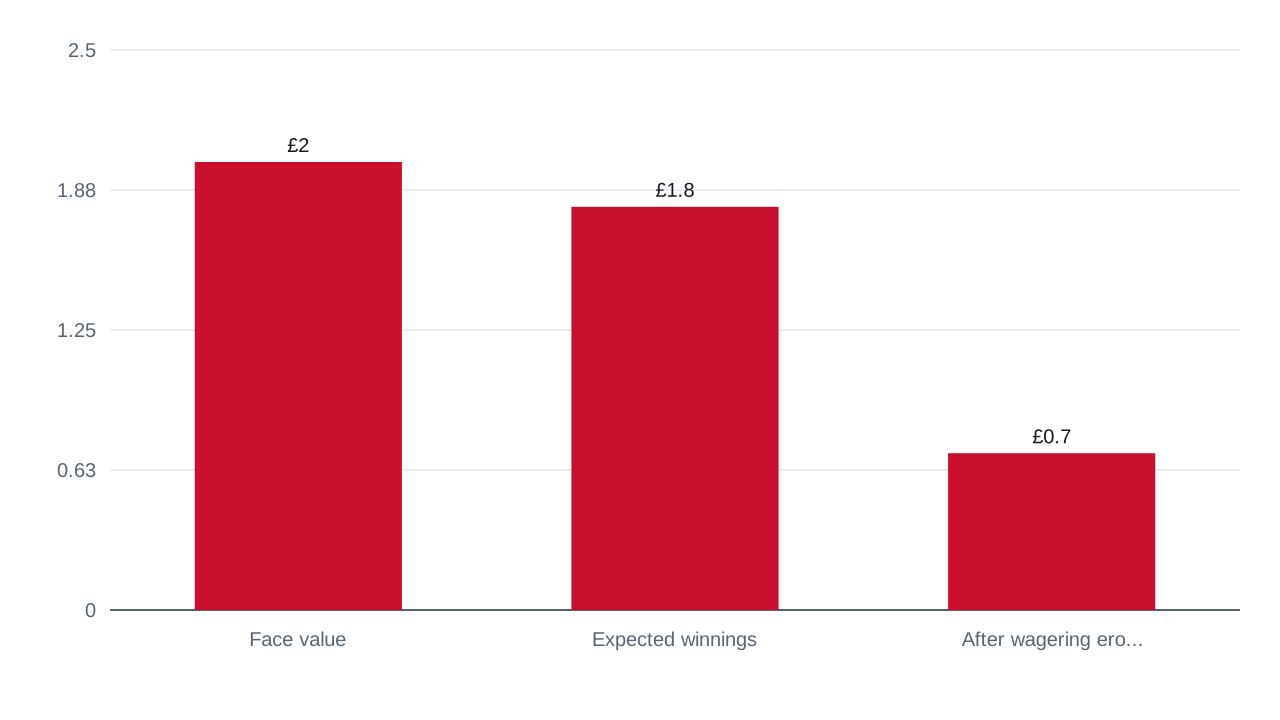
On the numbers behind 20 free spins on registration no deposit, the model takes twenty spins at a 10p stake, the midpoint of the 5p to 20p band typical for registration grants. Face value: £2.00 of game volume. Expected winnings at the model’s return assumption: £1.80. The sections that follow work those two figures through wagering, the cap and the clock to the cashier, with every assumption stated where it is used.
The count is the headline and the stake is the substance. Twenty spins at 5p produce £1.00 of play; twenty spins at 20p produce £4.00. The same count, four times the substance. Spin value is the first term in every sum on this page, which is why it takes a section of its own before the wagering model gets one.
Values on registration offers typically run between 5p and 20p per spin, and 10p is the working assumption here, the midpoint of that band. The terms state the figure, sometimes in the offer line, sometimes several paragraphs into the bonus rules, and occasionally per game, where two named slots carry different stakes. Wherever it sits, the stated figure rather than the headline count decides what the grant is worth.
Two refinements matter. Some grants peg the stake to the named game’s minimum button, so the value is whatever that slot’s lowest stake happens to be. Others fix the value in pence and let it run across the whole list. A reader whose terms state 5p should halve the face value and every figure after it; a reader whose terms state 20p should double the chain. The wagering multiplier and the cap do not care how the face value was reached, they simply operate on whatever arrives.
There is also the unstated case. A grant with no spin value printed has no stated worth, because free without a figure is a headline rather than a term. The five line routine at the end of this page makes the stake the first lookup for that reason: it is the number the whole package hangs from, and it is the easiest clause to check.
The journey from a credited grant to a withdrawal passes four stages, and each stage carries one figure. First, face value: twenty spins multiplied by 10p sets £2.00 of game volume. Second, expected winnings: a slot returns a little less than it takes in over the long run, the model assumes 90 percent, and twenty spins therefore leave £1.80 in expected winnings, which usually arrive as bonus funds rather than cash. Third, wagering: the terms multiply those winnings by 35, which sets a £63.00 turnover target. Fourth, cashout: whatever survives the target is paid, trimmed to the £40 cap where the cap applies.
The table below sets out the four stages, the arithmetic behind each figure and the clause that can move it.
| Stage | Figure | How it was reached | What can change it |
|---|---|---|---|
| Face value | £2.00 | 20 times 10p | A lower stated spin value |
| Expected winnings | £1.80 | 90 percent assumption | The named game return |
| Wagering | £63.00 | 35 times the winnings | Multiplier band 20 to 50 |
| Cashout | up to £40 cap | min of balance and cap | The printed cap |
Two of the four stages are arithmetic a reader can check on a phone, and two rest on assumptions. The first stage is pure multiplication. The second rests on the return figure, and a game’s published return, which the operator sets per title, can sit above or below the model’s 90 percent; the named game’s own figure governs. The third is multiplication again once the multiplier and its base are known. The fourth is a comparison: the lower of the remaining balance and the printed cap.
The chart below plots the three money figures in order: £2.00 of face value, £1.80 of expected winnings and £0.70 after wagering erosion. The bars fall because each stage applies a reduction, and the fall from the second bar to the third is where most of the grant’s paper value goes. The next section works that third bar out line by line.
Spins face value £2.00.
Estimated winnings before wagering £1.80 at a 90 percent return.
Wagering £0.63.
Cashable £1.80.
Assumptions: spins return 90 percent of face value before wagering; session cost uses the stated house edge as expected loss of bankroll per session.
The spins cost nothing to claim: an account is opened and the operator credits them without a payment. What they are not is money. They are rounds at a fixed, usually small, stake on named games. The account costs data rather than cash, the winnings usually arrive as bonus funds, and wagering, a cap and a clock each sit between any win and the cashier.
On the common shape the wagering multiplies the winnings, not the spin count. The model on this page takes 35 times because that sits at the midpoint of the 20 to 50 times band typical at this end of the market. Twenty spins at 10p are expected to produce about £1.80 of winnings, so the target works out near £63.00 of turnover before a withdrawal is allowed.
Whatever survives wagering, up to the printed cap. The model expects a small residue: about £0.70 from the £1.80 of expected winnings once the £63.00 target has been cleared. The £40 cap in the model binds only when a session runs well above expectation, for instance when a single feature round pays tens of pounds from a 10p stake. The printed cap in the terms you are reading is the figure that governs.
Treat the clock as short until the terms prove otherwise. This page works on a 72 hour assumption for using the spins, and a separate window, usually stated in days, for clearing any wagering attached to the winnings. Small grants carry the tightest clocks in the market because they cost the operator little and expire quietly. Check both lines, note where each clock starts, and set a reminder.
A true no deposit grant should not require payment details, and many operators credit the spins after nothing more than email or mobile verification. Some terms ask for a card before wagering can be completed, which changes the character of the offer and should be read carefully. On licensed sites a credit card cannot be used for gambling at all, a prohibition in force since April 2020.
British law aims its offences at operators and advertisers, not at individual players, so no offence falls on a person who plays on an unlicensed overseas site. What is lost is protection: no entry on the public register, no GAMSTOP coverage, no approved dispute resolution route and none of the advertising rules that bind licensed firms. Legality is the wrong question. Protection is the right one.
It suits a reader who wants to see how an account and a slot work without funding anything, and who is content with small numbers: £2.00 of game volume, £1.80 of expected winnings and a modest residue after wagering. It does not suit anyone hunting a bankroll. A reader who has self-excluded through GAMSTOP should also note that sites outside the UK regime sit beyond the scheme's coverage.
Licensed operators run registration and first deposit spin offers of their own, at similar stake values and multipliers, and the comparison table on this page sets the typical ranges side by side. The difference is not the arithmetic, it is the backing: a public register entry, GAMSTOP, approved dispute resolution, the credit card prohibition and independently tested game fairness. If those protections matter, filter for the UKGC label first.
Offers of this kind hold no UK Gambling Commission licence. That is not a technicality: it is the difference between a market with a public register, a national self-exclusion scheme, approved dispute resolution, a ban on credit card gambling, affordability checks and independently tested games, and a market with none of those guarantees. A dispute at a licensed operator goes to an approved scheme; an offshore dispute goes to the operator itself. Nothing on this page is an exception to that. If self-exclusion matters to you, GAMSTOP covers licensed operators only, and no tool on this page changes that.
Gambling can harm. For free, confidential support in the UK, call the National Gambling Helpline on 0808 8020 133 or contact BeGambleAware.
Keep reading
UK Gaming Club. Independent modelling of casino offers for British readers. No operator pays for a word on this page; board placement is bought and disclosed on the How We Are Paid page. 2026.