#1
Night Luck
8.2Editorial score
Casino welcome bonus 805% up to €6,400 + 280 FS
- MuchBetter · VISA · Apple Pay
- Crypto welcome 140% up to 1,600 USDT
- VIP pack 800% up to €14,500
Terms change often. Verify on the operator's own page.
Offers modelled before you claim
18+. Betting carries risk. Never stake more than you can afford to lose.
Every welcome offer is one of five shapes, match, spins, cashback, credit or a staged package, and at the usual 30 to 45 times wagering the branch decides the price long before the percentage does.
The board is editorial and its placement is bought, which the disclosure page explains. Terms move without notice, so verify each line on the operator's own page.
Casino welcome bonus 805% up to €6,400 + 280 FS
Terms change often. Verify on the operator's own page.
Welcome bonus €/£5,000 + 500 FS
Terms change often. Verify on the operator's own page.
Welcome pack €5,000 + 500 FS + €650 free bet
Terms change often. Verify on the operator's own page.
Welcome package 300% up to €/£1,000 + 150 FS
Terms change often. Verify on the operator's own page.
On this page
The percentage is the first number an offer shows you and the least useful one to know. Underneath every headline sits a mechanism, and across this market the mechanism comes in exactly five shapes: the match, the spins bundle, cashback, credit granted with no deposit, and the staged package. Name the shape and half the work of pricing is done, because the shape decides what the wagering attaches to, and what the wagering attaches to decides what the welcome bonus actually costs.
Why does the percentage mislead? Because a percentage on its own is half a sentence. It says how much credit arrives; it says nothing about what must be staked before that credit, or its winnings, become withdrawable money. A 200 percent match at 50 times costs more per pound than a 50 percent match at 20 times, and no quantity of percentage arithmetic repairs that, because the multiplier, the base it charges and the caps around it do the pricing. The family tree exists to put those facts in order before any comparison begins.
The match is the oldest branch and the simplest to describe: you deposit, the operator adds a percentage, and a multiplier must be cleared before either part can be withdrawn. The spins branch hands over a bundle of rounds instead, usually tied to one slot, and charges its multiplier not on the spins themselves but on whatever those spins win. Cashback runs in reverse: the offer waits until a loss has landed, then returns a slice of the net loss, sometimes with no wagering at all and sometimes with a small multiplier in tow. The no deposit branch grants a little credit for nothing more than opening an account, and it charges for the generosity with the heaviest multipliers in the family. The staged branch is the match wearing a bigger coat: three or more deposits, three or more percentages, one headline that adds them together.
It is worth calling this a family tree rather than a list, because the branches share clauses the way relatives share surnames. Every branch carries a cap somewhere, a clock somewhere, a maximum bet while wagering runs and a weighting table that decides which games count. What differs is where the multiplier lands. On a match it lands on credit you have received. On spins it lands on winnings you have not yet seen. On cashback it lands on money the operator has already handed back. On no deposit credit it lands on money you never paid for. On a package it lands three separate times, once per stage, and the stages do not share their deadlines.
The table below lines up the five branches at their usual settings: the headline each typically prints, the wagering each typically attaches and the clause that typically caps it. Read the figures as category ranges compiled from operator-published terms, not as quotes from any single promotion. The final column is the one to remember, because the cap is where each branch stops growing.
| Branch | Usual headline | Usual wagering | What caps it |
|---|---|---|---|
| Match | 100 percent | 30 to 40 times | deposit cap |
| Spins | 50 to 100 | 30 to 40 on winnings | cashout cap |
| Cashback | 5 to 15 percent | none to 5 times | weekly ceiling |
| Staged | split across three deposits | 30 to 45 times | per-stage expiry |
| No deposit credit | 5 to 30 pounds | 40 to 60 times | withdrawal ceiling |
Two offers can print identical percentages and sit on different branches, which makes them different prices. A 100 percent match and a 100 percent opening stage inside a package are not the same animal, even where the first screen of each looks the same. Some offers mix branches outright, a match with a block of spins bolted on, and the habit to build is the same whatever the mixture: separate the parts, name each one, and price them individually. The sections that follow walk each branch, cost each branch per pound deposited, and finish with a routine that works on any offer of any shape.
Percentages advertise; turnover prices. A fair way to compare branches is to put one question to each: for every pound deposited, how many pounds of qualifying stakes must be placed before the offer releases what it owes? The measure strips the headline away and leaves the mechanism, it survives mixed offers because it can be computed per part and then added, and once it is worked out for all five branches at their usual settings, the family tree turns into a price list.
The model behind the chart is deliberately plain. It takes a branch’s usual multiplier, applies it to the deposit plus whatever credit the branch hands over, and divides the result by the deposit. Where a branch has no deposit to divide by, the model divides by the credit instead. Every setting is a stated assumption rather than a measurement: the match is modelled at 100 percent and 35 times, cashback as a full rebate at 1 times, spins as winnings of £9 from a bundle that staked £10 at 35 times, the package at 200 percent across its stages and 40 times, and no deposit credit as £10 at 50 times. Change an assumption and the bar moves; the method does not.
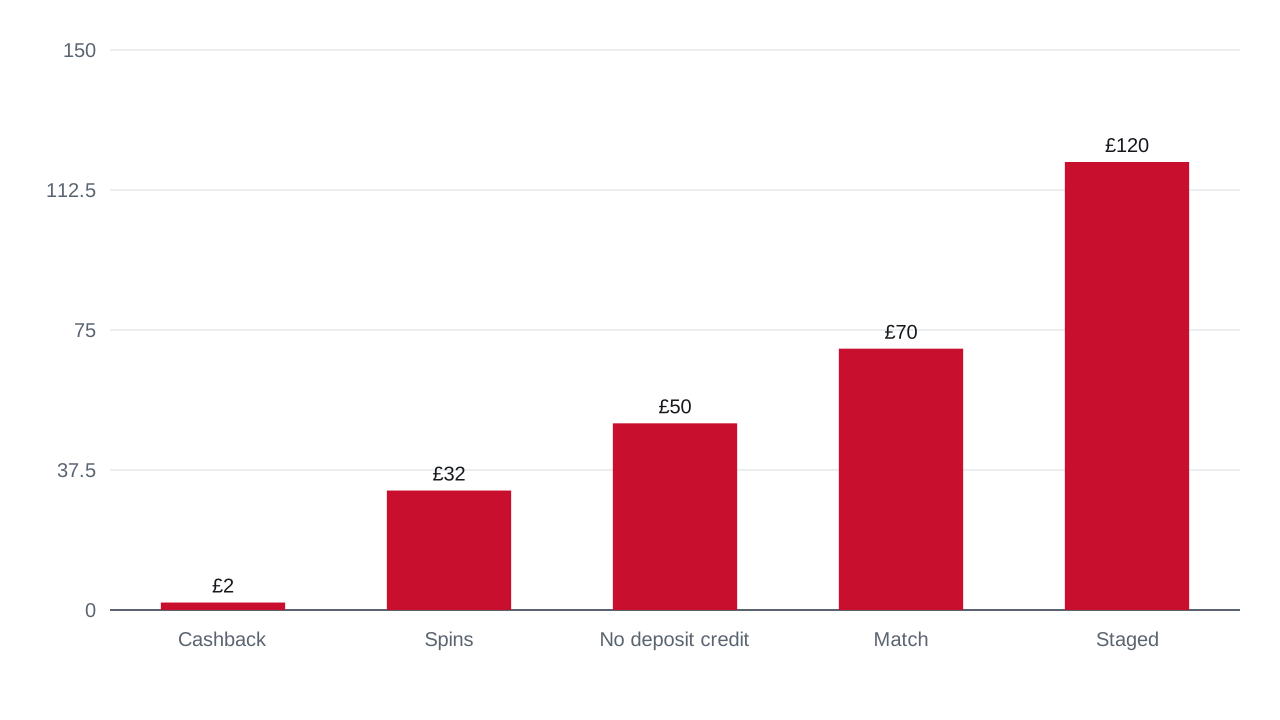
Run the arithmetic branch by branch. The match on a £25 deposit adds £25 of credit, so the base is £50; 35 times turns that into £1,750 of turnover, and £1,750 divided by £25 is £70 per pound deposited. Cashback behaves differently because the multiplier lands on the rebate rather than the deposit, so even on the generous reading where the rebate equals everything deposited, 1 times leaves £2 of turnover per pound. The spins branch starts from £9 of winnings produced by a bundle that staked £10; 35 times on those winnings is £315 of stakes, about £32 per pound deposited. The staged package takes £75 across three stages and grants £150 of credit in total, so 40 times on a £225 base is £9,000 of turnover, £120 for every pound deposited. The no deposit branch has no deposit for the denominator, so its bar is drawn per pound of credit: £10 of credit at 50 times is £500 of turnover, £50 per pound of credit.
The chart below plots those five figures side by side, in pounds of requirement per pound deposited, and the ordering tells the story the banners never do. The tallest bar does not belong to the largest percentage; it belongs to the branch that hides the most stages. The shortest bar belongs to the branch that pays after losses rather than before them. Between them sit the spins, whose cost is real but bounded by small winnings, and the no deposit grant, whose bar looks middling until you notice its base is credit rather than money, which makes its 50 times the harshest multiplier in the set. The match sits high at £70 because the model charges the multiplier on the deposit as well as the credit; where terms charge the credit alone, the same offer prices at roughly half that.
The measure counts obligation, not enjoyment, and it is worth saying what it leaves out. Wagering counts stakes, and stakes cost: at the published return to player levels common in slots, usually around 94 to 96 percent, the house edge takes its share while the clearing runs, a price no branch structure removes. The unit also survives scale, which is what makes it useful for comparison: a £10 deposit and a £500 deposit on the same match produce the same figure per pound, so the measure can sit beside ranges of offers without pretending any of them has been quoted. State the assumptions aloud whenever the arithmetic is redone for a specific offer. If the terms charge 35 times on the bonus alone, the match bar halves; if a package pays 150 percent across its stages rather than 200, its bar falls with it. The model is a ruler, not a verdict, and a ruler only reads true when the settings fed into it are written down.
Bonus credit £25.00.
Wagering before cash out £1,750.00 at 35 times.
Wagering per pound deposited 70 times.
Assumptions: spins return 90 percent of face value before wagering; session cost uses the stated house edge as expected loss of bankroll per session.
British law aims the offence at the operator, not the player. Providing remote gambling facilities to British consumers without a Gambling Commission licence breaches the Gambling Act 2005, so the unlicensed operator carries the legal risk, while an individual who plays on such a site commits no offence. What that player loses is protection rather than legality: no register entry, no approved dispute route and no self-exclusion coverage.
It means the stakes you must place before the credit, and usually its winnings, turn into withdrawable money. On £25 of credit at 35 times, that is £875 of qualifying stakes if the multiplier applies to the bonus alone, and £1,750 if it applies to the deposit plus the bonus. Check which base your terms use, because the two readings differ by half and both appear in this market.
Debit cards, bank transfer and the main e-wallets usually qualify, and many sites at this end of the market also take crypto. The classic exclusion is the e-wallet one: some terms refuse the offer when the deposit goes through a particular wallet, so the rail you choose can decide whether you receive credit at all. Read the payments section of the terms before you deposit, not after.
The usual clause forfeits the remaining credit and any winnings built from it. Packages add a second clock: each stage carries its own deadline, and missing one commonly ends the stages that follow. Cashback rebates can expire too if a weekly window closes unclaimed. Because forfeiture is total rather than partial, the expiry date deserves the same attention as the multiplier when you price an offer.
Nobody should choose one on the headline alone, because the headline totals three or more offers that each carry their own deposit, percentage, wagering and deadline. A staged package suits a player who has already decided to deposit across several sessions and who will read three sets of terms as carefully as one. If you intend only the first stage, price it as a standalone match and ignore the rest.
An offer from an operator holding a Gambling Commission licence. You can confirm the licence on the public register in seconds, and the licence carries the protections an offshore site lacks: approved dispute resolution, participation in GAMSTOP self-exclusion, the credit card ban and game fairness testing through approved houses. The percentages usually read smaller than offshore headlines. What you are comparing is the size of the credit against the rulebook behind it.
Usually not in full. No deposit credit, typically £5 to £30, carries the heaviest multipliers in the family, commonly 40 to 60 times, and a withdrawal ceiling caps what bonus play can pay out, often between £50 and £500. Many terms also ask for a first deposit to verify a payment method before any withdrawal is processed. Treat the grant as a way to test a site, not as money.
No, and the order runs the other way. Wagering sets the price: a 50 percent match at 20 times costs less per pound deposited than a 200 percent match at 50 times, because the multiplier is charged on a much larger credit. The percentage only decides how much credit enters the calculation. Name the branch and the multiplier first, and read the percentage as the numerator of a fraction, never as the answer.
Offers of this kind hold no UK Gambling Commission licence. That is not a technicality: it is the difference between a market with a public register, a national self-exclusion scheme, approved dispute resolution, a ban on credit card gambling, affordability checks and independently tested games, and a market with none of those guarantees. A dispute at a licensed operator goes to an approved scheme; an offshore dispute goes to the operator itself. Nothing on this page is an exception to that. If self-exclusion matters to you, GAMSTOP covers licensed operators only, and no tool on this page changes that.
Gambling can harm. For free, confidential support in the UK, call the National Gambling Helpline on 0808 8020 133 or contact BeGambleAware.
Keep reading
UK Gaming Club. Independent modelling of casino offers for British readers. No operator pays for a word on this page; board placement is bought and disclosed on the How We Are Paid page. 2026.