#1
Night Luck
8.2Editorial score
Casino welcome bonus 805% up to €6,400 + 280 FS
- MuchBetter · VISA · Apple Pay
- Crypto welcome 140% up to 1,600 USDT
- VIP pack 800% up to €14,500
Terms change often. Verify on the operator's own page.
Offers modelled before you claim
18+. Betting carries risk. Never stake more than you can afford to lose.
Published slot returns cluster between 94 and 96 percent, and a spins package at 10p a turn models at 90 before terms, so the six point discount and the wagering clause decide more than any theme.
The board is editorial and its placement is bought, which the disclosure page explains. Terms move without notice, so verify each line on the operator's own page.
Casino welcome bonus 805% up to €6,400 + 280 FS
Terms change often. Verify on the operator's own page.
Welcome bonus €/£5,000 + 500 FS
Terms change often. Verify on the operator's own page.
Welcome pack €5,000 + 500 FS + €650 free bet
Terms change often. Verify on the operator's own page.
Welcome package 300% up to €/£1,000 + 150 FS
Terms change often. Verify on the operator's own page.
The online slots UK players meet in a licensed lobby look like one product and behave like several. Beneath the artwork sit three numbers that decide nearly everything of consequence: the return the game publishes, the volatility it plays at, and the terms that attach when the spins come from a bonus rather than your own balance. Theme, sound and animation sit above those three lines and move none of them.
Formats come first: the shelf still carries three reel classics, which pay across a handful of lines and return small amounts often. Beside them sit five reel games on fixed paylines, then ways to win engines that score across hundreds of positions instead of named lines, then collect formats that hold symbols in place across a run of spins and pay when a quota fills. Jackpot linked titles tie a slice of play to a pooled prize that grows until it drops. Each class plays differently and, on the model this page uses, publishes a different band of returns.
Returns come second. The figure is set per game by the operator and published with it, and across the market it commonly lands between 94 and 96 percent. Read as a long run average, 95 percent means roughly 95p handed back for every £1 staked across a very large number of spins. It is not a forecast for an evening; short samples swing well clear of the average in both directions, and the swing, not the average, is what a player actually feels.
Terms come third, and they are where the arithmetic hides. A spins bonus does not pay its winnings as withdrawable cash by default. The winnings often carry a wagering multiple, a ceiling on the stake permitted while the bonus is live, a list of games that count differently or not at all, a cap on what can be withdrawn, and a clock that closes the window. Stacked, the clauses decide what a package is worth, and by how much it falls short of its headline.
Why do these clauses cluster around slot play in particular? Because slots are the usual clearing engine for a bonus: full weighting in the typical shape, fast stakes, and a published return that makes the cost of turnover computable. The terms are written for the machine most people will use, which is one reason the return and the terms belong on the same page rather than in separate drawers.
This page prices the whole stack. The table below is the page’s own working model for five format classes: the return band each typically publishes, the volatility it plays at, the share of spins that return anything at all, and the shape of a session spent on it. The bands are assumptions for comparison, compiled for the October 2026 model. They are not measurements of any named game, and no game is named here.
| Format class | Return band | Volatility | Hit rate band | Session shape |
|---|---|---|---|---|
| Three reel classics | 94 to 95 percent | low | 25 to 35 percent | long, flat |
| Five reel mid | 95 to 96 percent | medium | 20 to 28 percent | mixed |
| High variance | 96 percent plus | high | 10 to 18 percent | sparse |
| Jackpot linked | 91 to 93 percent | very high | 5 to 10 percent | rare events |
| Collect formats | 95 to 96 percent | high | 8 to 15 percent | lumpy |
Two rows repay a second look. Jackpot linked titles publish the lowest band, 91 to 93 percent on the model, because a slice of each stake is assumed to fund the pooled prize, and their hit rate band of 5 to 10 percent implies long stretches between returns. High variance games sit at the top of the return range and near the bottom of the hit rate range, which is the trade in miniature: the highest published figure on the page, delivered in the most uneven way.
The sections that follow take the numbers in order: the return bands behind the chart, a spins package run through the calculator, volatility and what it does to a session, hit rate and the gaps it leaves, the clauses that ride on bonus play, what a British licence adds, how to read the comparison table, and a five line routine to run before any deposit.
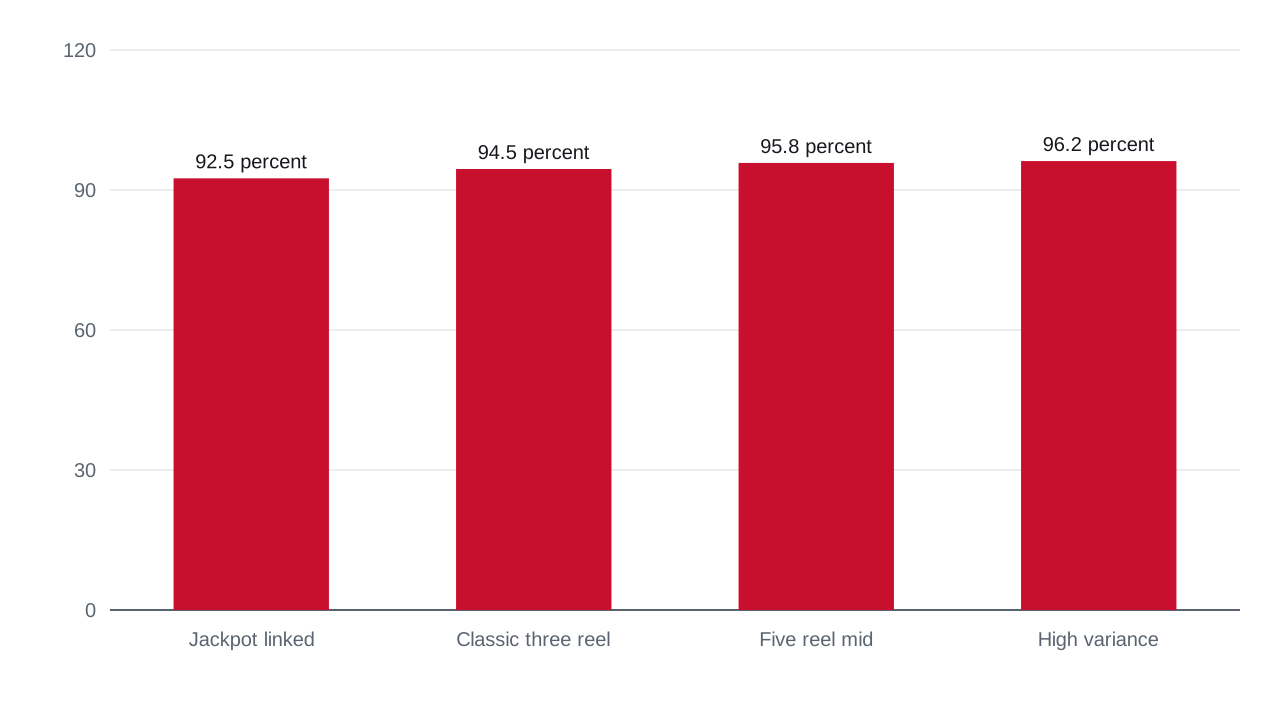
The chart below plots one bar per format class, from 92.5 to 96.2 percent, and dates itself: a model of typical published returns, October 2026. Read it as a map of the shelf rather than a scoreboard. No bar measures a named game; each represents where a class usually publishes, and the operator sets every individual figure within or near its class band.
Start at the left. Jackpot linked classes model at 92.5 percent, the lowest bar, and the assumption behind it is plain: a slice of every stake feeds the pooled prize, so the base game returns less while the jackpot waits. Classic three reel games sit at 94.5, close to the bottom of the market wide band.
Five reel mid volatility games, the bulk of most lobbies, model at 95.8. High variance games top the chart at 96.2, the highest published figure on the page and the hardest to convert into a session anyone would recognise. If four points reads like a narrow spread, the next paragraph is the corrective.
The spread matters more than four points sound. Turned on its head, a published return is a margin: 92.5 percent leaves a 7.5 percent margin on turnover, while 96.2 leaves 3.8. On £100 of play, the modelled difference between the two bars is about £3.70, money that stays with the player in one class and goes to the house in the other. That gap exists before any bonus term touches anything, which is why the standfirst gives it top billing beside the wagering clause.
The margin carries the operator’s costs too, and one of them is on the record. Remote gaming duty is charged on the British facing gaming profits of licensed remote operators, and the rate stood at 21 percent at the last check. Duty is one of the costs a margin has to cover, and it is an operator tax, not a deduction from any player’s balance.
Why does the band stop near 96? Because a class cannot publish much higher and stay a class on the model’s terms: the margin has to fund the features, the duty and the house, and a figure far above the band would be its own headline. The ceiling is part of the map, not a flaw in it.
Where does a bonus sit against these bars? The next section prices a spins offer at 10p a turn, and the model deliberately starts below the lowest bar: at 90 percent of face value before terms. The haircut reflects the plumbing of a bonus, in which the operator picks the game, fixes the coin size and often caps what a single spin can win. The player controls none of those dials, and the model charges for the loss of control rather than pretending it away.
One reading habit is worth building here. A band is a class level assumption, and the figure that applies to you is the one published for the exact game at the exact stake you intend to play. The place to look is the game’s own information screens on the operator’s site. Bands choose the shelf; the game’s own line prices the contents.
And a note on what the bars do not say. None of them predicts an evening. A 96.2 percent game can take a balance apart in twenty minutes and hand it back in two spins the following night, while a 94.5 percent classic can crawl along close to its average for hours. Return is a long run property, and volatility, two sections ahead, decides how it is delivered.
Spins face value £10.00.
Estimated winnings before wagering £9.00 at a 90 percent return.
Wagering £3.15.
Cashable £9.00.
Assumptions: spins return 90 percent of face value before wagering; session cost uses the stated house edge as expected loss of bankroll per session.
Yes for the player, in the narrow sense the law uses: the offence provisions of the Gambling Act 2005 fall on operators and advertisers, not on individuals who play. What you give up is protection. A site without a Gambling Commission licence sits off the British register, offers no approved dispute route and is not bound by the British credit card ban.
It means the winnings from the spins must be staked repeatedly before they can be withdrawn. Take 100 spins at 10p modelled at 90 percent of face value: about 90p of winnings. 35 times that is £31.50 of turnover. Clearing it with your own balance at a typical published return gives back about £1.58 on expectation, more than the spins are worth.
Debit cards and the major e-wallets are the common rails at licensed British cashiers, with bank transfer widely available and some sites adding newer methods. Crypto cashiers sit mostly offshore. Two checks matter: licensed operators have been barred from accepting credit cards for gambling since April 2020, and some offers exclude deposits made through particular methods, so a payment can go through and still not qualify.
Often both, and the range is wide. On the model this page uses, cashout caps on offers of this kind typically run from 50 to 500 pounds, and spins commonly carry an expiry measured in days. Where a cap applies, terms usually say winnings above it are not paid, and unused spins lapse when the window closes. Both lines sit in the offer's own terms, which can change without notice.
A package of this kind suits a reader who wants a small, bounded sample of play and is content to read a short list of terms first. It suits less well anyone who wants certainty of cash value: where winnings carry 35 times wagering and a cap, the modelled outcome is modest and the clearing ride depends on volatility. Playing without a bonus at all is a legitimate choice.
Coverage. A licensed operator sits on the public register, must offer access to approved alternative dispute resolution, participates in GAMSTOP self exclusion, is barred from taking credit cards, has its games tested by approved test houses with returns published per game, and declares on a published scale how customer funds are protected. An offshore operator is bound by none of that as a class, so the protection gap is the difference.
The published figure is set per game by the operator and commonly sits between 94 and 96 percent. The model on this page puts jackpot linked classes in the low nineties and high variance classes just above 96. Read it as a long run average: about 95p back for every £1 staked across a very large number of spins, with no implication for any single session.
Return says how much comes back over a long run; volatility says how that amount is distributed on the way. Two games can publish the same 95 percent and play differently: a low volatility game gives small amounts back often, while a high volatility game gives rarely and larger when it does. Hit rate adds a third angle: how often any return lands at all. The table and chart on this page hold all three side by side.
Offers of this kind hold no UK Gambling Commission licence. That is not a technicality: it is the difference between a market with a public register, a national self-exclusion scheme, approved dispute resolution, a ban on credit card gambling, affordability checks and independently tested games, and a market with none of those guarantees. A dispute at a licensed operator goes to an approved scheme; an offshore dispute goes to the operator itself. Nothing on this page is an exception to that. If self-exclusion matters to you, GAMSTOP covers licensed operators only, and no tool on this page changes that.
Gambling can harm. For free, confidential support in the UK, call the National Gambling Helpline on 0808 8020 133 or contact BeGambleAware.
Keep reading
UK Gaming Club. Independent modelling of casino offers for British readers. No operator pays for a word on this page; board placement is bought and disclosed on the How We Are Paid page. 2026.