#1
Night Luck
8.2Editorial score
Casino welcome bonus 805% up to €6,400 + 280 FS
- MuchBetter · VISA · Apple Pay
- Crypto welcome 140% up to 1,600 USDT
- VIP pack 800% up to €14,500
Terms change often. Verify on the operator's own page.
Offers modelled before you claim
18+. Betting carries risk. Never stake more than you can afford to lose.
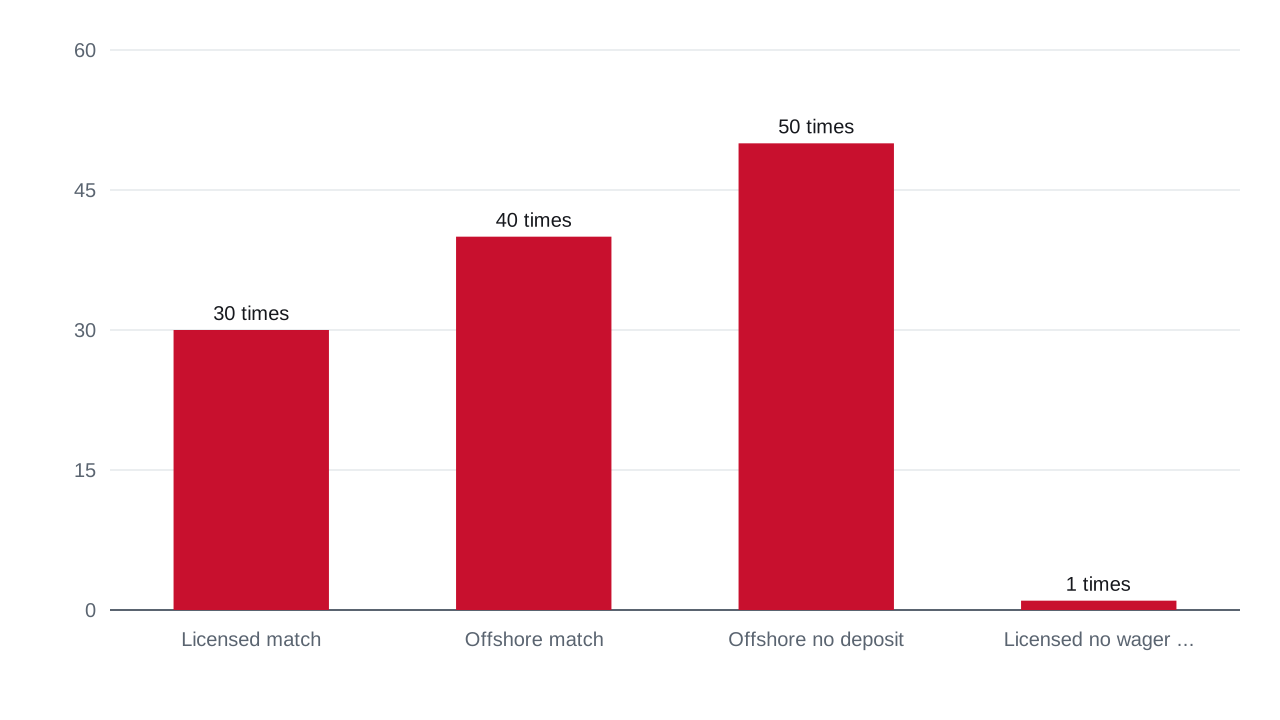
A licensed British welcome usually matches 100 percent at 20 to 35 times wagering, and everything the offshore fringe offers louder, it offers without the register, the dispute route or the scheme.
The board is editorial and its placement is bought, which the disclosure page explains. Terms move without notice, so verify each line on the operator's own page.
Casino welcome bonus 805% up to €6,400 + 280 FS
Terms change often. Verify on the operator's own page.
Welcome bonus €/£5,000 + 500 FS
Terms change often. Verify on the operator's own page.
Welcome pack €5,000 + 500 FS + €650 free bet
Terms change often. Verify on the operator's own page.
Welcome package 300% up to €/£1,000 + 150 FS
Terms change often. Verify on the operator's own page.
On this page
Type online casino UK into a search bar and the results mix two kinds of site that look alike and are not. The first holds a licence from the Gambling Commission and appears, by name, on the public register that the Commission publishes. The second holds a licence from somewhere else, usually offshore, appears on no British register, and markets to people in Britain all the same. The games look similar, the bonuses are written in the same vocabulary, and the cashiers take many of the same rails. What separates them is not the front end. It is everything that sits behind it.
This page calls the first group the licensed baseline and the second the offshore fringe. The naming is deliberate. The licensed market is the baseline because the law makes it so: providing remote gambling facilities to someone in Great Britain requires an operating licence under the Gambling Act 2005, so the tier whose advertising sits under the British code and whose licence can be read on a register is the tier the statute covers. The fringe is a fringe because it operates beside that regime, not inside it, however polished its website looks.
In 2026 the line is easy to draw, because both ends of the online casino UK market have hardened their shapes. The licensed tier has settled around a familiar welcome: a 100 percent match on a first deposit, wagering somewhere between 20 and 35 times, debit cards and e-wallets at the cashier, credit cards excluded by rule. The fringe has settled around its own familiar welcome: bigger headline matches, wagering between 35 and 50 times, crypto rails at the cashier, and none of the British machinery attached.
The honest way to compare the two is on the trade each one offers. The licensed trade runs to smaller numbers, more questions at the cashier, more checks behind the account, and a set of protections you can verify before you deposit a pound. The fringe trade runs to bigger numbers, fewer questions, and a backstop that consists of the operator’s own goodwill. Neither description is a secret. Both are printed in the terms, if the terms are read, and both are modelled on this page.
Everything below runs on one fact base. Claims about the law come from the statute and the Commission. Claims about protections come from the schemes themselves: GAMSTOP, the helpline, the approved dispute providers. Claims about offers are model assumptions, stated where they are used, because terms move and this page does not chase them. Where a figure is a working assumption rather than a measurement, the text says so. That discipline is the difference between a guide and a brochure.
A note on what this page is not. It takes no side in advance, holds no prize for either tier, and does not accept the fringe’s framing that protection is a tax on generosity. Protection is a product feature with a cost profile, wagering is another, payout speed is a third, and the reader’s job is to price the bundle rather than admire its cover. The sections that follow do the pricing in order: the baseline offer first, then the licence, then the wagering, the rails, the fringe and the frame around both.
Start where most readers start: the welcome offer on a licensed site. The shape is familiar across the tier. You deposit, the operator matches a percentage of it as bonus funds, and the bonus carries a wagering multiplier that must be turned over before anything can be withdrawn. The model used on this page takes the most common licensed shape: a 100 percent match, wagering at 35 times the bonus, and a bonus ceiling of £250. Those are working assumptions, chosen because they sit at the centre of what the licensed tier typically publishes. They are not a quote of any single promotion, and the terms of any offer you actually consider may sit above or below them.
Take a £25 deposit and run the line. A 100 percent match adds £25 of bonus funds, so £50 sits in the account: £25 of cash and £25 of bonus. The multiplier applies to the bonus. At 35 times, the account must record £875 of qualifying stakes before the bonus and anything won with it becomes withdrawable. The arithmetic is one line: deposit, times the match percent, times the multiplier. £25 at 100 percent is £25 of bonus, and £25 at 35 times is £875 of turnover.
The ceiling matters at the other end of the scale. Because the model caps the matchable bonus at £250, a deposit above £250 at a 100 percent match earns no additional bonus in the model: £250 is where the match stops. Real terms set their own ceilings, some lower, some higher, a few applying the match to the first deposit only. The reason to state a ceiling at all is that the first pounds of a match are always worth the most. A ceiling tells you where extra deposits stop earning anything, which is exactly where a headline match stops being interesting.
Three assumptions sit under the arithmetic, and each is stated rather than hidden. First, the multiplier of 35 times is the working midpoint this site’s calculators use for licensed match offers; the typical band runs from roughly 20 to 35 times, so the model sits at the middle of it. Second, the model assumes every pound staked counts in full toward the wagering; real terms often weight some games at less than full contribution or exclude them entirely, which stretches the clearing without changing the headline. Third, the £875 is turnover, not expected loss. What it actually costs depends on the stakes you choose, the games you play and the session you have.
Run the same £25 through the calculator that follows this section and the prefill does the work: deposit 25, match at 100 percent, multiplier 35, ceiling 250. Change any input and the output moves in proportion, which is the point of showing the machine rather than one answer. Wagering is linear. Double the deposit and the turnover doubles. Halve the multiplier and it halves. Nothing in a match offer compounds or hides, once the three inputs are on the table and labelled as assumptions.
One more line belongs here, because the fringe will quote it back at you. The licensed match is small. A £25 bonus is a modest figure next to the four and five figure matches the fringe advertises, and this page does not pretend otherwise. What the licensed figure buys is predictability: a multiplier inside a narrow band, a ceiling stated in pounds, terms enforced under a dispute route with authority behind it. The rest of this page prices exactly that trade, number by number.
Bonus credit £25.00.
Wagering before cash out £1,750.00 at 35 times.
Wagering per pound deposited 70 times.
Assumptions: spins return 90 percent of face value before wagering; session cost uses the stated house edge as expected loss of bankroll per session.
No. The offence provisions of the Gambling Act 2005 fall on operators and advertisers, not on individual players, so nobody commits a crime by playing on an unlicensed overseas site. What you give up is protection: no British register entry, no approved dispute route, no GAMSTOP coverage and no enforceable advertising code. The legal question and the protected question have different answers, and this page is about the second.
Multiply the bonus by the multiplier. A £25 bonus at 35 times asks for £875 of qualifying stakes before the balance can be withdrawn, assuming the games you play count in full. At 30 times the same bonus needs £750, and at 50 times it needs £1,250. The stake sizes are yours to choose, so the figure is turnover rather than expected loss, but it is the number that decides how long clearing takes.
Not with a licensed operator. Since 14 April 2020 the Gambling Commission has banned credit card gambling across the British market, online and offline, so licensed cashiers take debit cards, e-wallets and similar rails only. An offshore site is not bound by that ban, so whether a credit card works there is decided by the card issuer, not by any British rule. Using credit for gambling carries its own risks, which the ban was designed to address.
The model bands used on this site treat e-wallet payments as 0 to 24 hours, debit cards as 1 to 3 banking days and bank transfer as 1 to 5 banking days, with crypto often settling in minutes to a few hours. These are assumption ranges, not measurements, and every operator sets its own verification steps before the clock starts. The comparison table carries a typical window per row so the rails and the wait can be read together.
Mostly, yes. A match offer usually caps the bonus at a set ceiling, which is why the calculator on this page uses a £250 ceiling as its working assumption. No-deposit offers commonly carry a cashout cap between £50 and £500, with £100 the working figure here. Terms also run on a clock: expiry windows of days to weeks are typical, and anything uncleared when the clock stops is usually forfeited, so read the line before you opt in.
It suits a reader who wants the arithmetic on the label to match the protections behind it: a deposit that clears at 20 to 35 times, a cashier that takes debit cards only, and a complaints route with teeth. If your priority is the biggest headline number, this tier will rarely win it, because its match rates and caps are comparatively modest. If your priority is clearing the bonus, the licensed shape is the one built for that.
No. GAMSTOP covers every Gambling Commission licensed online operator serving Great Britain, and an exclusion with it applies across that whole set at once, for a minimum of six months with one-year and five-year options. Offshore sites do not participate in the scheme, so an exclusion does not reach them. If self-exclusion matters to you, that gap is the single clearest difference between the tiers, and nothing on this site will help you work around it.
Four checks cover most of it. Look the operator up on the Commission's public register and confirm the licence is live. Read the bonus line for the multiplier, the ceiling and the expiry. Check the cashier for the rails you actually use and the stated payout window. Set your deposit limits and confirm the operator's rating for how customer funds are held. The whole routine takes minutes, and every step is published by the licensed side.
Offers of this kind hold no UK Gambling Commission licence. That is not a technicality: it is the difference between a market with a public register, a national self-exclusion scheme, approved dispute resolution, a ban on credit card gambling, affordability checks and independently tested games, and a market with none of those guarantees. A dispute at a licensed operator goes to an approved scheme; an offshore dispute goes to the operator itself. Nothing on this page is an exception to that. If self-exclusion matters to you, GAMSTOP covers licensed operators only, and no tool on this page changes that.
Gambling can harm. For free, confidential support in the UK, call the National Gambling Helpline on 0808 8020 133 or contact BeGambleAware.
Keep reading
UK Gaming Club. Independent modelling of casino offers for British readers. No operator pays for a word on this page; board placement is bought and disclosed on the How We Are Paid page. 2026.