#1
Night Luck
8.2Editorial score
Casino welcome bonus 805% up to €6,400 + 280 FS
- MuchBetter · VISA · Apple Pay
- Crypto welcome 140% up to 1,600 USDT
- VIP pack 800% up to €14,500
Terms change often. Verify on the operator's own page.
Offers modelled before you claim
18+. Betting carries risk. Never stake more than you can afford to lose.
Fifty no deposit spins at a few pence of face value return about £4.50 before wagering on the usual 90 percent assumption, which is why the spin value line decides the whole offer.
The board renders an editorial score and offers whose terms move without notice. Treat it as a starting point and verify each line on the operator's own page.
Casino welcome bonus 805% up to €6,400 + 280 FS
Terms change often. Verify on the operator's own page.
Welcome bonus €/£5,000 + 500 FS
Terms change often. Verify on the operator's own page.
Welcome pack €5,000 + 500 FS + €650 free bet
Terms change often. Verify on the operator's own page.
Welcome package 300% up to €/£1,000 + 150 FS
Terms change often. Verify on the operator's own page.
On this page
A no deposit spins offer presents itself as the simplest promotion in gambling: a fixed number of turns on a named slot, credited to an account, with nothing paid in first. The search term free spins no deposit casino gathers a whole family of these offers, and the family is wide. The presentation is simple. The arithmetic underneath is not, because the headline number is the least informative figure attached to the deal. Two packages can both promise fifty spins and differ by a factor of five in what they are actually worth, and the difference hides in figures that rarely reach the advertisement: the stake behind each spin, and the terms that govern what happens to anything won.
The first figure to find is the value per spin, sometimes written as the stake per spin or as the coin size the spins use. The operator sets it, and it runs from a few pence at the bottom of the market to half a pound on the packages that circulate most widely. Multiply it by the count and the result is face value: the total amount of game volume the package stakes on the player’s behalf. Twenty spins at £0.10 carry £2.00 of face value. Fifty spins at £0.10 carry £5.00. The same fifty spins at £0.25 carry £12.50. Face value is the honest size of the package, and nothing else about the offer can be judged until it is known.
It helps to be clear about what face value is not. It is not cash, and none of it sits in the account as a withdrawable balance. The player never chooses how it is staked either: the operator picks the game, fixes the stake per turn and decides how long the spins stay alive. What the package buys is volume on a machine the reader did not choose, at a price the reader did not set. That is still something of value, but it is value of a specific kind, and the rest of this page is about turning that kind of value into a number that can be written down and compared.
The order of operations runs in four steps, and each step can only reduce the figure that reaches it. Face value comes first, the count times the stake. Expected winnings come second, which on a stated return assumption means a fixed share of face value comes back across the volume. Wagering comes third, and in the usual shape of these offers the multiplier attaches to the winnings rather than to the spins, so the winnings must be staked through before they become cash. A cashout cap comes last, limiting what can be withdrawn however well the middle stages went.
Readers who hold that order in mind will notice how much of the ordinary marketing language falls away. A large count at a small stake can be worth less than a modest count at a chunky stake. A package with no multiplier on its winnings can beat a bigger one whose winnings sit locked behind heavy play-through. A cap can strand a lucky run. None of these comparisons requires an opinion about luck or a claim about any particular site: they fall out of the terms themselves, which is why the sections below work through them one at a time, with every assumption written out in full.
Finding the value per spin takes a minute. It sits in the offer’s terms, usually close to the game name, phrased as a stake, a coin value or a line value depending on how the slot is built. Where a promotion lists the game but not the stake, the omission is itself information. Stake and game together determine what the package is made of, and an operator confident about both tends to print both. The examples used throughout this page assume the stake is stated, because a package whose central figure cannot be checked before registration is difficult to price at all.
One more distinction keeps the rest of the page tidy. The count is a quantity, the stake is a price, and face value is the product of the two. Offers are marketed on the quantity because a bigger number reads better, while the price is where the value lives. A variation is worth flagging here: some offers ask for card details at registration before the spins are credited, which still counts as no deposit in the terms but adds a step the reader should expect. The next section stays with the price, because between the bottom of the usual range and the top of it sits a fivefold difference that no count can offset on its own.
Between the bottom and the top of the usual range for spins sits a gap worth taking seriously. Values of £0.05 a turn appear at the floor of the market, £0.10 is the common working figure, and packages attached to a first deposit frequently run higher, at £0.20, £0.25 or occasionally £0.50. This page prices registration spins at £0.10 wherever a figure must be fixed, and it treats anything outside the £0.05 to £0.50 band as unusual enough to check twice in the terms before trusting.
The reason the figure dominates is that expected winnings move in a straight line with the stake. Double the value per spin, with the count held constant, and the expected winnings double. A hundred spins at £0.05 and twenty spins at £0.25 produce the same £5.00 of face value, the same staked volume, and on any fixed return assumption the same expected winnings. The counts differ by a factor of five. The reader who compares those two offers on count alone reaches a conclusion the arithmetic does not support, and the advertisement is built to invite exactly that comparison.
Count inflation is the pattern to watch for. A larger count costs the granting operator less per unit of value when the stake behind it is small, and it photographs better in promotion. Fifty spins reads generously; fifty spins at £0.05 is £2.50 of face value, half of what the same count is worth at the working £0.10. Nothing in that comparison is hidden. The stake sits in the terms, and the multiplication is not difficult. The difficulty is that the advertisement never does the multiplication for the reader, and most readers reasonably expect the big number to be the important one.
The stake also fixes something the player cannot adjust: the size of every bet placed under the package. Granted spins run at the operator’s set value, so there is no dial to turn and no configuration to tweak. That makes the per-spin figure a pure input to the model rather than a choice, which is convenient for arithmetic and worth remembering whenever terms list a stake beside a game name. The two together, the named game and the fixed stake, describe the entire playing experience the package contains.
Working the line through at the page’s return assumption shows how compact the numbers are. At 90 percent, each £0.10 spin returns £0.09 on average across the volume, so fifty spins return £4.50 in expected winnings. At £0.05 the same count returns £2.25. At £0.25 it returns £11.25. These are averages over a long run rather than statements about any single session, and real outcomes land above and below them, but the relationship itself never bends: stake, times count, times return assumption, is the whole calculation, and every later stage works on whatever that calculation produces.
It follows that the offers worth closer attention are the ones that print a stake a reader can respect. A small count at £0.25 can outprice a large count at £0.05 while looking humbler in the promotion, and a package that never states its stake is asking the reader to accept an unknown price for a known quantity. Where the stake turns out to sit at the very bottom of the range, the count has to be extraordinary before the face value becomes interesting, and extraordinary counts tend to arrive with the heaviest terms attached.
Two practical checks keep the figure honest. First, confirm that the stake applies to every spin in the package rather than to a subset, since some offers tier their spins across different games or spread them across several days. Second, check whether the stated figure is per spin or per line, because a line-based value on a slot with many lines can understate the true stake per turn. Both details live in the same paragraph of terms, and either one, read differently from the advertisement, changes the face value calculation.
A final word on where the top of the range comes from. Higher-value spins usually appear on packages tied to a first deposit rather than on registration grants, because a stake of £0.25 or £0.50 a turn becomes expensive quickly as the count grows. The pattern is consistent enough to be useful: the bigger the stake, the more likely the spins sit behind a deposit condition, and the more carefully the rest of the terms deserve reading before anything is claimed.
Wagering on winnings is the term that separates a spins package from a cash grant. Under the usual arrangement the spins themselves are already paid for: the operator staked them, so nothing further is owed on the spins. Whatever they win, though, arrives as bonus funds, and those funds carry a multiplier. The multiplier applies to the winnings rather than to the stake behind them, which is one of the fairer shapes in this corner of the market, and still the reason the winnings are not cash on arrival.
The page’s working assumptions are set out here in full, because every number that follows depends on them. The model takes fifty spins at £0.10 a spin, a 90 percent return across the staked volume, a wagering multiplier of 35 times the winnings, and a £100 cashout cap. The 35 times figure is a working midpoint: multipliers of this kind usually run from 20 to 50 times, and this page prices them at 35 unless the terms in front of the reader say otherwise. The £100 cap is likewise a midpoint, taken from a common spread that runs from £50 to £500.
The arithmetic runs in four short lines. Fifty spins at £0.10 is £5.00 of face value. At a 90 percent return, the expected winnings are £4.50. Wagering at 35 times those winnings asks for £157.50 of further staking before the funds become withdrawable cash. The cap then limits any cashout to £100, whatever the bonus balance reads once the wagering is finished.
Notice what the cap is doing in that example, and what it is not. With expected winnings of £4.50 against a £100 cap, the cap sits far above the average outcome and binds only on the kind of run where a feature lands and the balance climbs past it. It is not the main drag on value in the typical case. The wagering is. Turning £4.50 into withdrawable cash requires £157.50 of staked volume, and across that volume the house edge keeps working, which is why the expected cashout lands well below the expected winnings that began the process.
The table below runs the same model across five package shapes, holding the 90 percent return assumption throughout. The final two rows carry the same face value and the same expected winnings under different caps, which is a reminder that the cap is set independently of everything else in the package. The rows are this page’s own worked model rather than a survey of live offers, and the calculator that follows uses the same machinery with the same prefill, so every figure can be pulled apart and rerun against the terms of a real offer.
| Spins | Value per spin | Face value | Expected winnings | Cap |
|---|---|---|---|---|
| 20 | £0.10 | £2.00 | £1.80 | £100 |
| 50 | £0.10 | £5.00 | £4.50 | £100 |
| 50 | £0.25 | £12.50 | £11.25 | £100 |
| 100 | £0.10 | £10.00 | £9.00 | £100 |
| 200 | £0.05 | £10.00 | £9.00 | £50 |
Read down the expected winnings column and the shape of this market appears. The packages cluster between £1.80 and £11.25 of expected winnings before wagering, and the 200 spin package at £0.05 lands exactly where the 100 spin package at £0.10 lands, £9.00 against £9.00. The counts differ by a factor of two and the stakes by a factor of two in the opposite direction, so the face values converge. That convergence is the quiet argument of this whole page: the count is presentation, the stake is price, and the two only mean anything multiplied together.
Two refinements matter for anyone rerunning the model with different figures. First, the multiplier here applies to winnings. Some terms apply the wagering to the spins’ face value instead, which multiplies the burden several times over and is worth spotting before registration rather than after. Second, some terms convert winnings to cash with no multiplier at all, which changes the character of the offer completely and usually arrives with a smaller count or a lower stake to balance it. The calculator keeps the winnings-based shape because that is the common one, but the terms of any real offer always override the model.
Expected loss per session £1.50.
Expected loss across 10 sessions: £15.00.
Assumptions: spins return 90 percent of face value before wagering; session cost uses the stated house edge as expected loss of bankroll per session.
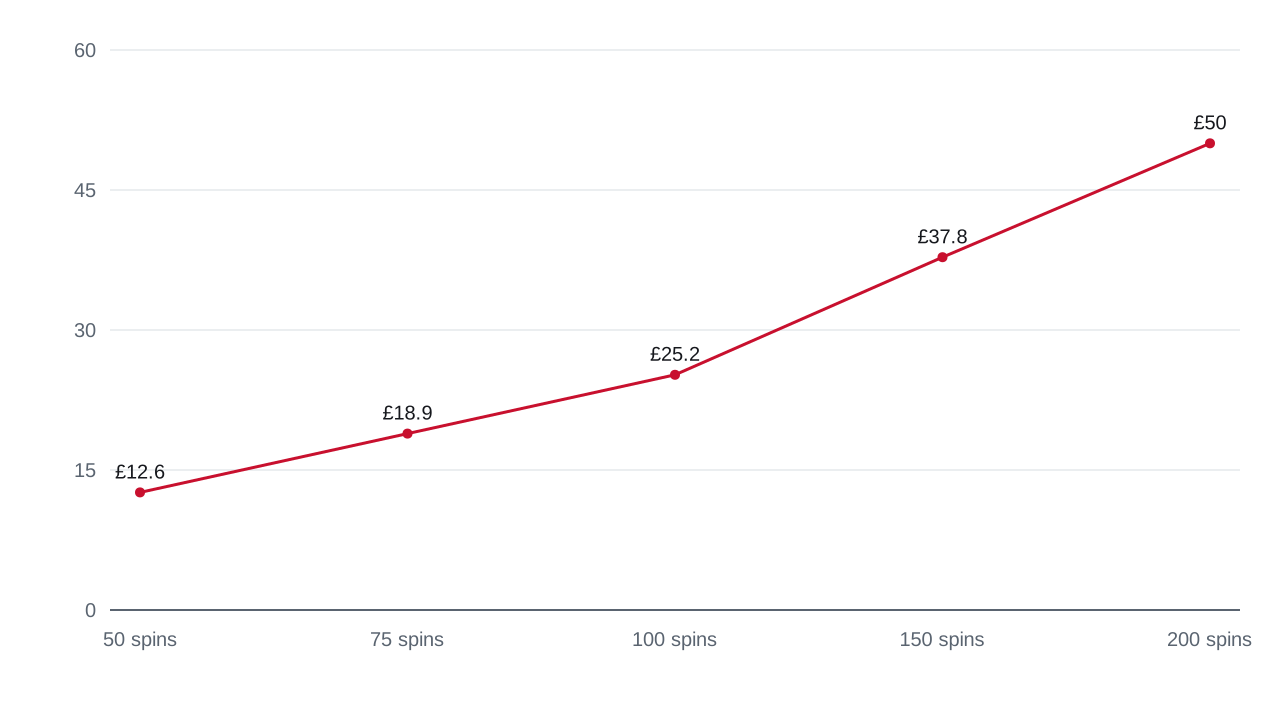
The return starts from face value, which is the spin count multiplied by the fixed stake per spin. On this page's 90 percent return assumption, fifty spins at £0.10 carry £5.00 of staked volume and about £4.50 of expected winnings. Wagering on those winnings, and any cashout cap, then decide how much of the £4.50 can ever be withdrawn as cash.
It means the winnings from the spins land as bonus funds rather than withdrawable cash. A multiplier, commonly between 20 and 50 times under this page's stated assumptions, sets how much must be staked before those funds convert. At 35 times, £4.50 of winnings needs £157.50 of further staking. Anything unconverted when the deadline arrives is usually removed, which is why the multiplier matters more than the spin count.
Cashiers pay out to verified payment methods in the account holder's name, so identity and payment checks come first, and an account that has only claimed spins has often not completed them. Many operators also require that the payout rail was used for a deposit, and most set a minimum withdrawal floor. Small winnings from a spins package frequently sit below that floor, which is why a balance often waits.
A cap limits how much can be withdrawn from the package's winnings, whatever the balance shows once wagering is complete. Under this page's working assumptions, caps in this part of the market run from £50 to £500, with £100 the midpoint used here. A player whose £4.50 of expected winnings grows to £180 during the play-through would still be limited to the capped figure at cashout.
In most cases yes. The terms give the spins a clock that starts when they are credited, and it usually runs in days rather than weeks, with some offers shorter still. Unused spins vanish when it ends. Winnings that move into wagering normally face a second deadline of their own, and unfinished wagering at that point usually closes the bonus and removes what remains of the funds.
A reader who wants to see a site's lobby, cashier and game behaviour before staking any of their own money gets the most from the format. The exposure on the spins themselves is the operator's, so the cost is time and attention rather than cash. Anyone who has already decided to deposit a fixed amount should usually price a match on that deposit instead, because it multiplies money they were prepared to stake anyway.
An operator holding a Gambling Commission licence appears on the public register, must provide access to approved dispute resolution, and advertises under rules the Advertising Standards Authority enforces. Credit card gambling is banned on licensed sites, customer funds protection is declared on a published scale, and games are tested by approved test houses. Sites outside the British regime offer none of those protections, and that absence is the real price of their headline figures.
The figures come from arithmetic rather than staking. The model takes a spin count, a fixed value per spin and a 90 percent return assumption, applies a wagering multiplier to the expected winnings, and applies the cap to the cashout. No account is opened, no deposit is made and no game is played at any point, so every number here is a stated assumption that can be checked against real terms and rerun with better inputs.
Offers of this kind hold no UK Gambling Commission licence. That is not a technicality: it is the difference between a market with a public register, a national self-exclusion scheme, approved dispute resolution, a ban on credit card gambling, affordability checks and independently tested games, and a market with none of those guarantees. A dispute at a licensed operator goes to an approved scheme; an offshore dispute goes to the operator itself. Nothing on this page is an exception to that. If self-exclusion matters to you, GAMSTOP covers licensed operators only, and no tool on this page changes that.
Gambling can harm. For free, confidential support in the UK, call the National Gambling Helpline on 0808 8020 133 or contact BeGambleAware.
Keep reading
UK Gaming Club. Independent modelling of casino offers for British readers. No operator pays for a word on this page; board placement is bought and disclosed on the How We Are Paid page. 2026.