#1
Night Luck
8.2Editorial score
Casino welcome bonus 805% up to €6,400 + 280 FS
- MuchBetter · VISA · Apple Pay
- Crypto welcome 140% up to 1,600 USDT
- VIP pack 800% up to €14,500
Terms change often. Verify on the operator's own page.
Offers modelled before you claim
18+. Betting carries risk. Never stake more than you can afford to lose.
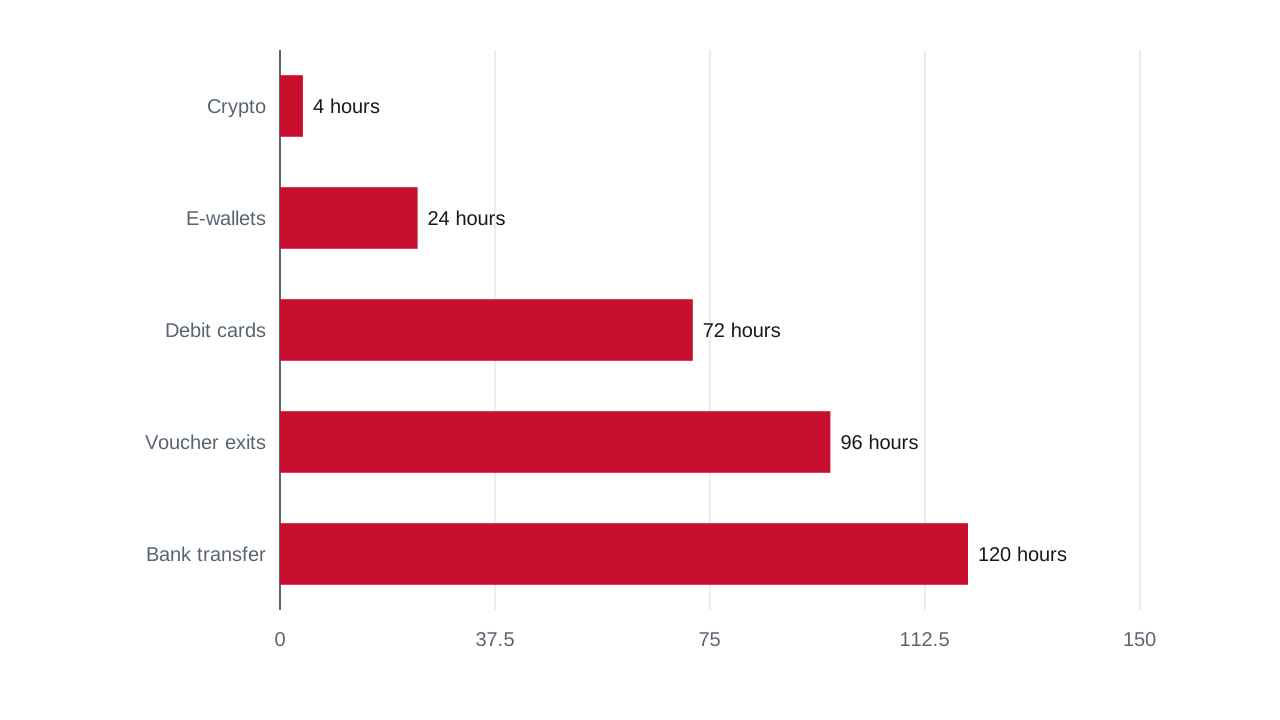
Crypto rails settle in minutes to a few hours, which is the fastest money moves in this market, and licensed British cashiers refuse the rail entirely, so the speed and the licence never come bundled.
The board is editorial and its placement is bought, which the disclosure page explains. Terms move without notice, so verify each line on the operator's own page.
Casino welcome bonus 805% up to €6,400 + 280 FS
Terms change often. Verify on the operator's own page.
Welcome bonus €/£5,000 + 500 FS
Terms change often. Verify on the operator's own page.
Welcome pack €5,000 + 500 FS + €650 free bet
Terms change often. Verify on the operator's own page.
Welcome package 300% up to €/£1,000 + 150 FS
Terms change often. Verify on the operator's own page.
On this page
A crypto casino is easiest to understand as a cashier question rather than a games question. The lobby, the slots, the live tables and the promotions are broadly the same furniture this market sells everywhere. What changes is the pipe the money travels in. On one side sits a rail that clears in minutes to a few hours, and on the other a set of rails that clears in banking days. That difference is real, and it is the honest reason a reader looks at this end of the market at all.
The odd part is not the speed. It is who refuses it. Every cashier holding a Gambling Commission licence keeps coin transfers off its payment page, and the refusal is consistent across the licensed market. So the fastest way to move money and the strongest set of player protections sit in different buildings, and no operator sells both under one roof. This page treats that as the starting fact and works out what it means for the money you would actually deposit.
The split is a fact of licensing, not a technical limit of the coin. Serving British consumers with remote gambling requires an operating licence from the Gambling Commission, and an operator that takes British players without one is acting outside the British regime altogether. Such an operator appears on no British register, and its advertising to a British audience does not answer to the same rules a licensed operator’s advertising answers to. Whatever a site says about itself in its footer, the register is the test, and the coin cashiers fail it by construction.
Where does that leave the individual reader? The offence provisions in the law fall on operators and advertisers, on those providing gambling facilities or promoting them without a licence. The Act creates no offence for a person who plays on an unlicensed overseas site. So the question was never whether you would break a rule by playing; it is what you stop carrying when you step off the register. What you lose is protection, and the rest of this page prices that loss line by line.
It is worth being precise about why the licensed side stays away, because the reasons travel with the money. A card payment carries an issuer behind it, and an issuer gives a dispute somewhere to go when a transaction is contested. A coin transfer carries no such counterparty: once a transfer is confirmed on the network there is no pull-back route and no third party to appeal to. A regulator that polices how deposits are handled, how customer funds are protected and how complaints are resolved has less to hold when the rail itself removes the handle. The licensed cashiers respond by declining the rail, and the offshore cashiers respond by building their pitch on it.
What does the speed actually buy? On the rail’s own terms, a finished transfer is a settled transfer: money confirmed on the network is money the cashier holds, and the deposit side of the story can run end to end within the band this page charts. What it does not buy is a faster exit from any queue the cashier runs in front of the rail, and it does not buy any of the framework the register carries. Speed is a property of the pipe, and the pipe is not the whole store.
One boundary before the arithmetic. Nothing here tells anyone how to defeat a self-exclusion, a payment block or an ISP block; those tools work, and describing routes around them is out of scope on this site. What the page does is count the costs of the rail honestly, so that the choice, whichever way it lands, is made with the costs in plain view.
The table below condenses the plumbing into a single view before any of the arithmetic starts, and the sections that follow take its rows one at a time: the cost model, the settlement bands, the fee share, the checks and the licence.
| Feature | Crypto rail | Card rail | What it changes |
|---|---|---|---|
| Settlement | minutes to hours | 1 to 3 banking days | Speed |
| Network fee | fixed per transfer | none | Small deposits pay share |
| Chargeback | none possible | Issuer route | Dispute leverage |
| Volatility | coin price moves | none | Balance risk |
| Verification | same documents | same | Delayed not removed |
The word crypto covers a family, and the members behave very differently once they are holding your money. The split that matters at a cashier is between volatile coins and stablecoins. A volatile coin is an asset first: its price against the pound moves continuously, through the session and across the week, and nothing about a deposit freezes that price in place. A stablecoin is built to track a fixed reference value, which removes most of the drift, and the working assumption on this page is that the reference is a major currency.
Follow the volatile case through a plain deposit. Say £200 of coin goes in and the balance sits untouched overnight. If the coin’s pound price steps up, the balance reads a little fatter before a single round is played; if it steps down, it reads thinner. Compound those steps across a week and the swing can pass the size of a session’s expected cost several times over. The wagering, the edge and the house rules do not change at all; the unit they are measured in does.
The stablecoin case narrows the risk instead of erasing it. A balance held in a coin that tracks a reference currency holds still against that currency, so the session arithmetic stops moving underneath you. Two frictions remain. The first is the pound rate: if your money is measured in sterling, a balance referenced to another currency still wobbles with the exchange rate, though gently next to a volatile coin. The second is the tracking itself: holding the reference is a design commitment maintained by the issuer, and the page that describes how it is kept is the page you read before depositing.
Cashiers differ in what they do at the conversion step. Some price the account in coin and convert to game currency for play, a crypto casino may hold the balance in the coin you sent, and some quote both. The difference decides which of the two behaviours above applies to you, so it is worth one careful read of the payments page before the first transfer. The plumbing is documented there, and if it is not documented, that absence is itself an answer.
Two costs sit at the edges of the coin family, and both belong to the model rather than to the games. The first is acquisition: the coin has to be bought somewhere before it reaches a cashier, and that step carries its own fees and its own waits, which this page’s arithmetic deliberately leaves outside. The second is conversion at the cashier itself, where pounds become coin and coin becomes pounds again, usually at a rate the operator sets. Both edges widen the true cost of a session beyond what the house edge alone prices, and both deserve a line in any honest budget.
The data table on this page carries one row for volatility, and the card rail reads none in that column. That is not an argument that the card is cheaper or better; it is a statement of unit risk. A card balance is denominated in pounds and stays there. A coin balance is a position. Readers who want their bankroll to be a fixed number while they play have a defined feature to look for, and readers who accept the position have a second variable to watch alongside the games themselves.
One habit closes the section. Whatever the cashier holds, decide the unit you want to think in, and convert the balance into that unit before you set a stake. A £2 stake planned against a balance that has quietly moved is a stake made against a number you have not actually seen.
The calculator on this page runs a session model, and its prefill is deliberately plain: a bankroll of £100, a stake of £2, an edge of 2 per cent and ten sessions. Each input is an assumption you can change, and each one changes the figure the tool prints. This section walks the same arithmetic in prose, so the numbers have a visible origin rather than an authority.
Start with the edge, because it is the input most often misread. The edge is the share of everything staked that the game keeps over the long run, not a fee on your balance and not a prediction about any single round. At the prefill’s 2 per cent, a £2 round carries an expected cost of about 4p. That figure is trivial on one round and decisive on a thousand, which is the whole character of a house edge.
The stake decides how much money passes through the game. A hundred rounds at £2 pushes £200 of throughput in a session, and at the modelled edge that throughput carries an expected cost of £4. Ten sessions of the same shape put £2,000 through the game and price the stretch at £40 of expected cost against a £100 bankroll. The rounds-per-session figure is an assumption, stated as one: the model here takes a hundred. If your sessions run longer, scale the arithmetic, because the edge per pound never rests.
The 2 per cent edge is a gentle assumption, and it is stated so it can be argued with. Published return-to-player figures on slots commonly sit around 94 to 96 per cent, which implies a house edge of 4 to 6 per cent on that category. Table games and certain other formats can run leaner. The prefill sits below the slot band on purpose, so the shape of the curve shows without the worst case shouting over it. Move the input to match the game you actually play, and the tool keeps up.
Why ten sessions rather than one? A single session hides the arithmetic in noise, and a run of them reveals it in full. Ten is a working shape for a couple of weeks of regular play, long enough for the expected cost to stop being theoretical and short enough to stay honest about the assumptions. Change the count and the model scales in a straight line, which is the useful property worth keeping in mind.
Notice what the model leaves out: the rail. A £100 bankroll moved by debit card adds nothing at the checkout line of this model, because a card deposit carries no fee for the player at a British cashier. The same £100 moved in coin picks up a network charge on the way in and again on the way out, and later sections price it. The session model prices the games; the rail adds its own line on top, and the two lines arrive from different directions.
One more read of the inputs is worth the space. The stake is the only lever that sets how many decisions a bankroll buys: at £2 a round, £100 is fifty rounds deep before any result helps or hurts, while a £10 stake spends the same bankroll in ten rounds. Faster stakes push more money through the edge per hour, and throughput is what the edge feeds on. Whatever the rail, that relationship is the cheapest discipline on the page.
What the model cannot print is variance. Expectation is not a schedule: the same hundred rounds can finish several pounds under or over the expected cost, and the spread widens with stake and speed while the expectation stays put. Treat the printed figure as the centre of a range rather than the result, and treat the bankroll as the thing that absorbs the difference. That is the honest use of any cost model, and it is the reason the inputs deserve your attention more than the output does.
Expected loss per session £2.00.
Expected loss across 10 sessions: £20.00.
Assumptions: spins return 90 percent of face value before wagering; session cost uses the stated house edge as expected loss of bankroll per session.
The offence provisions of the Gambling Act 2005 fall on operators and advertisers, not on individual players, so playing on an unlicensed overseas site creates no offence for you. What ends at the border is protection: no British register entry, no GAMSTOP coverage, no approved dispute route and no credit card ban behind the cashier. The site is acting outside the British regime either way, and this page treats that as the price of the speed.
Treat 20 to 50 times the bonus, or the winnings where the offer is wagering-on-winnings, as the working band at this end of the market, with 35 times the usual midpoint for models. The base matters as much as the number: bonus-only and deposit-plus-bonus wording change the arithmetic sharply. Read the multiplier, the cap and the expiry together, because a low multiplier with a tight cap can cost more than it looks.
The model band on this page runs from minutes to a few hours, with four hours as the ceiling the chart plots. Two queues sit in front of that speed: the cashier's approval step, which runs at its own pace on every rail, and identity checks if they have not been completed yet. The transfer is rarely the slow part; the processing ahead of it decides when the money arrives.
They can, and the shape of the fee explains it. A network charge is fixed per transfer, so its share of the deposit falls as the amount rises. On this page's worked figures, a £2 fee takes 10 per cent of a £20 deposit, 4 per cent of £50 and 0.4 per cent of £500. Whether the cashier absorbs the fee or passes it through is written on its payment page, and it changes the answer.
A volatile coin re-prices continuously, so a balance can grow or shrink in pound terms before a single round is played, independent of how the games go. A dollar-referenced stablecoin removes most of that drift, though the pound exchange rate still moves gently underneath. If you want the bankroll to be a fixed number while you play, the stablecoin option is the feature to confirm on the cashier's own payment page before depositing.
It suits a reader who values settlement speed above the protections a British licence carries, who is comfortable holding a balance in coin and who reads terms without being asked twice. It does not suit anyone who wants GAMSTOP self-exclusion enforced across sites, an approved dispute route behind a complaint, or the credit card ban's shape of protection. Those features only exist inside the licensed market, and the licensed market does not run the rail.
Debit cards, established e-wallets and bank transfer, settling inside the bands this page's chart shows, with checks built into account opening rather than bolted onto the first withdrawal. Around those rails sits the licence itself: a public register entry to verify, GAMSTOP coverage, an approved dispute resolution provider, the credit card ban and game testing through approved houses. The trade is straightforward: fewer minutes on the payout, a framework behind the money.
Category-typical terms include a maximum cashout on bonus winnings, an expiry window measured in days, and a restricted game list while wagering runs. The comparison table prints ranges rather than quotes, so the numbers that bind are the ones on the operator's own promotion page. A tight cap deserves as much attention as the multiplier, because it can cut an offer short exactly where the wagering would have finished.
Offers of this kind hold no UK Gambling Commission licence. That is not a technicality: it is the difference between a market with a public register, a national self-exclusion scheme, approved dispute resolution, a ban on credit card gambling, affordability checks and independently tested games, and a market with none of those guarantees. A dispute at a licensed operator goes to an approved scheme; an offshore dispute goes to the operator itself. Nothing on this page is an exception to that. If self-exclusion matters to you, GAMSTOP covers licensed operators only, and no tool on this page changes that.
Gambling can harm. For free, confidential support in the UK, call the National Gambling Helpline on 0808 8020 133 or contact BeGambleAware.
Keep reading
UK Gaming Club. Independent modelling of casino offers for British readers. No operator pays for a word on this page; board placement is bought and disclosed on the How We Are Paid page. 2026.