#1
Night Luck
8.2Editorial score
Casino welcome bonus 805% up to €6,400 + 280 FS
- MuchBetter · VISA · Apple Pay
- Crypto welcome 140% up to 1,600 USDT
- VIP pack 800% up to €14,500
Terms change often. Verify on the operator's own page.
Offers modelled before you claim
18+. Betting carries risk. Never stake more than you can afford to lose.
A credit denominated in a stablecoin keeps its size while a 40 times wagering run lasts, which removes the price variable a volatile coin adds, and the fee structure becomes the only moving part.
The board is editorial and its placement is bought, which the disclosure page explains. Terms move without notice, so verify each line on the operator's own page.
Casino welcome bonus 805% up to €6,400 + 280 FS
Terms change often. Verify on the operator's own page.
Welcome bonus €/£5,000 + 500 FS
Terms change often. Verify on the operator's own page.
Welcome pack €5,000 + 500 FS + €650 free bet
Terms change often. Verify on the operator's own page.
Welcome package 300% up to €/£1,000 + 150 FS
Terms change often. Verify on the operator's own page.
On this page
A stablecoin is a token issued against a fixed target: one unit is meant to sit at one dollar for as long as the balance is held. USDT, issued by Tether, is the largest issue of this kind and the ticker a USDT casino most often quotes. The issuer holds assets behind the token and honours redemption at par, and that arrangement, rather than market appetite, is what holds the price near its anchor.
That matters during a wagering run because time is the hidden input. A credit denominated in a volatile coin changes size while the turnover proceeds: if the coin climbs, the balance is worth more in pounds by the time you convert, and if it falls, the same spin count returns less. A stablecoin takes that variable out of the run. The size you accept on day one is, give or take the bands set out below, the size you still hold when the last spin clears.
The table below sorts the balance types a reader meets at a crypto cashier into four classes, with model behaviour for each. Treat the peg column as a modelling band rather than a measurement: the assumption running through this page is that deviations stay inside the ranges shown, which is the premise the chart and the worked model both use. The fee line repeats across every row because the transfer cost belongs to the network rather than to the asset; the risk column is the one that actually separates the classes.
| Asset | Peg behaviour in a run | Fee profile | Balance risk |
|---|---|---|---|
| Major stablecoin | holds within 0.1 percent | network fee only | minimal |
| Mid stablecoin | holds within 0.3 percent | network fee only | small |
| Smaller stablecoin | can slip 1 percent or more | network fee only | real |
| Volatile coin | free float | network fee only | carried fully |
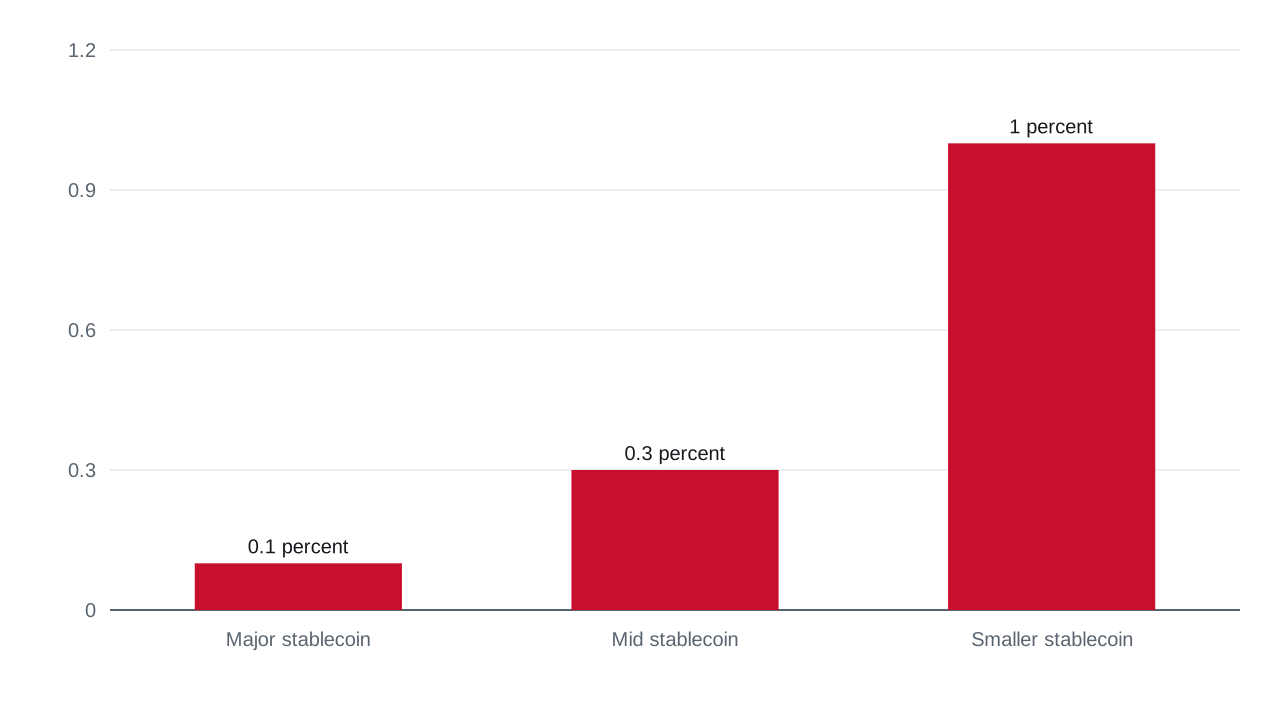
Peg deviations are measured in tenths. The working model on this page holds a major issue within about 0.1 percent of par in ordinary conditions, a mid-tier issue within about 0.3 percent, and a smaller issue inside a band that can reach 1 percent or more when redemption pressure builds. These are model bands set for October 2026, stated as assumptions, not numbers lifted from any order book.
The chart below plots the three bands side by side, and the scale matters more than the bars. Even the widest band is one part in a hundred, which is why the model treats peg drift as a rounding cost and treats volatility as a genuine variable. On a 400 USDT balance, a 0.1 percent drift is four tenths of a coin and a 1 percent drift is four coins, which at ordinary dollar sterling rates runs from pence to a few pounds.
Two readings follow. First, drift scales with the balance, so a reader running large amounts through a long run should weight the risk column more heavily than a reader clearing a £75 bonus. Second, the bands describe ordinary conditions only; a run on an issuer is the exception the risk section below takes up, and no band on this chart survives that kind of event.
Bonus credit £75.00.
Wagering before cash out £5,000.00 at 40 times.
Wagering per pound deposited 100 times.
Assumptions: spins return 90 percent of face value before wagering; session cost uses the stated house edge as expected loss of bankroll per session.
The Gambling Act 2005 places the offence on operators and advertisers, not on individuals who play on unlicensed overseas sites, so playing offshore is not a criminal act for the player. What you give up is protection: no British register entry, no approved dispute resolution route, no GAMSTOP coverage and no credit card ban behind you. This page's position is that the licence gap matters more than the stability of the coin.
The worked example multiplies the bonus by 40, so a £75 bonus means £3,000 of turnover. Most terms apply the multiplier to the bonus alone; a minority apply it to deposit and bonus together, which roughly doubles the load. Check which base your own terms use before counting anything.
Check the network printed beside the deposit address first, because the same ticker can exist under more than one token standard and a transfer sent on the wrong one can be delayed or lost. Then check the minimum deposit, the confirmations required before the balance becomes playable, and whether the cashier holds the coin itself or converts deposits into a house currency on arrival.
Offers of this kind commonly pair a conversion cap with an expiry window, and the model on this page assumes a £400 ceiling as its working figure. If the wagering is not finished inside the window, remaining bonus funds and winnings tied to them are usually forfeited under the standard drafting. Caps and clocks vary widely at this end of the market, so both lines need reading before a deposit.
It suits a reader who already holds the coin, already runs an exchange account, and wants a bonus to keep a predictable size across a wagering run that may last days. It does not suit someone who wants pounds in and pounds out through one debit card, because the exit rail adds exchanges, identity checks and fee layers between the balance and the bank.
A Gambling Commission licensed casino serving Great Britain. Its licence can be checked on the public register before money moves, self exclusion through GAMSTOP covers every licensed operator at once, the credit card ban has applied since April 2020, and an approved dispute resolution provider exists for complaints. Welcome offers there are denominated in pounds, so no peg and no exit conversion sits between you and the balance.
No. It removes the price variable, not the house edge. Every spin still carries the game's built in margin, so the expected cost of clearing a 40 times run is the same in a stablecoin as it is in pounds. What the peg steadies is the size of the balance between deposit and conversion, which is worth having, and worth describing exactly as narrowly as that.
The model bands on this page put major issues within about 0.1 percent of par and smaller issues within 1 percent or more, so a small slip moves the pound value of a typical bonus balance by pence. A genuine break is different: the balance falls with the coin for as long as you hold it, and the terms still decide what converts at the end.
Offers of this kind hold no UK Gambling Commission licence. That is not a technicality: it is the difference between a market with a public register, a national self-exclusion scheme, approved dispute resolution, a ban on credit card gambling, affordability checks and independently tested games, and a market with none of those guarantees. A dispute at a licensed operator goes to an approved scheme; an offshore dispute goes to the operator itself. Nothing on this page is an exception to that. If self-exclusion matters to you, GAMSTOP covers licensed operators only, and no tool on this page changes that.
Gambling can harm. For free, confidential support in the UK, call the National Gambling Helpline on 0808 8020 133 or contact BeGambleAware.
Keep reading
UK Gaming Club. Independent modelling of casino offers for British readers. No operator pays for a word on this page; board placement is bought and disclosed on the How We Are Paid page. 2026.